
Rhythm & Stillness
A collection exploring movement, gesture, colour and surface — where rhythm develops through repetition, material curiosity and the physical act of making.
Not every work begins with a story that needs to be told. Sometimes it begins with a mark, a texture, a curve, a brushstroke or simply the question: what happens if I do this?
Rhythm & Stillness grew from that kind of curiosity.
These vessels are places for experimentation. Surfaces are brushed, sprayed, impressed, carved, layered, rubbed back and allowed to change through firing. Repeated marks create rhythm; interruptions create pause. Some gestures are deliberate and controlled, while others are allowed to remain spontaneous, imperfect or surprising.
Colour and pattern move around the forms rather than simply decorating them. The making remains visible — evidence of the hand, the tool, the material and the decisions that accumulated along the way.
Together, the works reflect the rhythm of studio practice itself: periods of movement followed by stillness, experimentation followed by reflection, intention balanced with intuition.
Sometimes the most important discovery is not what a vessel represents, but what happens when I allow myself to make without already knowing where it will lead.
Surface Tension · 2026
Coil-thrown stoneware; sprayed ceramic surface treatments, hosiery resist and selective glaze
Tallest Sister
52 × 32 cm · 4,259 g CA$1,200
Tall Sister
44 × 26 cm · 3,114 g CA$1,000
Small Sister I
25 × 15 cm · 1,237 g CA$300
Small Sister II
19 × 16 cm · 872 g CA$250
Small Sister III
17.5 × 16 cm · 834 g CA$225
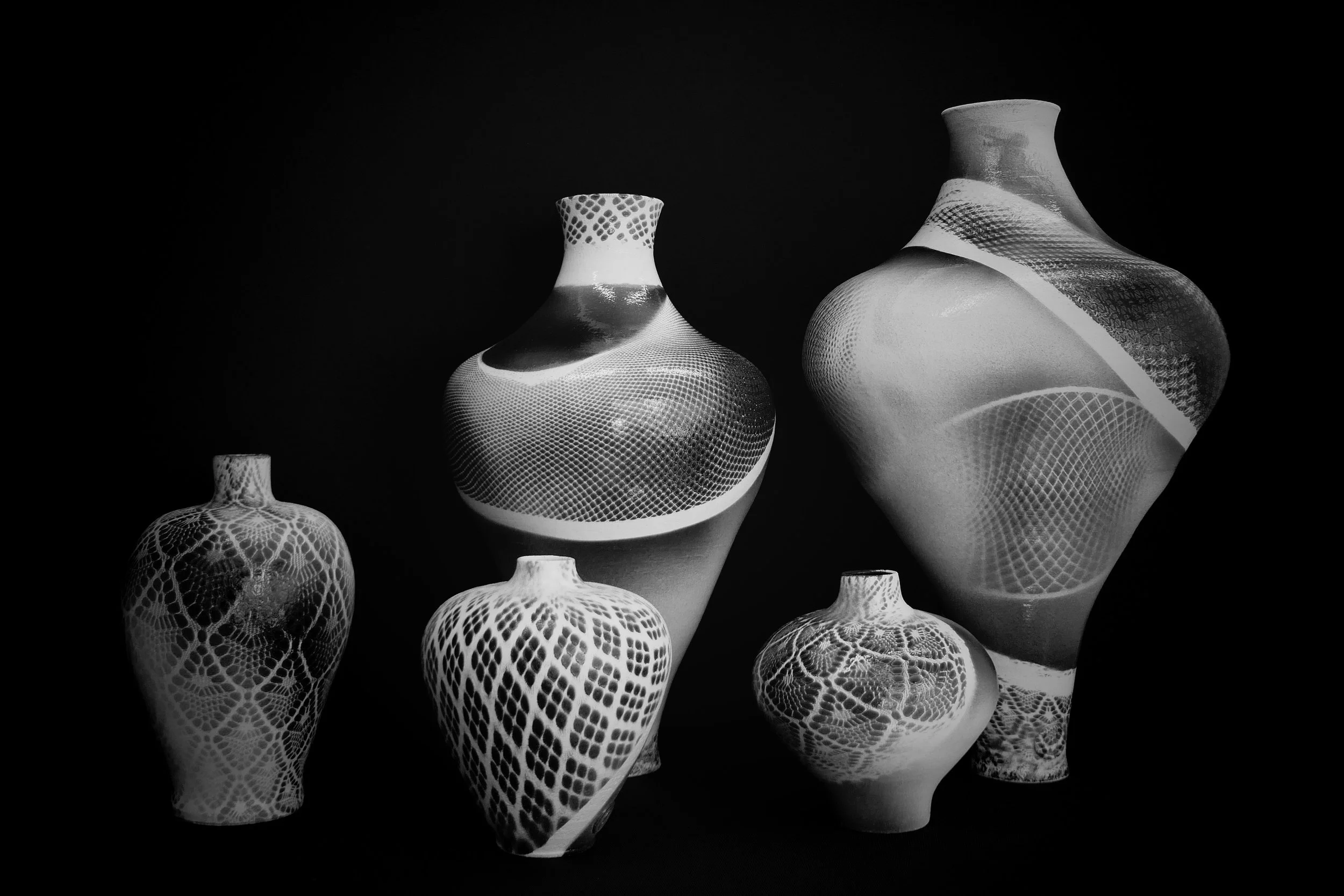
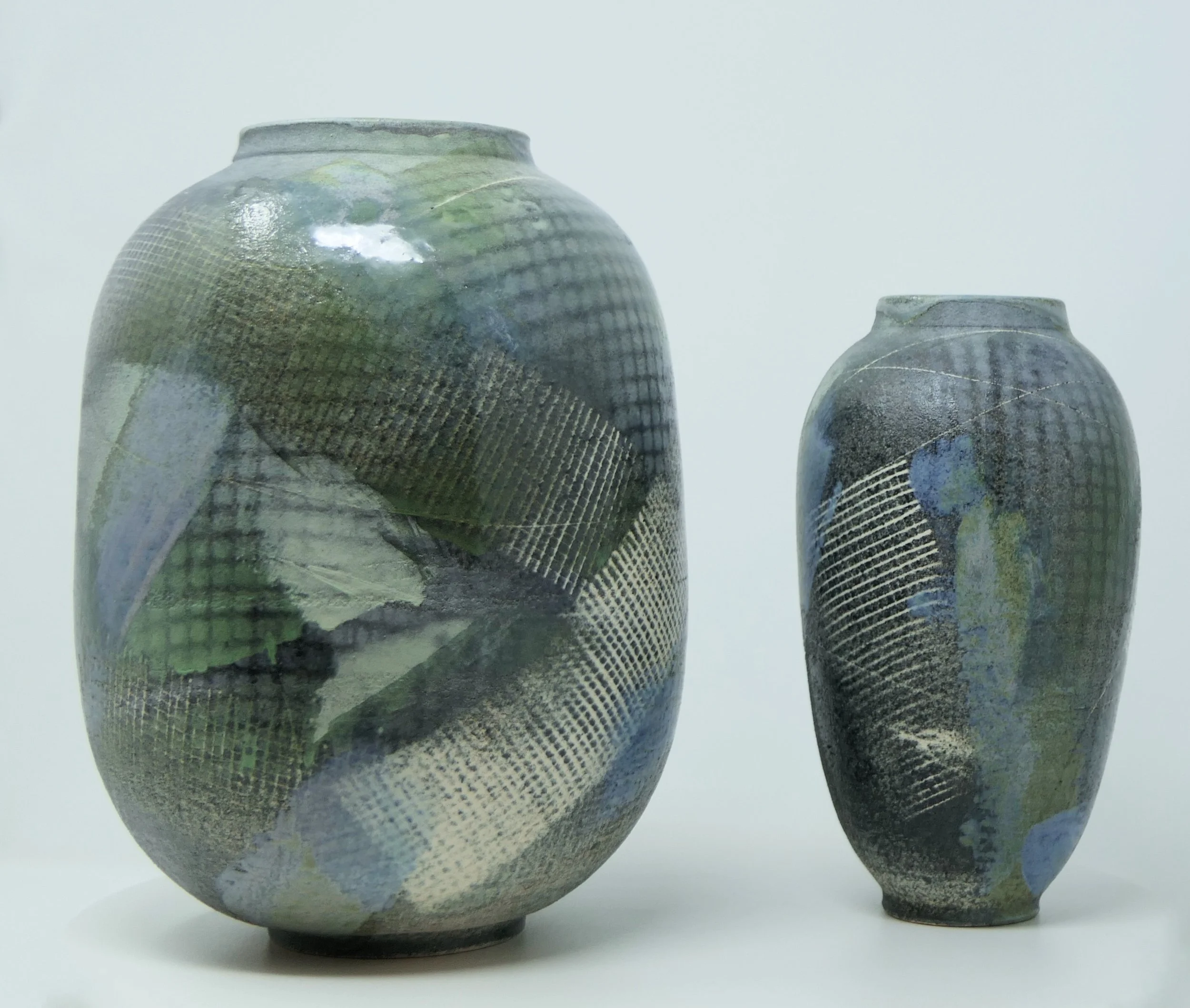
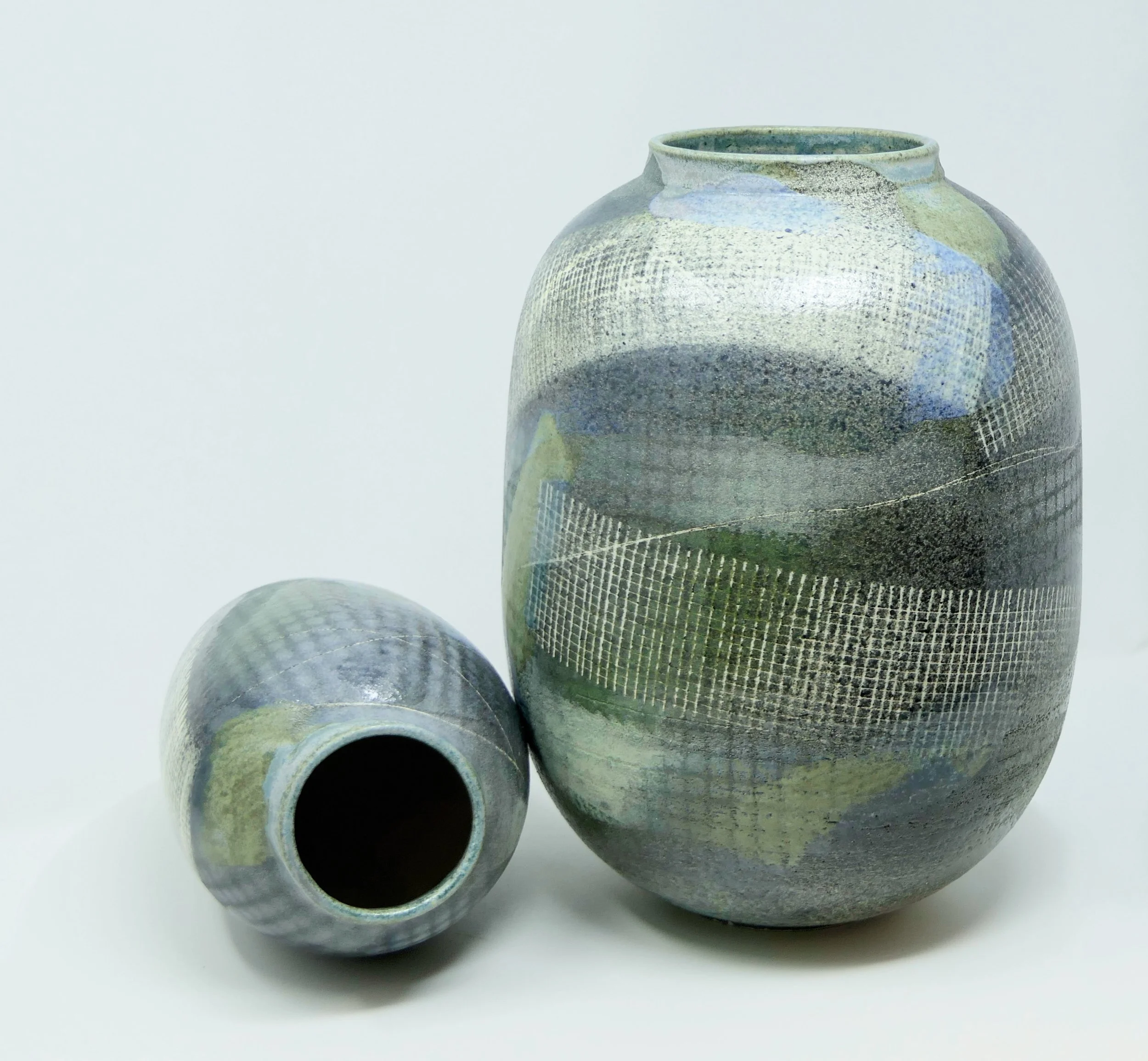
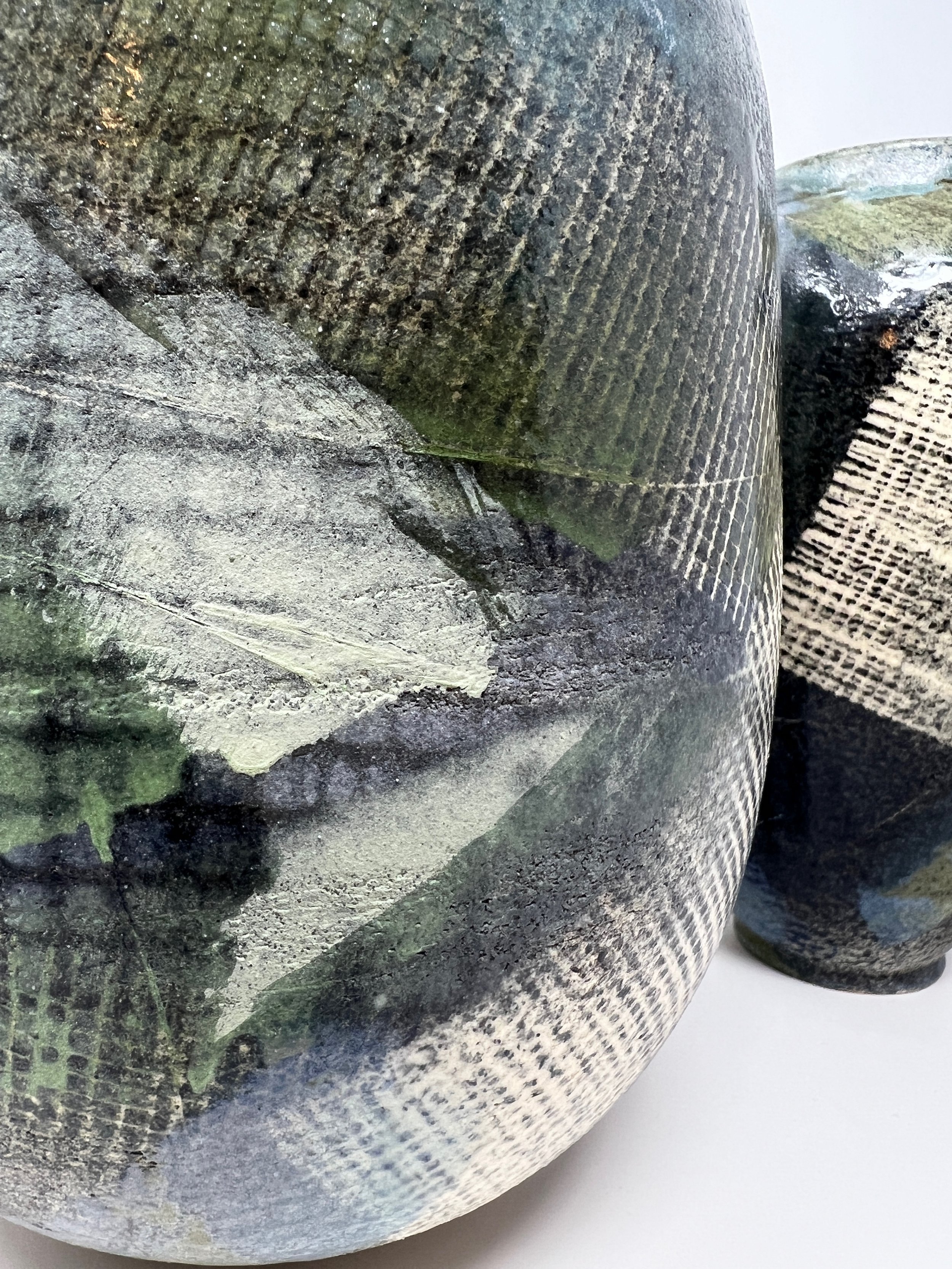
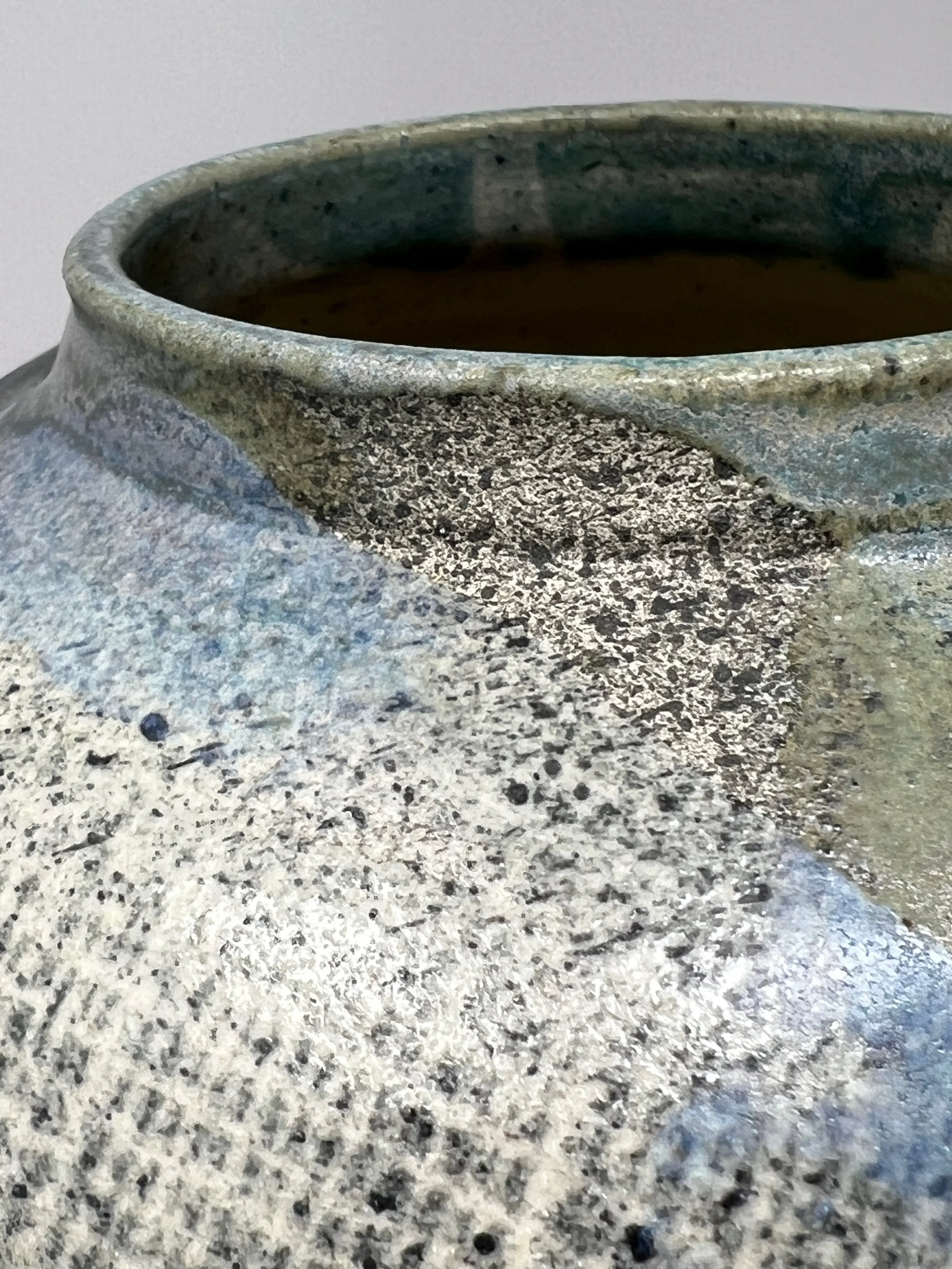
Surface Tension — Pattern stretches, shifts and changes with the form.
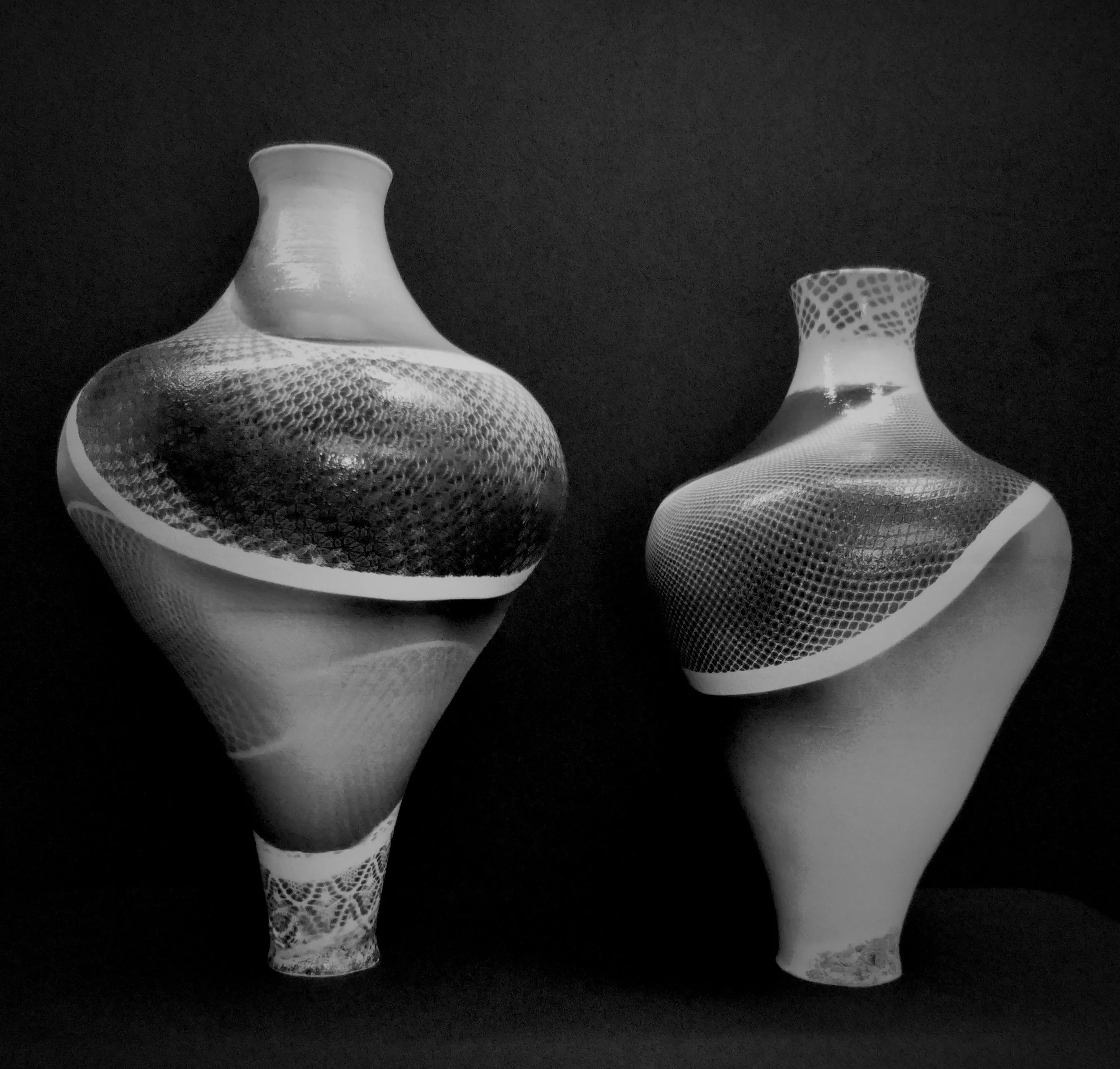
Surface becomes structure.
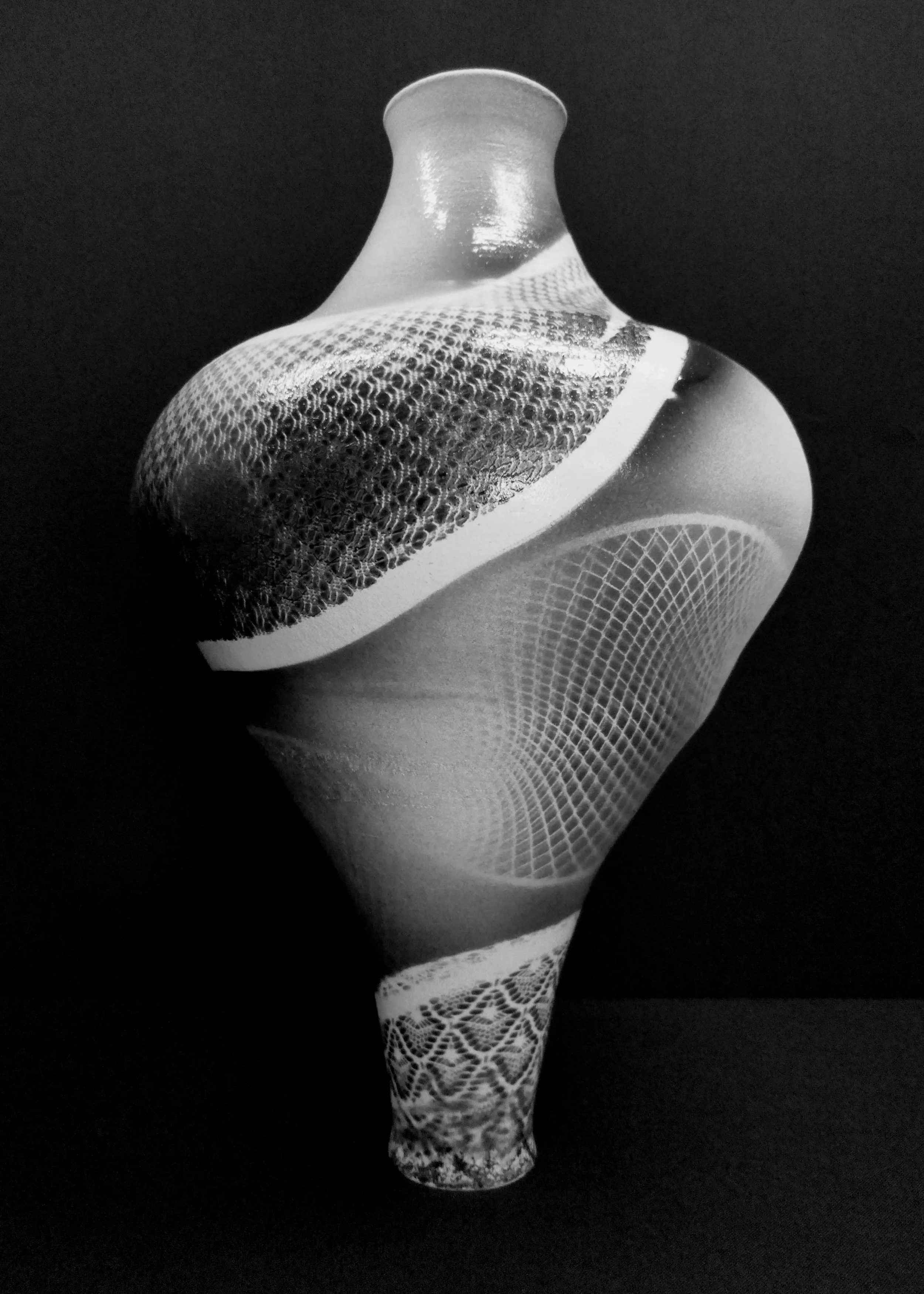
Tension creates movement.
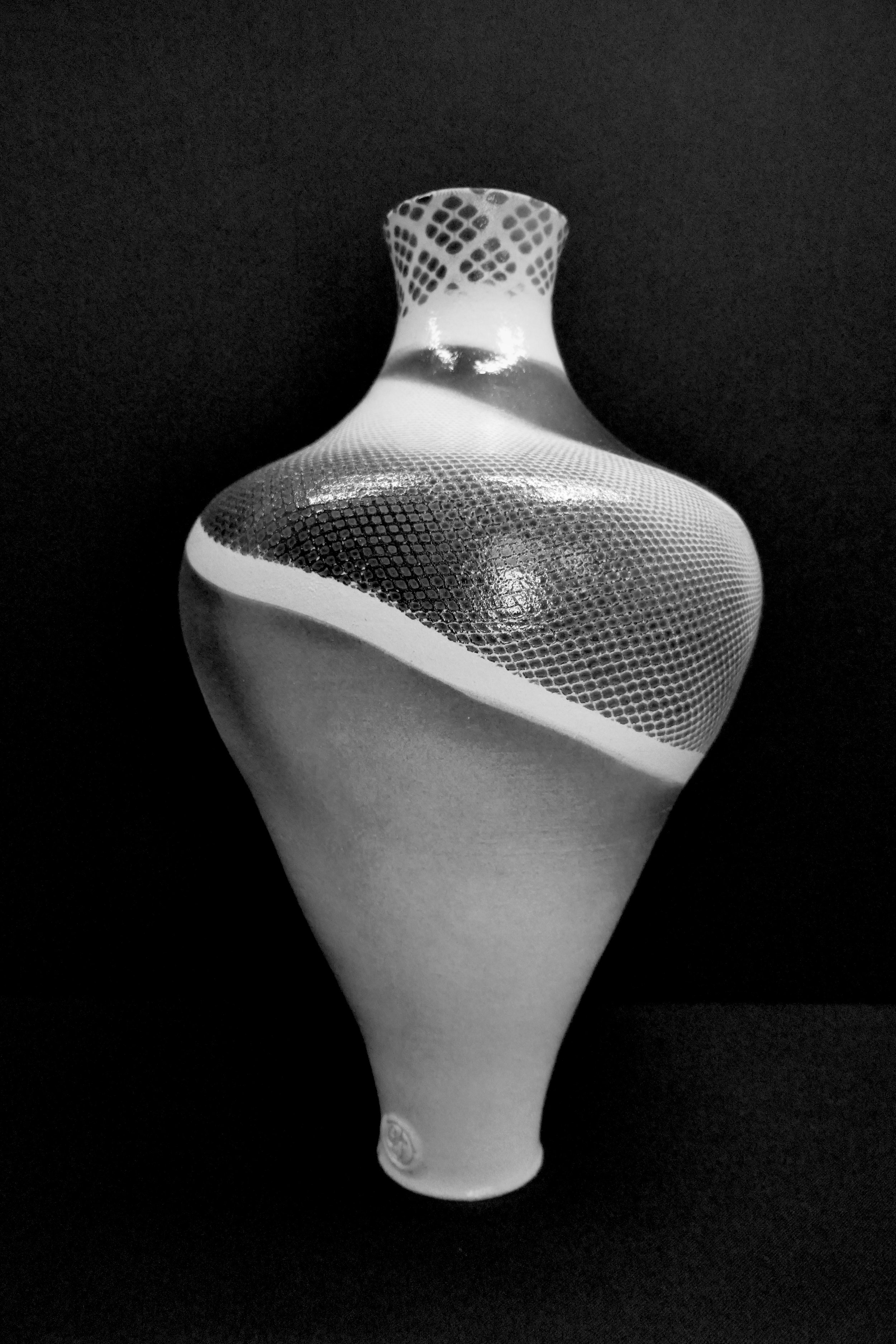
Every curve changes the pattern.
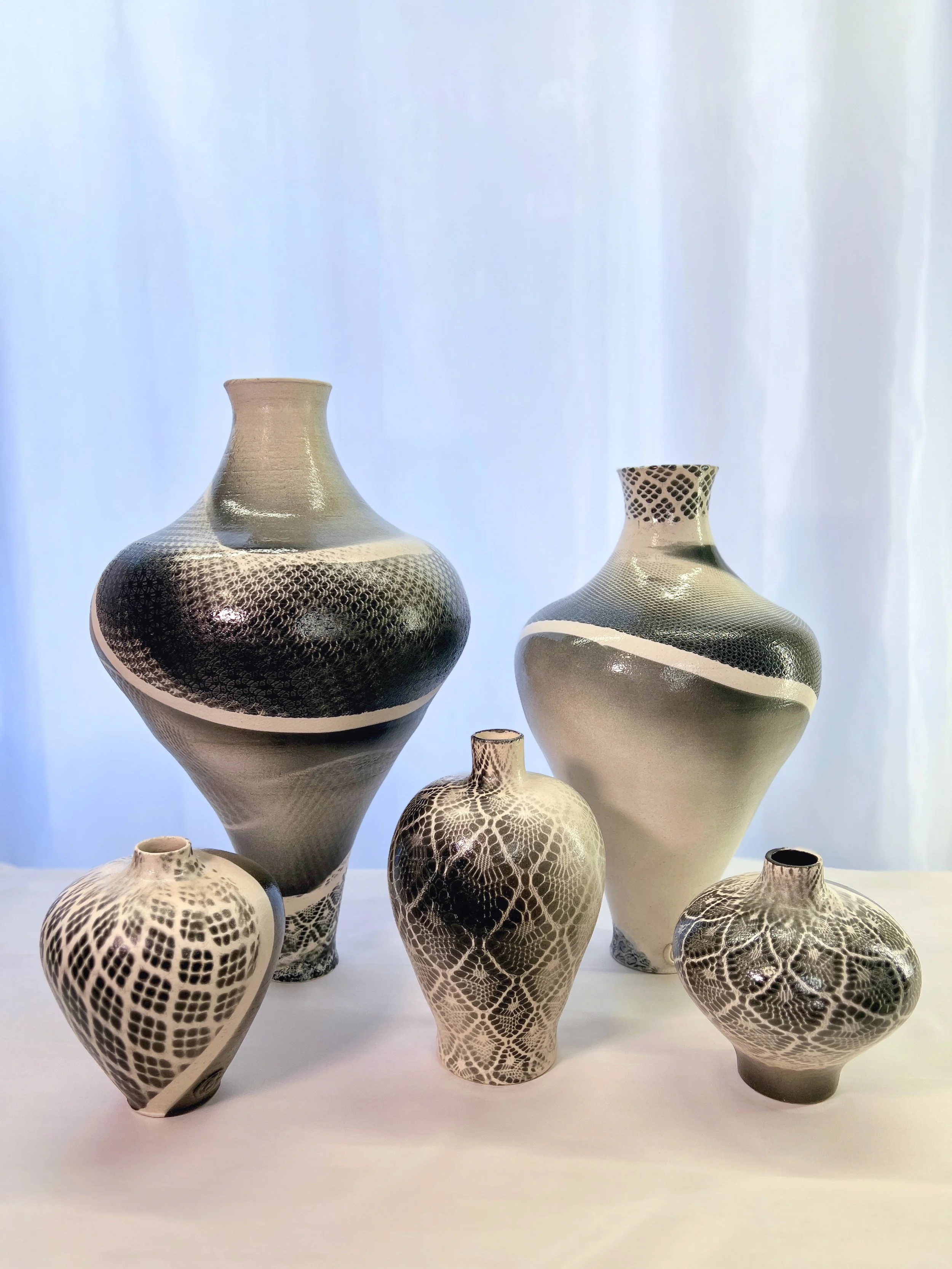
One visual language, carried across five distinct forms.
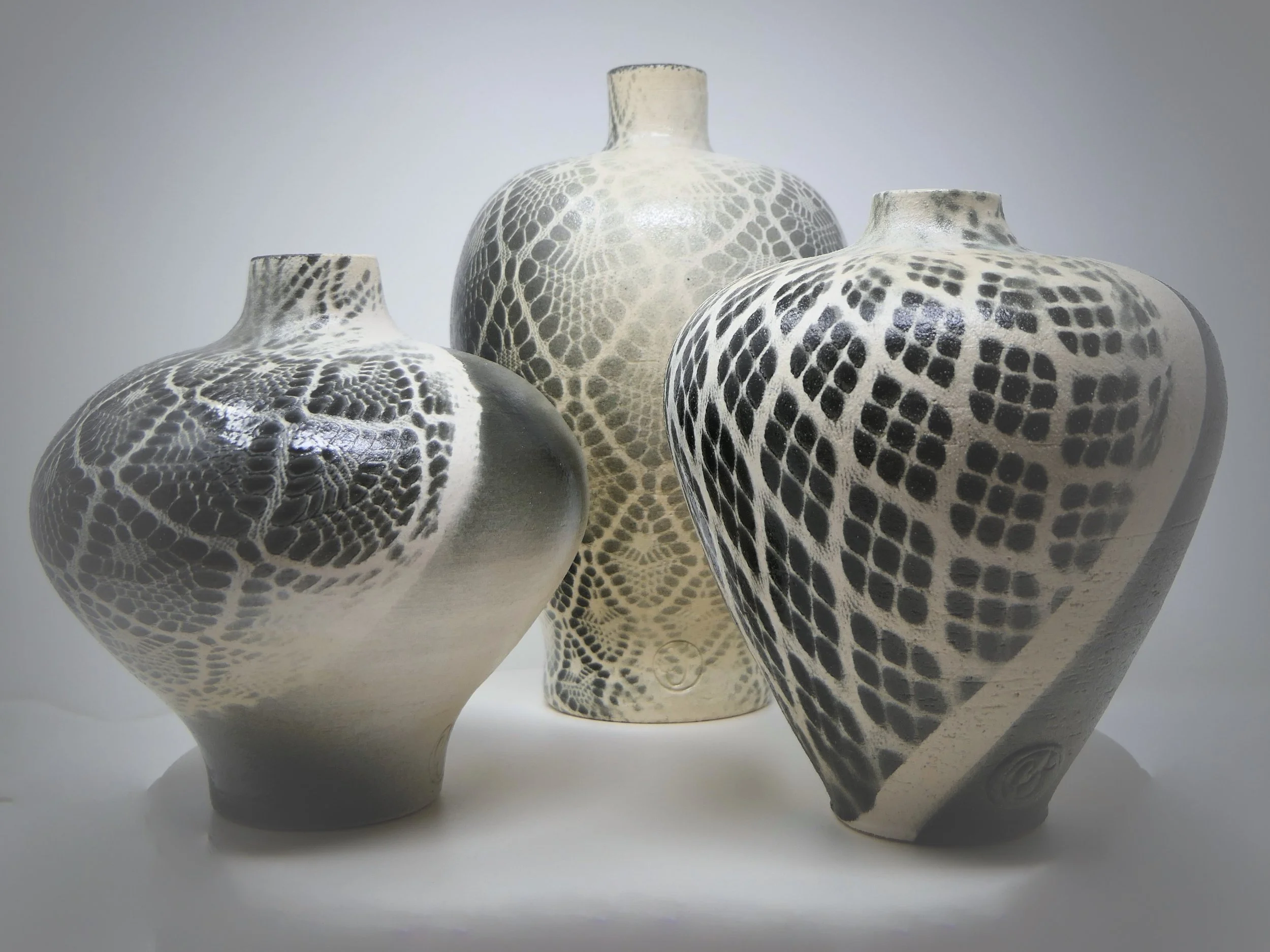
Precision becomes more interesting when the process leaves a trace.
Surface Tension grew from an exploration of what happens when a very controlled pattern is stretched across an increasingly animated form.
The vessels were coil-thrown, then sprayed through hosiery and other resist materials. As the stocking stretched, shifted and occasionally slipped, the pattern distorted with the clay. What began as a repeated grid became something less predictable: softened edges, ghosted marks, gradients and interruptions that record both intention and movement.
I became particularly interested in the places where order began to break down. Crisp pattern could easily become decorative, but once it stretched around a curve or slipped slightly during spraying, it began to behave more like structure.
The tall vessels push that tension further. Their narrow bases make them appear precarious, while their substantial bodies remain firmly grounded. The smaller works carry the same visual language at a more intimate scale.
Surface Tension explores the point where precision meets disruption — where pattern, form and material begin to pull against one another without coming apart.
In Conversation · 2025
Coil-thrown stoneware; layered glazes and engobes with resist techniques
In Conversation I
22 × 16 × 16 cm · 1,319 g
CA$400 · Available
In Conversation II
18.5 × 10 × 10 cm · 446 g
CA$225 · Available
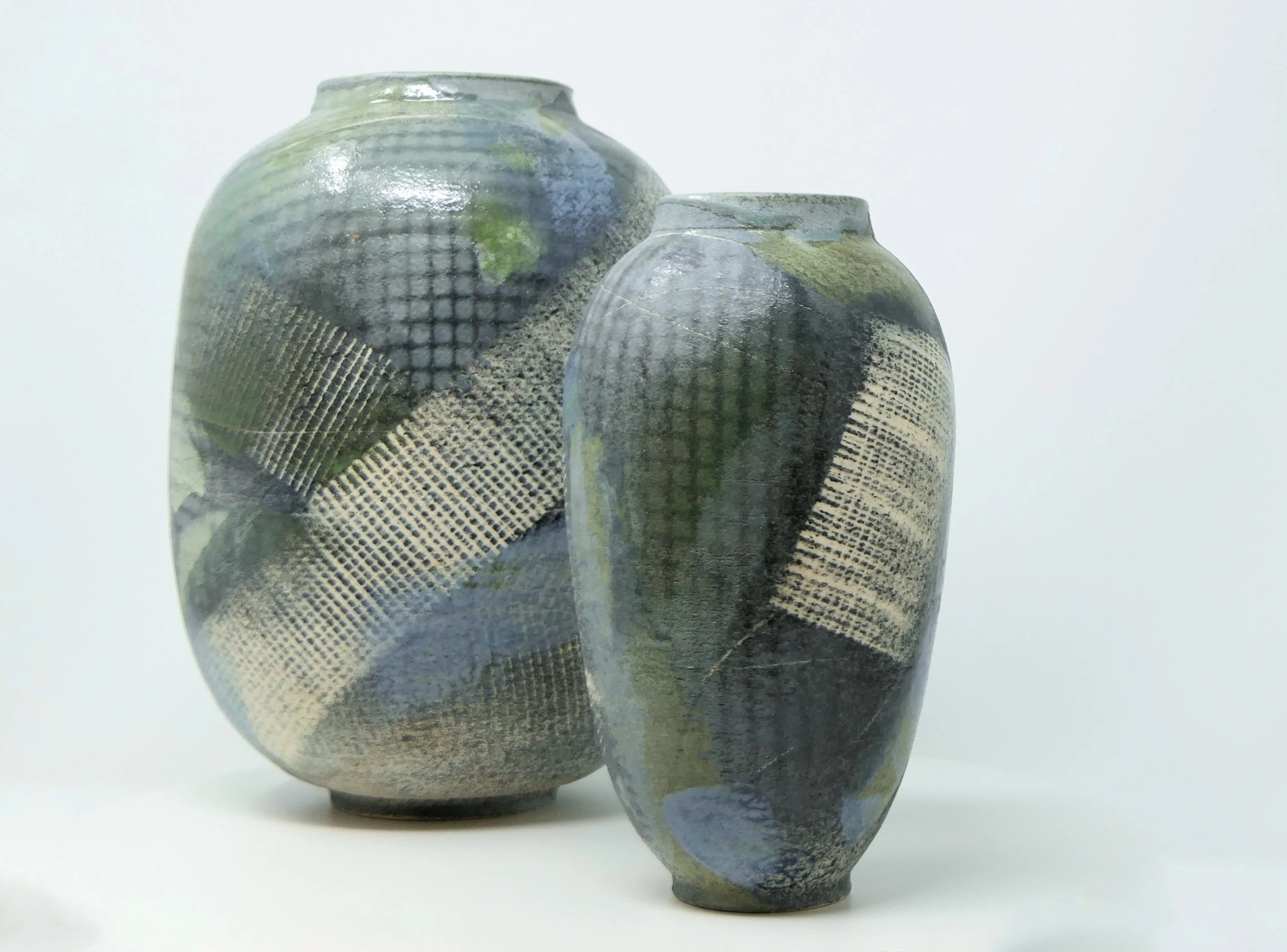
In Conversation — Two distinct forms held within the same visual language.
Layered glazes, engobes and resist marks move differently across each vessel.
Connection does not require sameness.
Mesh, tape and string interrupt the surface, leaving traces of the making process.
Matte, satin and glazed passages change as the vessels turn.
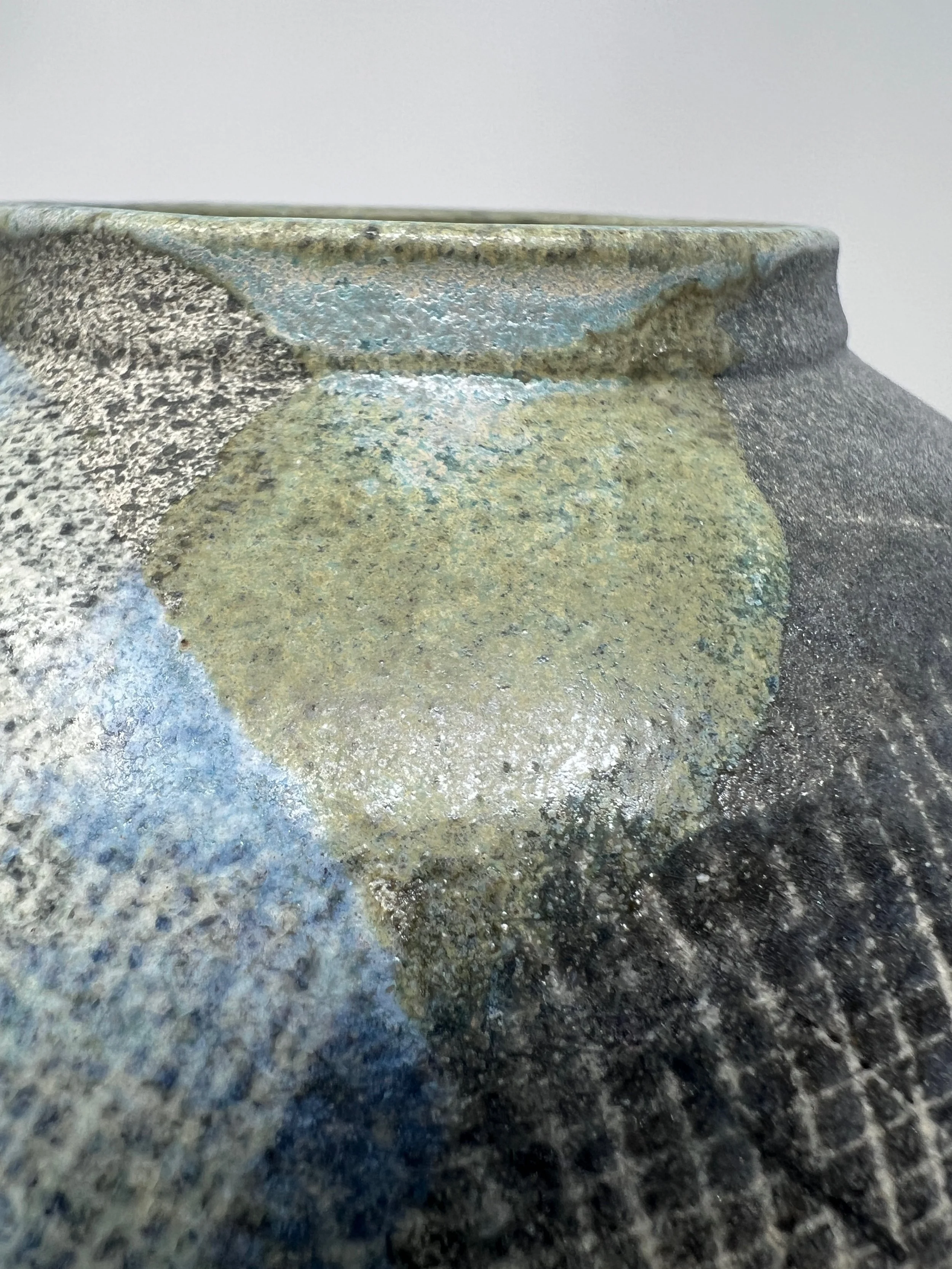
Together, each vessel becomes more fully itself.
In Conversation began as two related vessels made with the same materials and surface processes, but their relationship became apparent only after they were finished.
Both were coil-thrown, then built up through layers of sprayed and brushed glazes and engobes. Mesh, drywall tape and string were used as resists, allowing areas of pattern, abrasion and interruption to travel across the forms. Matte, satin and glazed passages sit beside one another, changing as the vessels turn.
The forms are intentionally different. In Conversation I is broader and more grounded; In Conversation II is narrower and quieter. They share a visual language without becoming versions of one another.
For me, the pair gradually came to reflect something familiar about close relationships: two people can share a life, history and language while remaining distinctly themselves. Connection does not require sameness.
In Conversation is about companionship, difference, and the space that exists between two separate presences.
First Snow · 2025
Coil-thrown stoneware; layered commercial glazes with resist techniques
First Snow I
21 × 19 × 19 cm · 1,134 g
CA$375 · Available
First Snow II
15 × 11 × 11 cm · 400 g
CA$225 · Available
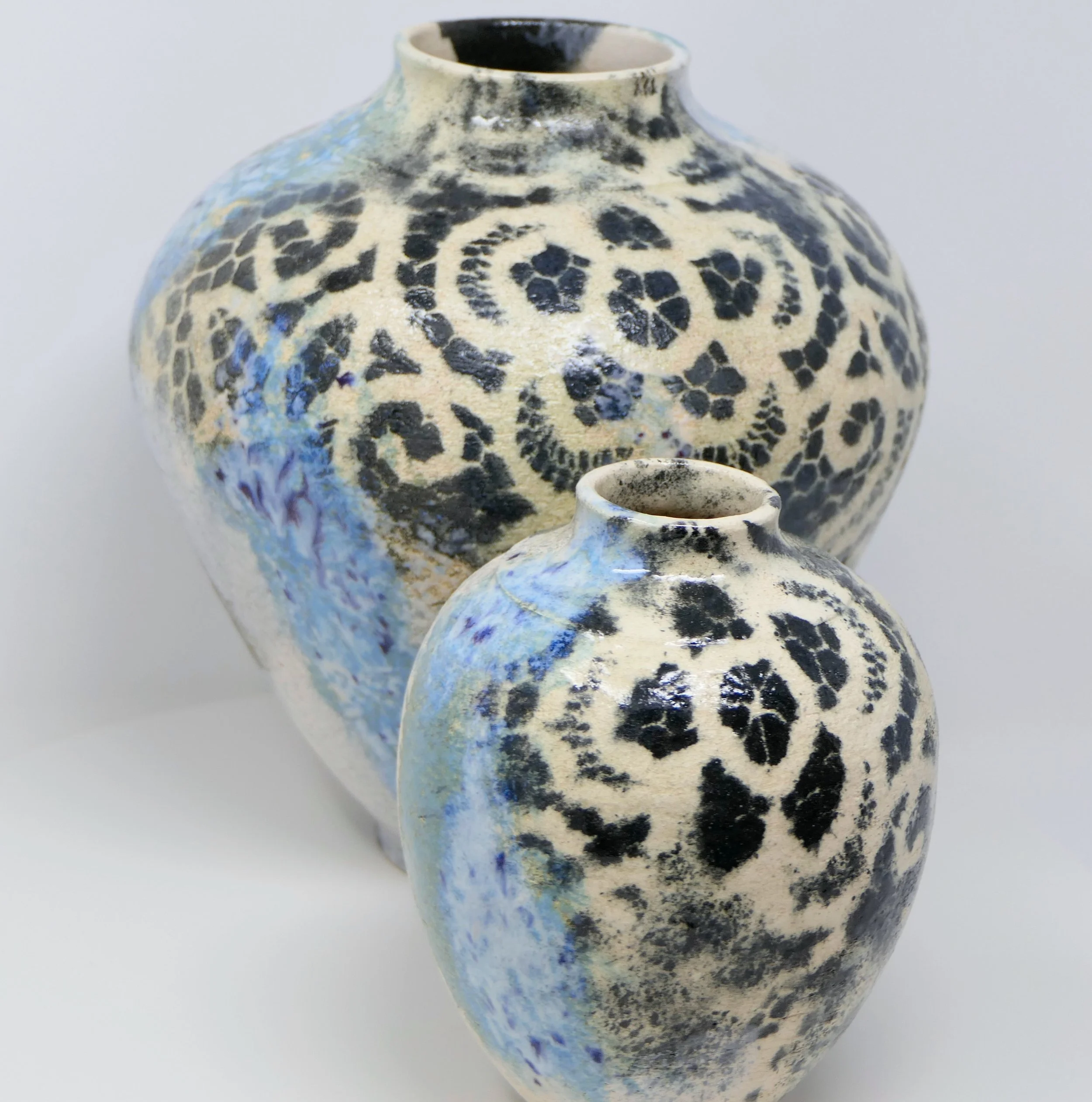
First Snow — Soft colour, quiet pattern, and the beginning of a more resolved surface language.
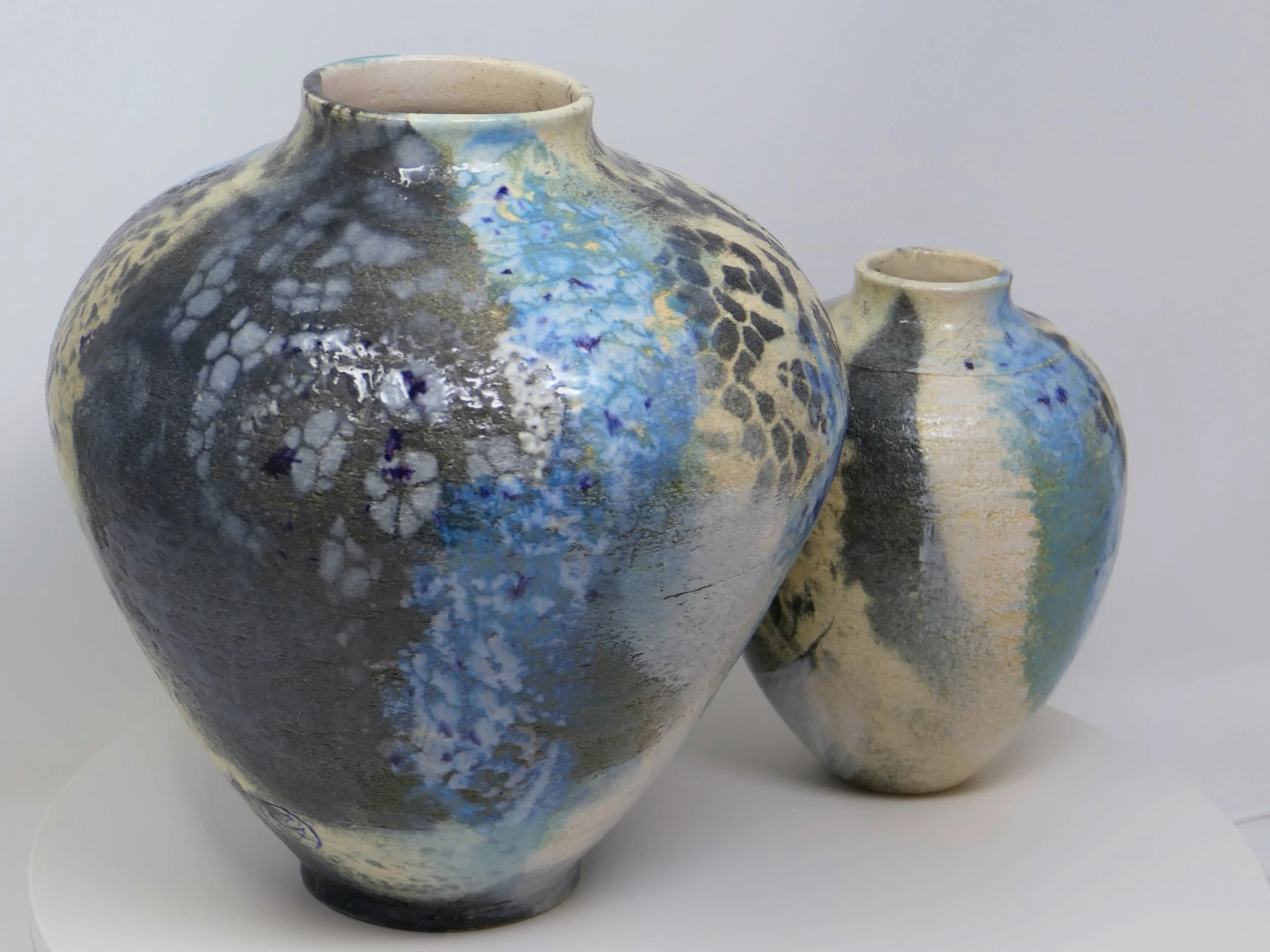
Blue, black and pale clay move across the form in shifting layers of matte and glaze.
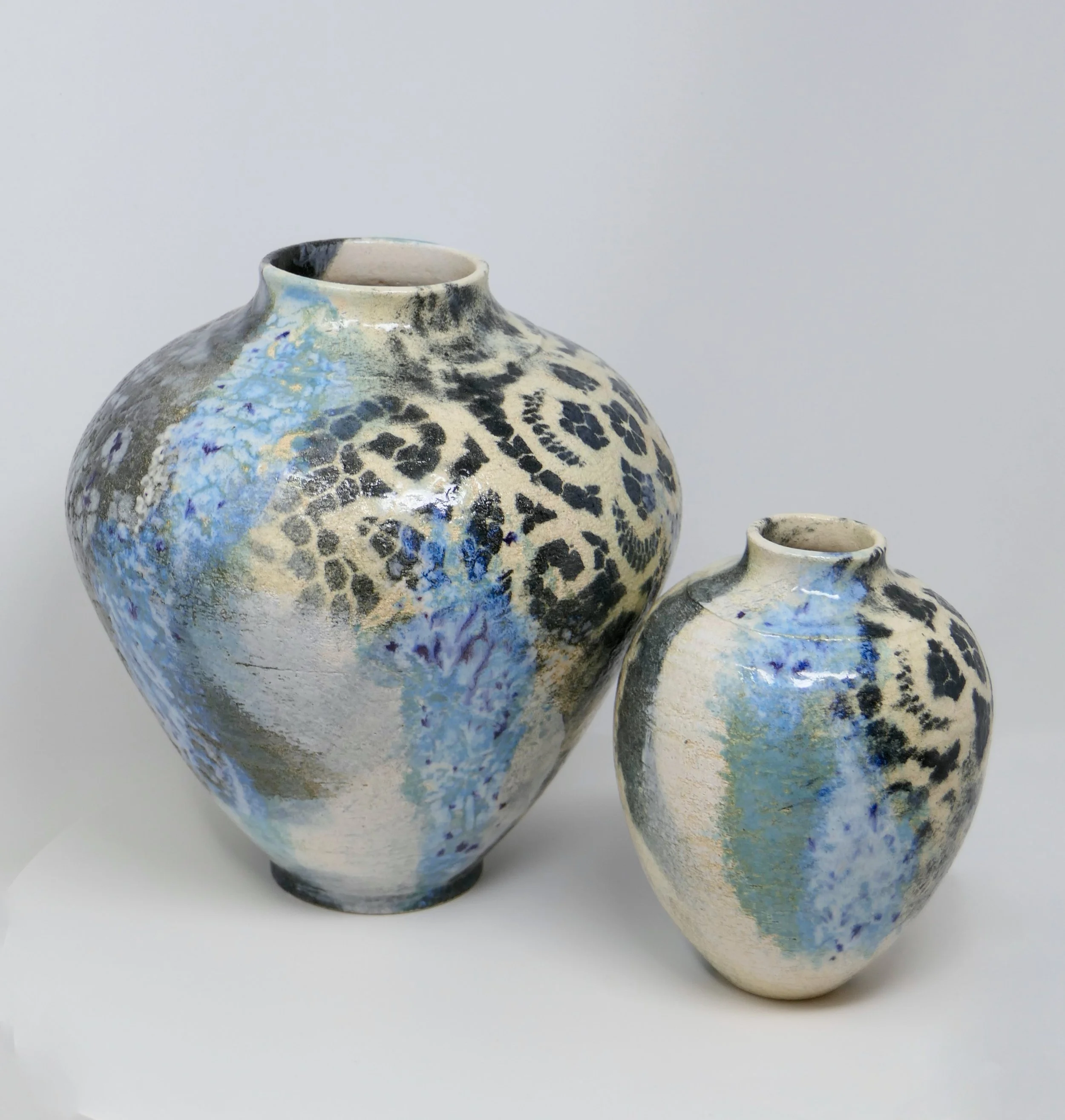
The same palette changes character as it travels across two related forms.
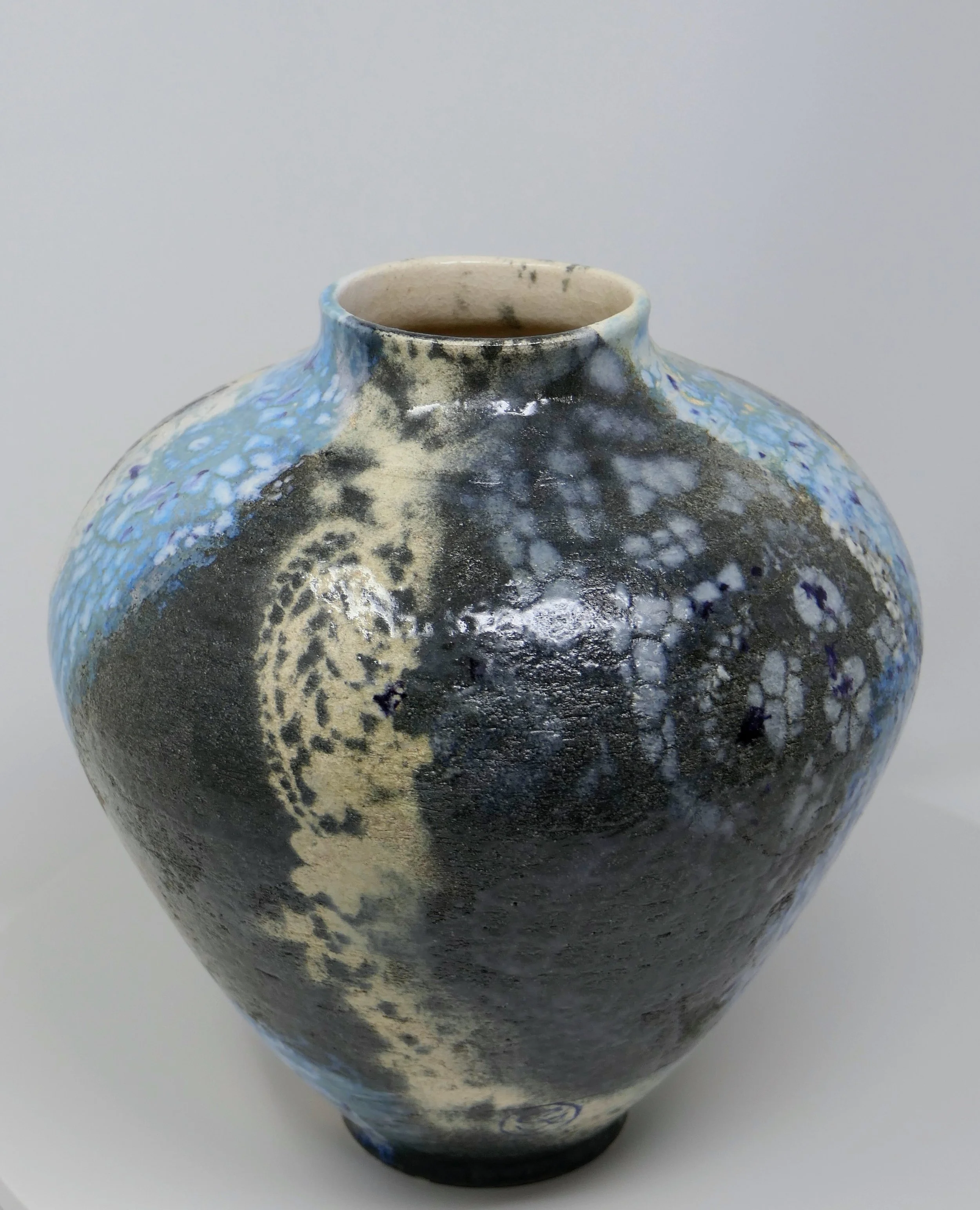
Pattern became most useful when it moved with the vessel rather than sitting on top of it.
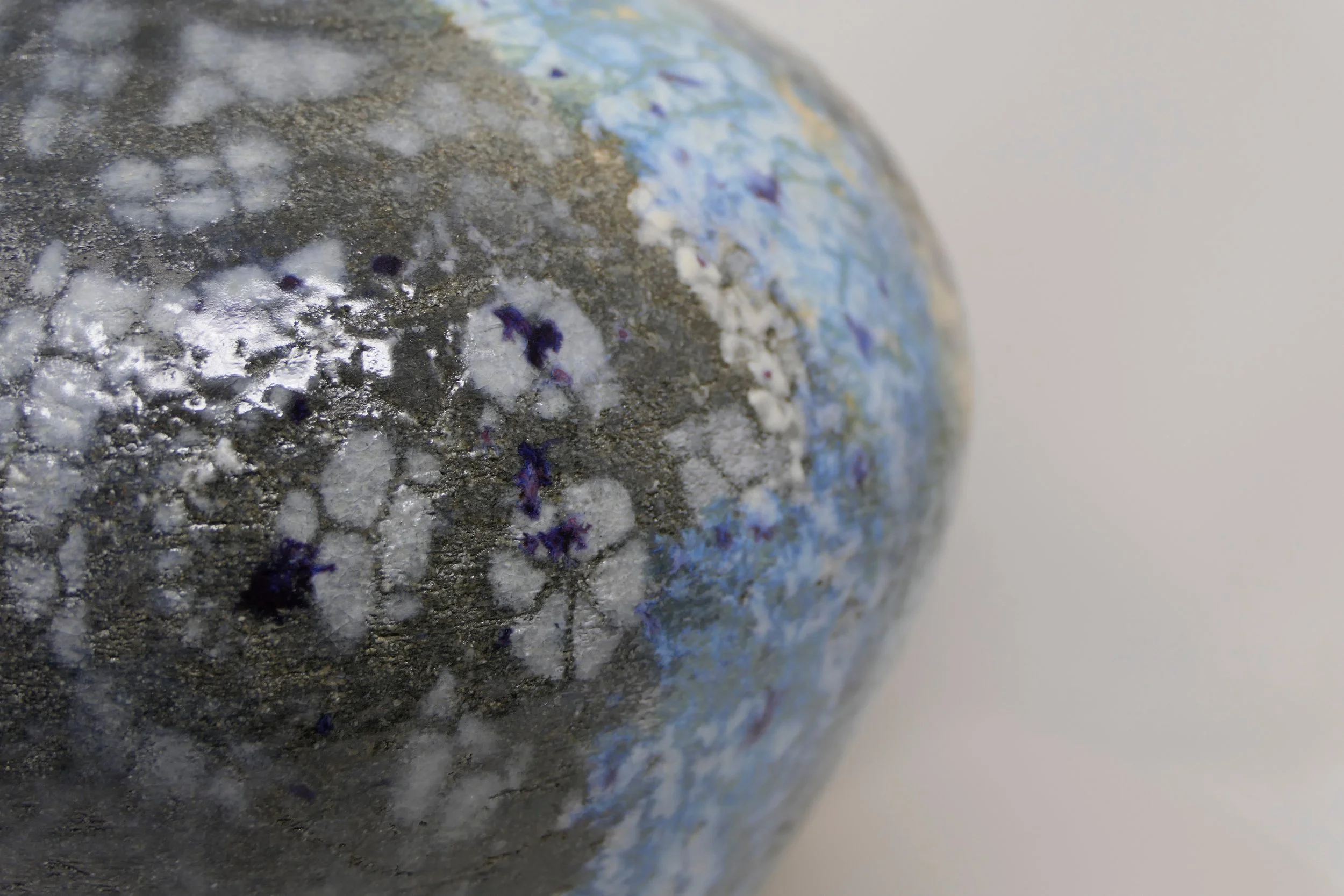
Close up, lace, glaze and raw clay break into small passages of texture and colour.
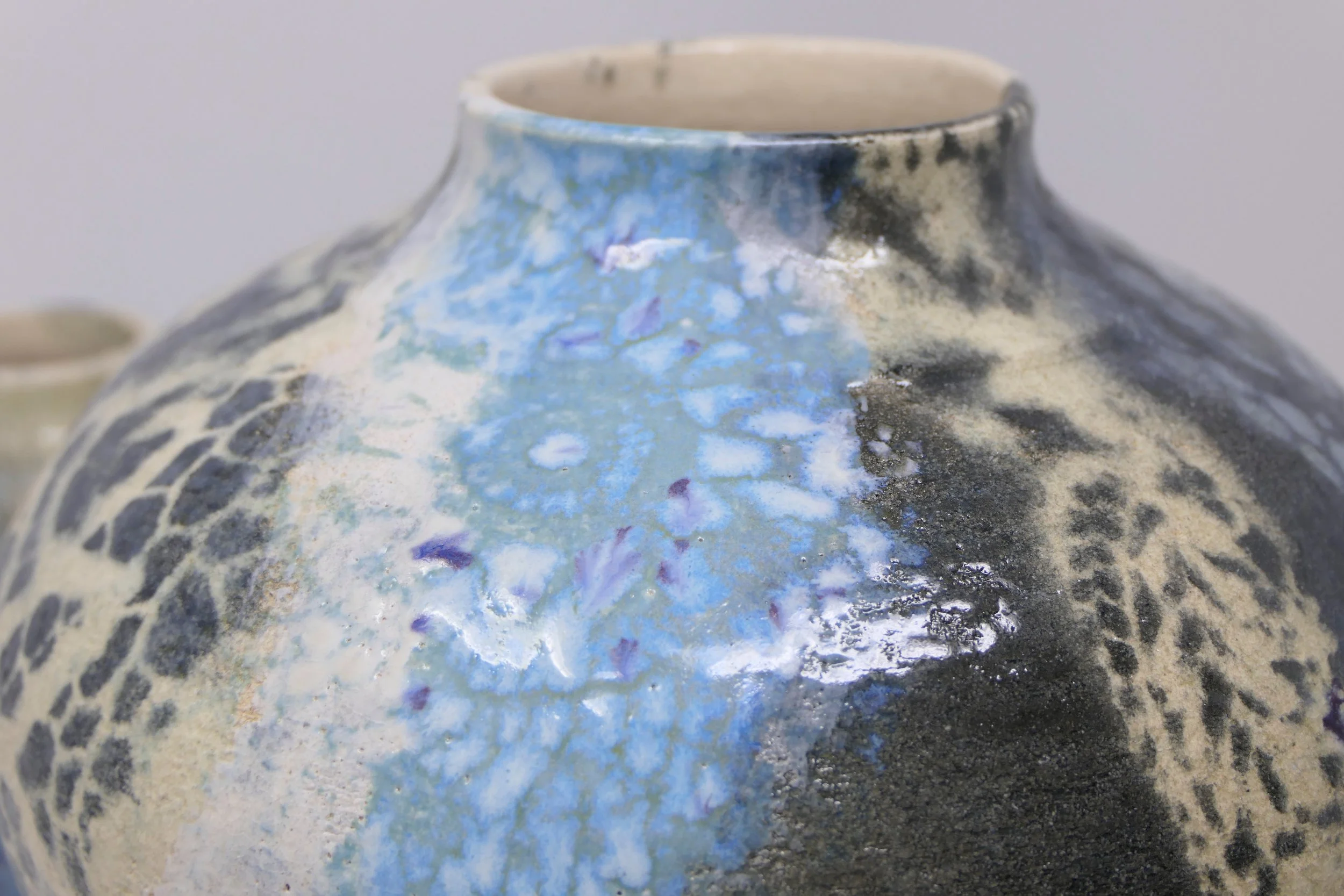
A transitional pair — learning when precision supports the form, and when decoration begins to take over.
First Snow developed during a period when my coil-thrown forms were becoming more assured and my attention was shifting toward the relationship between surface and form.
The two vessels share a quiet palette of soft blue, black and pale clay, with lace-resist patterning moving across rounded forms. Areas of raw, matte and glazed surface sit beside one another, creating subtle changes in texture and light as the vessels are viewed from different angles.
At the time, I was learning how much pattern could contribute to a form without overwhelming it. The crisp floral lace became an important lesson: I was drawn to precision and repetition, but increasingly aware that I wanted pattern to feel integrated, abstract and responsive rather than simply decorative.
Looking back, First Snow marks a transitional moment in my practice. The forms are calmer and more resolved than earlier experiments, while the surfaces begin to point toward the layered, rhythmic language I continue to explore now.
The pair holds that threshold quietly — a pause between learning control and learning when to let go of it.
Discovering Joy · 2025
Coil-thrown stoneware, layered ceramic surface treatments, crackle glaze, India ink cold finish
Large vessel: 24 cm H × 20 cm W · 1,196 g
Small vessel: 13 cm H × 9 cm W · 250 g
CA$650 pair · Available
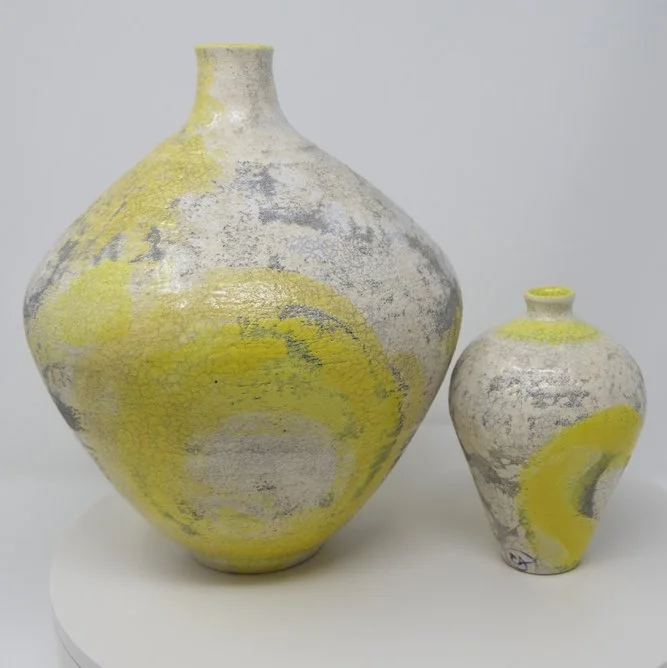
Discovering Joy — An exploration in colour, texture, and happy surprises.
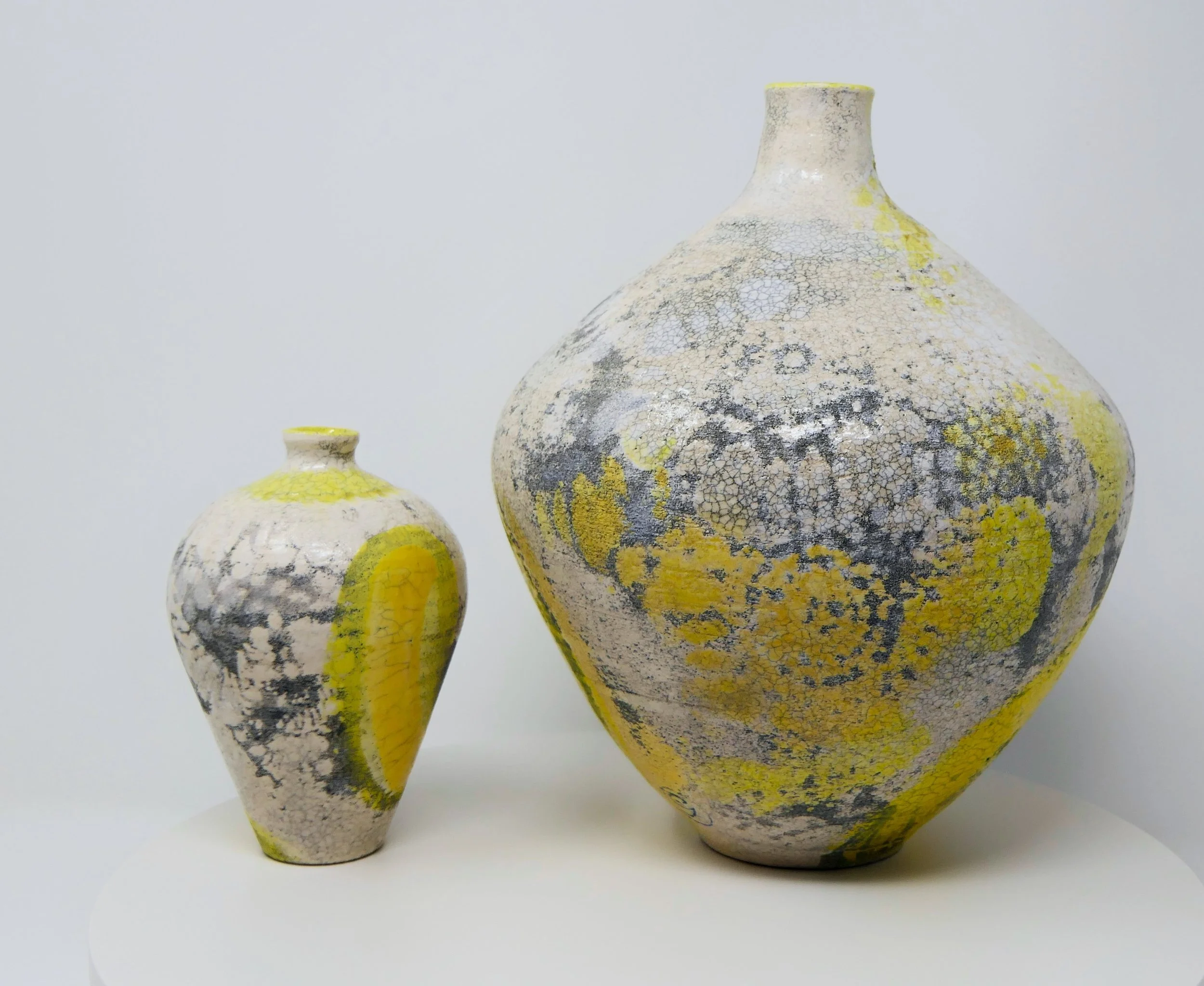
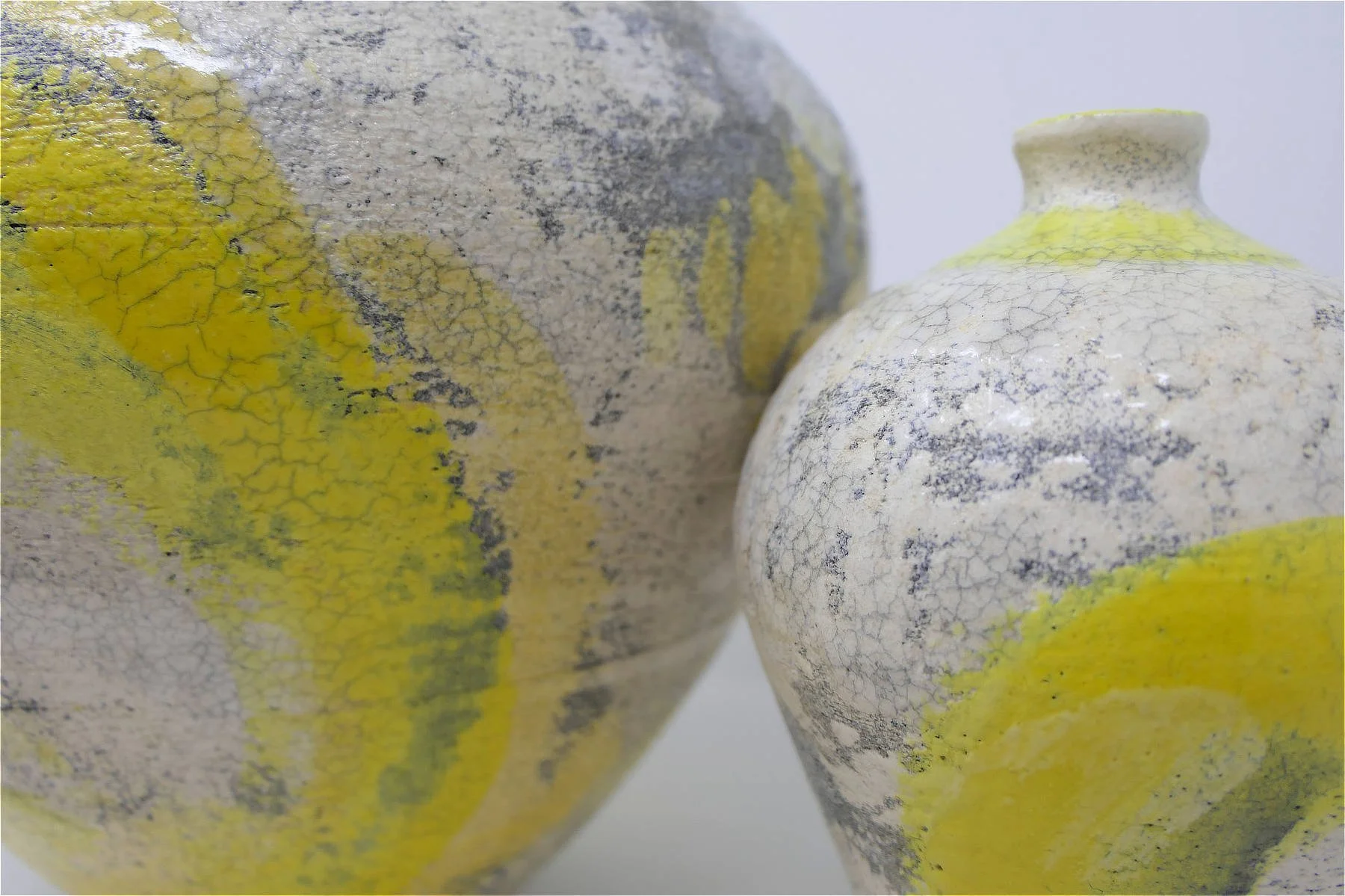
Some surfaces feel weathered before they've lived a day.
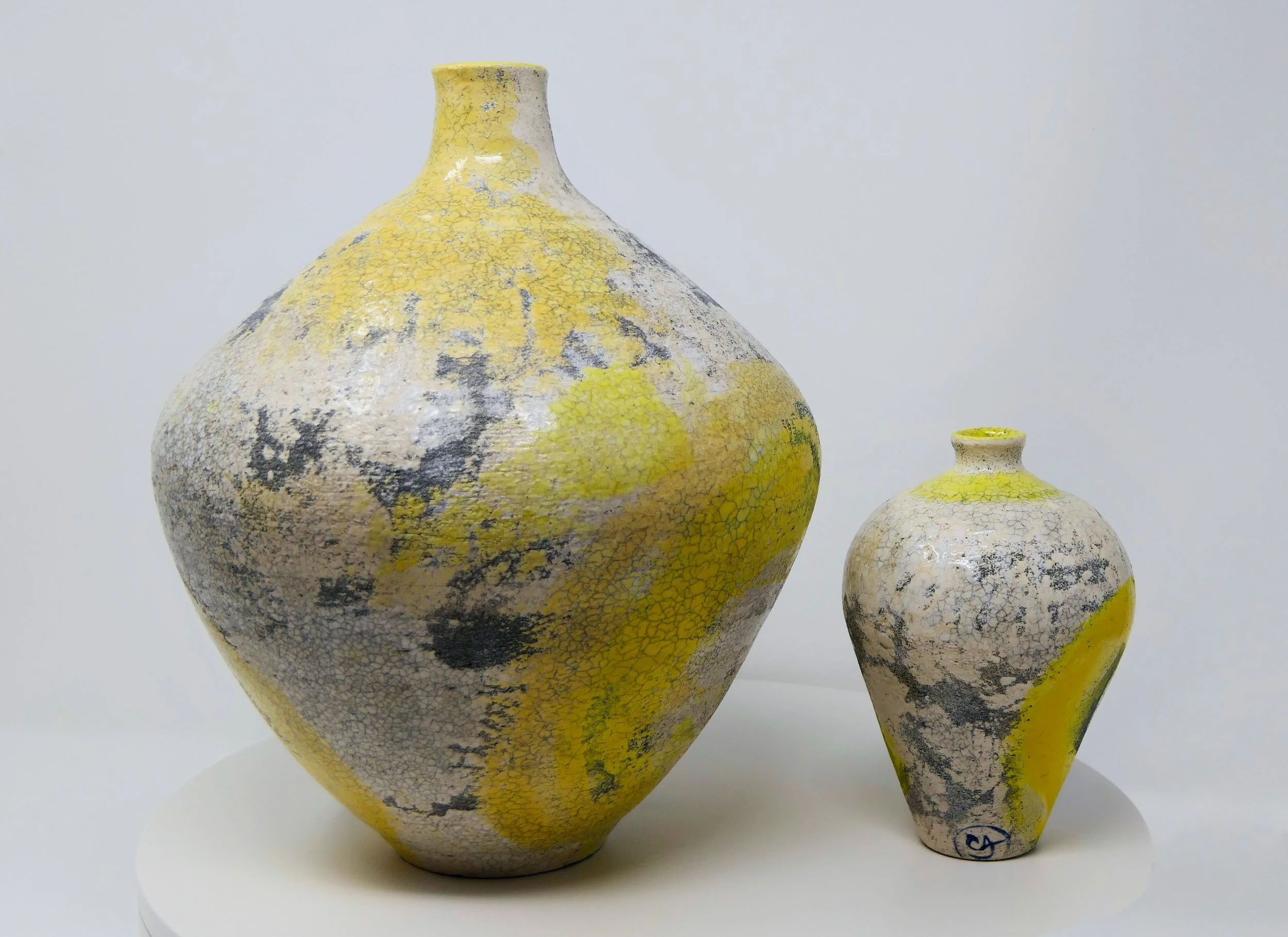
Every firing brings its own quiet discoveries.
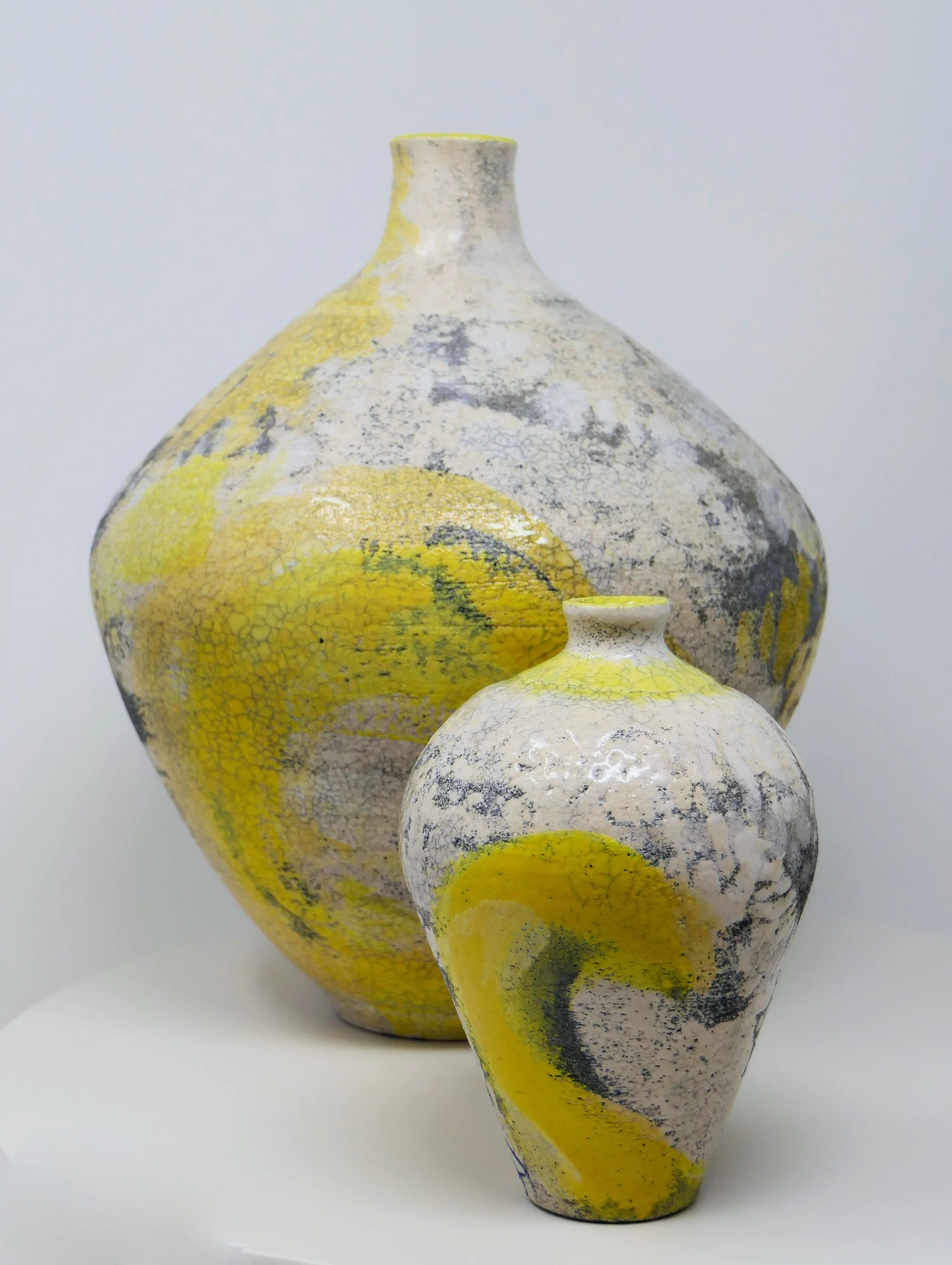
Joy is often found in the unexpected.
Discovering Joy marks one of the earliest moments when I began to recognize that coil building and the wheel did not have to belong to separate ways of making.
These vessels developed slowly and responsively. Their uneven forms, narrow bases and layered surfaces record a period when I was learning to trust movement, imbalance and unpredictability rather than correct them immediately.
The surface became the real discovery. Layers of yellow, white and grey, areas of texture and crackle, and subtle changes created through firing initially felt almost too quiet. Working India ink into the fired surface changed everything. The ink settled into the cracks, marks and interruptions already present in the clay, revealing movement that had been there all along.
That became an important lesson: a cold finish did not need to cover or rescue the ceramic surface. It could simply reveal another layer.
The joy in these works is not exuberant. It is quieter — the pleasure of curiosity, compassion toward an imperfect form, and the moment when an unfamiliar way of working begins to feel like your own.
Finding My Rhythm · 2025
Coil-thrown stoneware, mixed ceramic surface treatments
Large: 19 cm H × 25 cm W · 2,225 g $300
Medium: 18 cm H × 23 cm W · 2,006 g $250
Small: 10 cm H × 14 cm W · 546 g $175
· Available
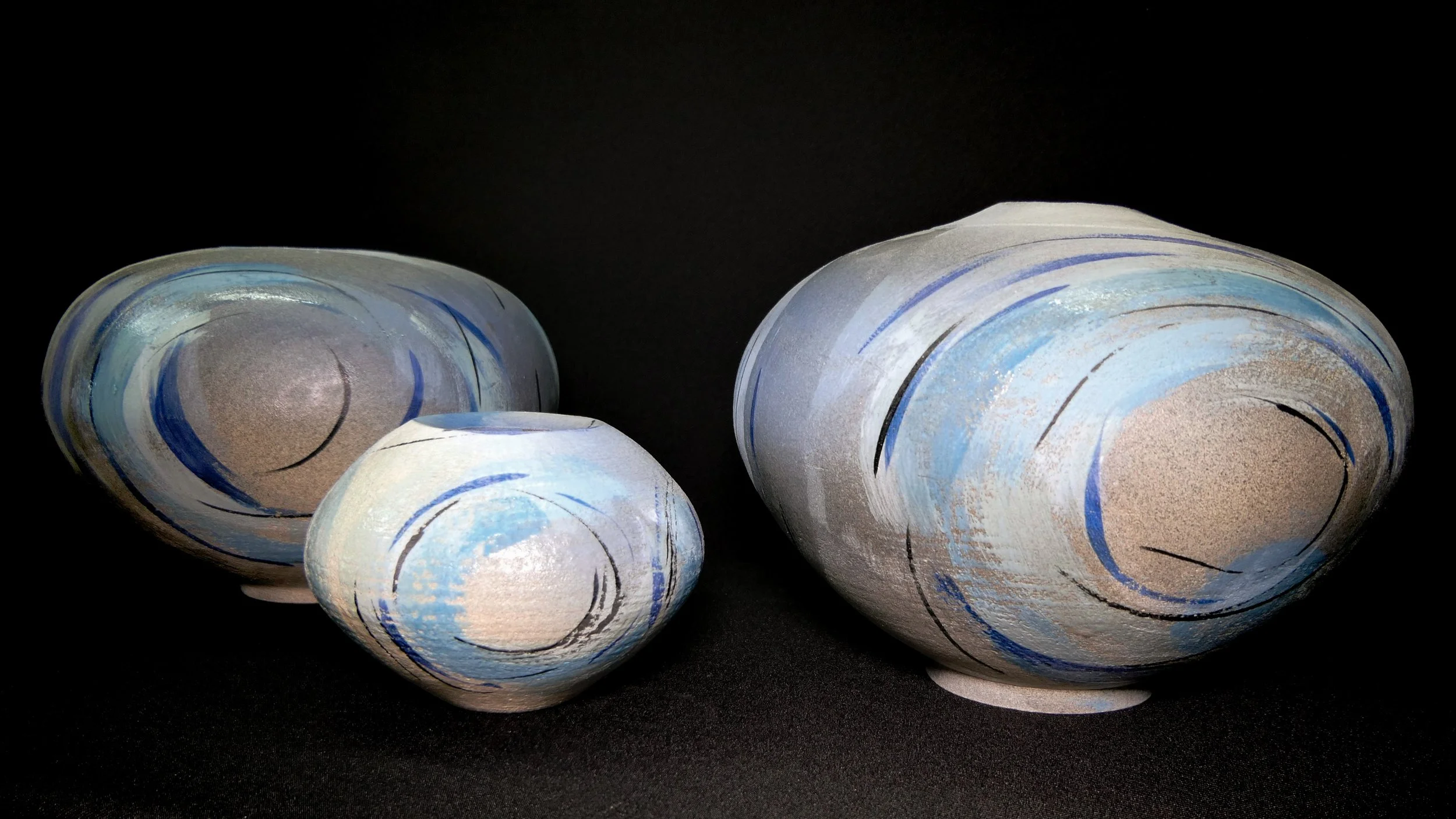
Finding My Rhythm — An early exploration of coil-throwing, combining the rhythm of the wheel with the freedom of handbuilding.
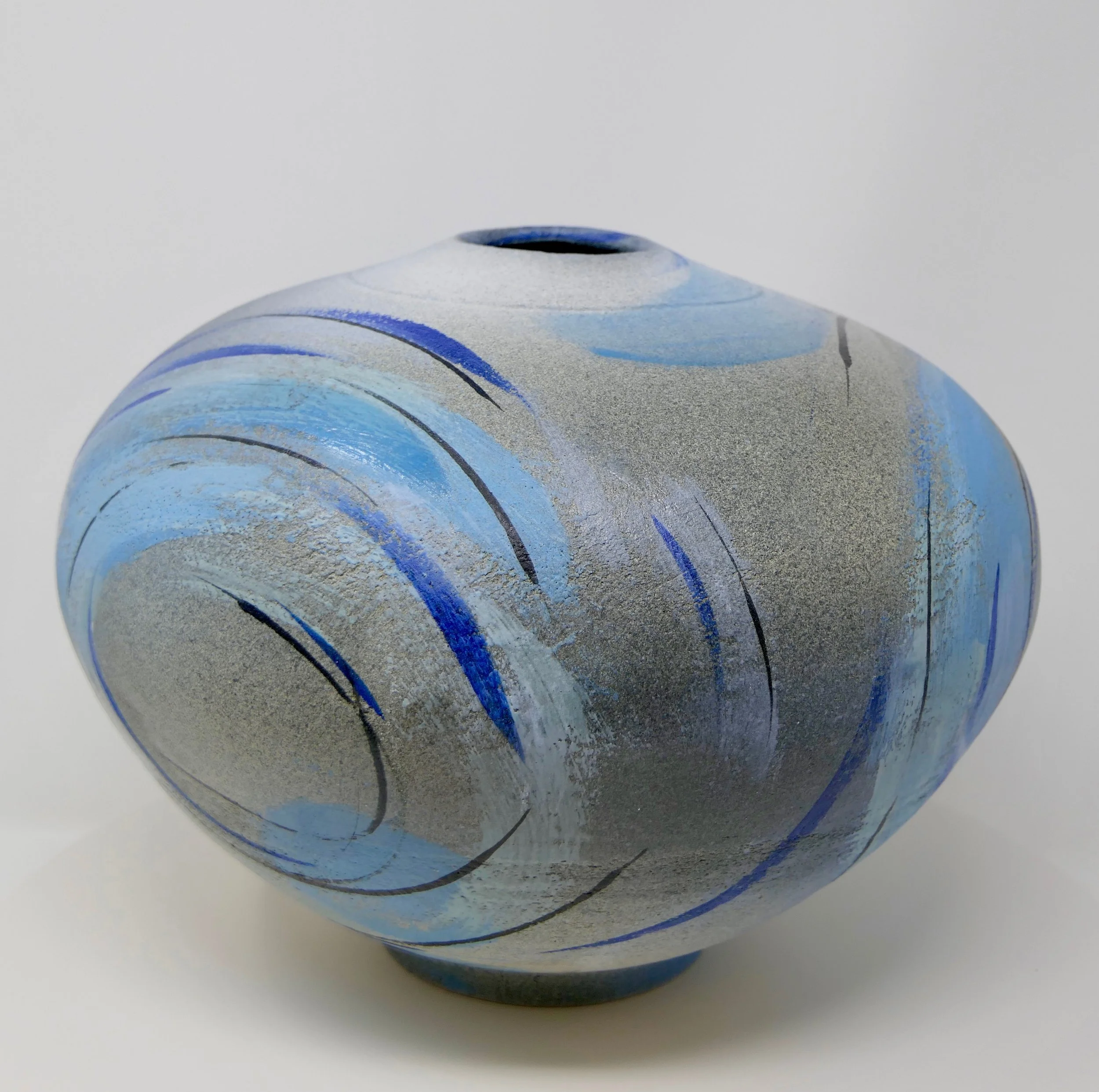
Surface in Motion - Brushstrokes, spray, layered glaze and movement begin their own conversation across the form.
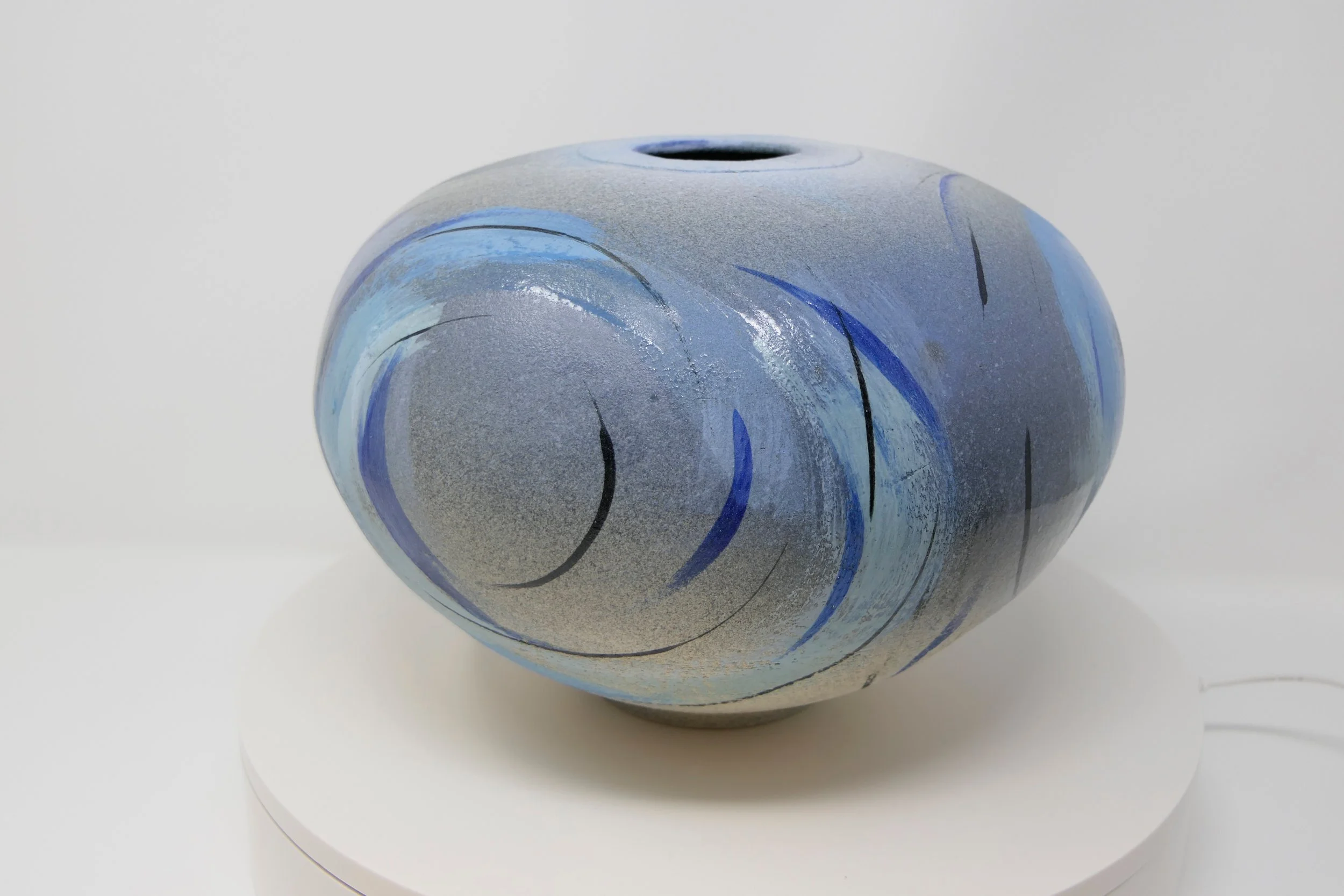
Curiosity as Process - Every new technique begins with curiosity — a willingness to try, respond and change direction.
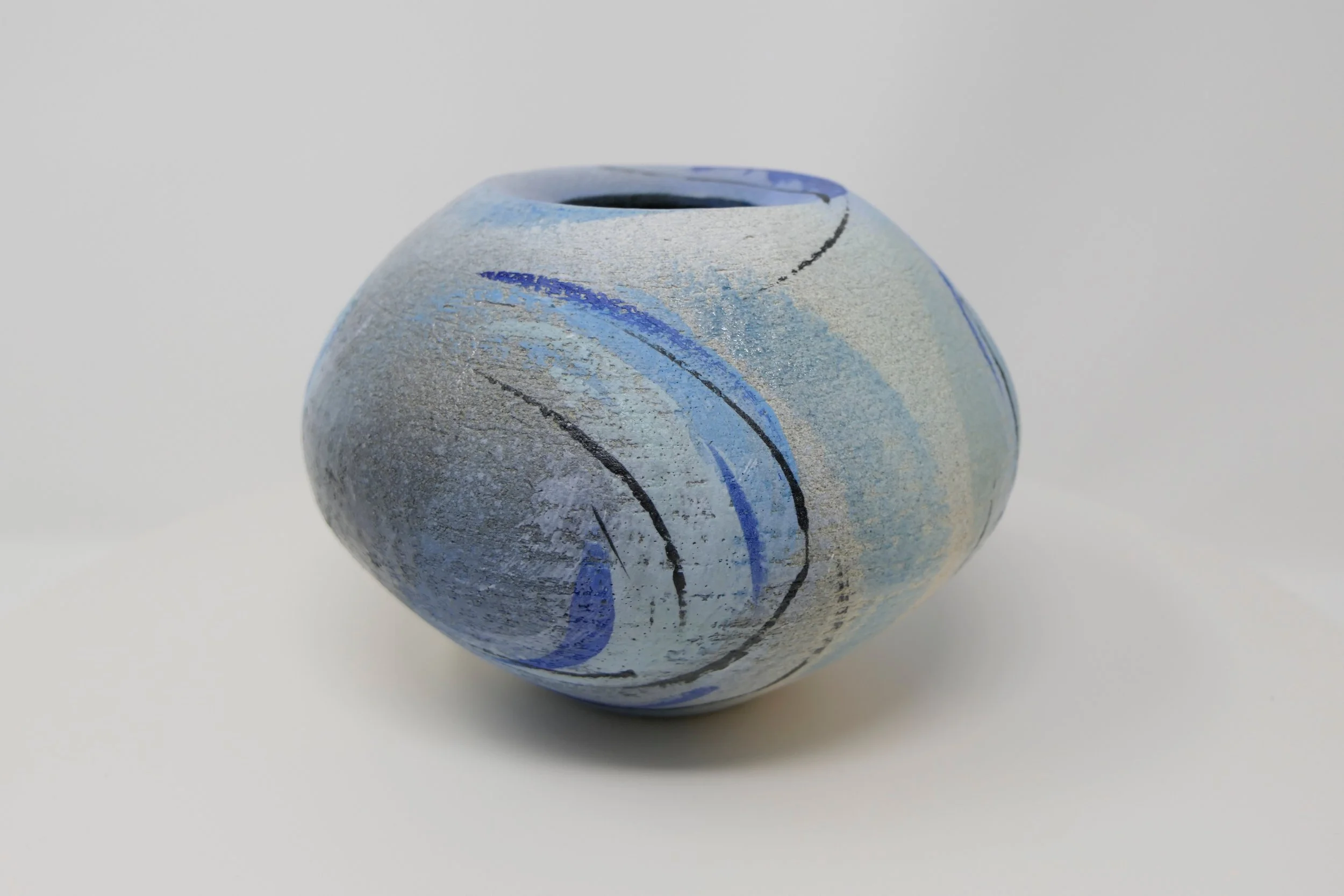
Finding My Way - In finding my rhythm, I began to recognise my own way of making.
Finding My Rhythm marks an important shift in my studio practice.
These were among the first vessels where I began combining the rhythm of the wheel with the freedom of handbuilding. I was no longer trying to make a technically perfect thrown pot or follow somebody else’s idea of what pottery should look like. Instead, I began using the wheel as one tool among many.
The forms developed through a combination of throwing, coiling, stretching and responding to what the clay wanted to do. Their surfaces evolved in much the same way: brushed, sprayed, layered and marked without requiring the outcome to be completely predictable.
The series became less about mastering a technique and more about discovering a way of working that felt like mine.
That is where the title came from.
Permission to Play · 2026
Slab-built and coil-thrown stoneware, layered underglaze, clear glaze
32 × 24 cm · 2,694 g
CA$450 · Available
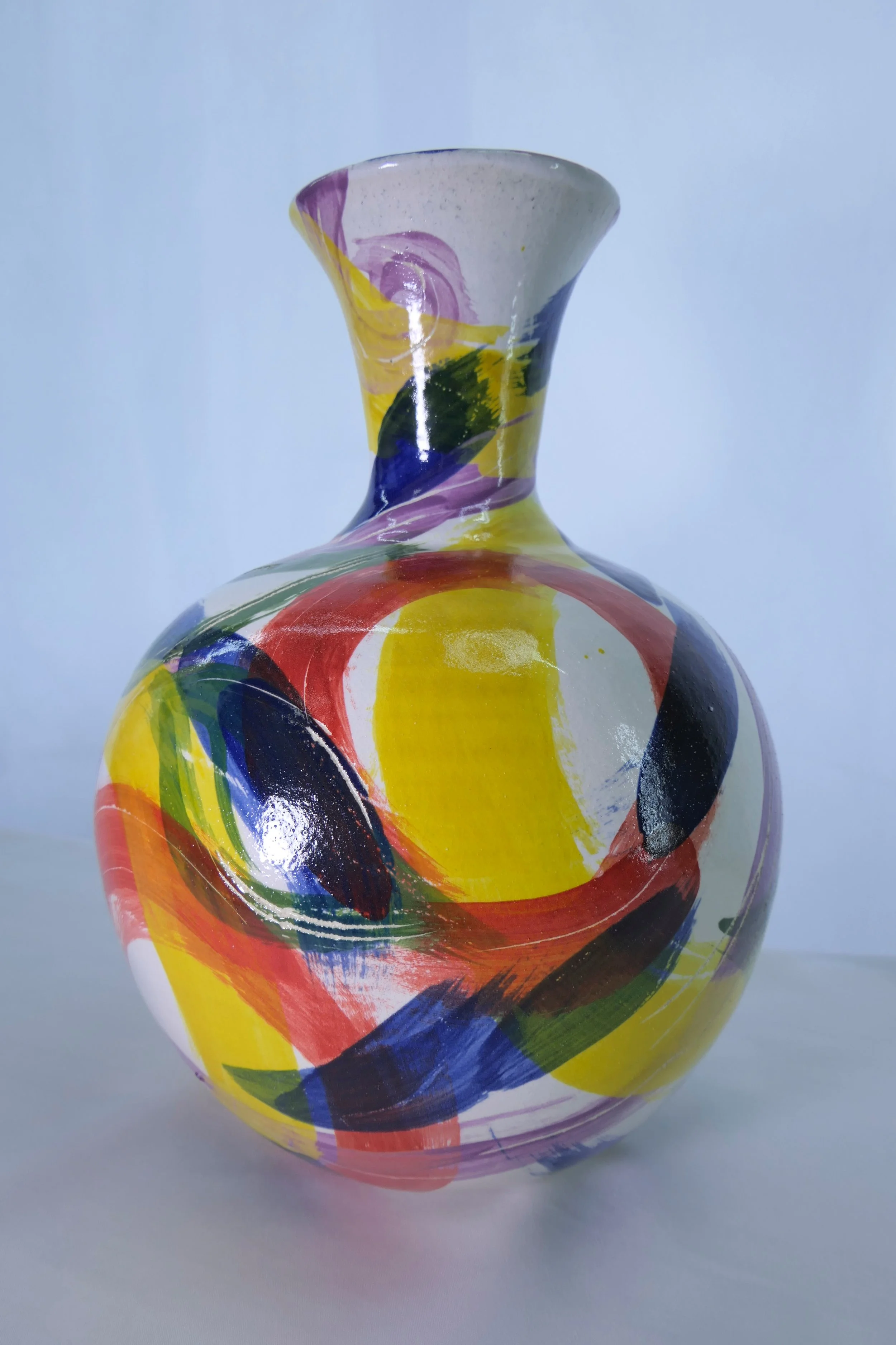
Colour found its own rhythm.
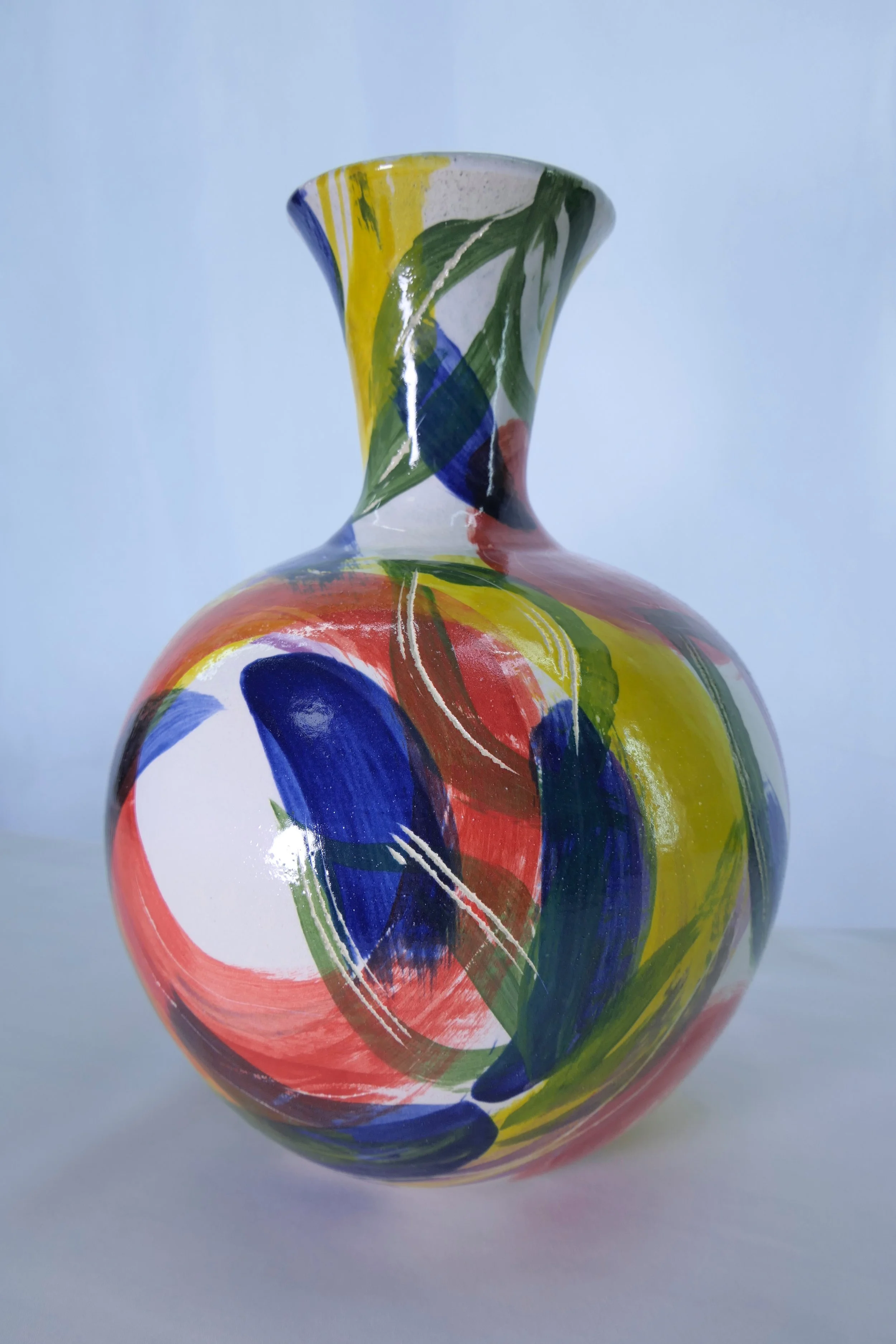
The brush wandered. I followed.
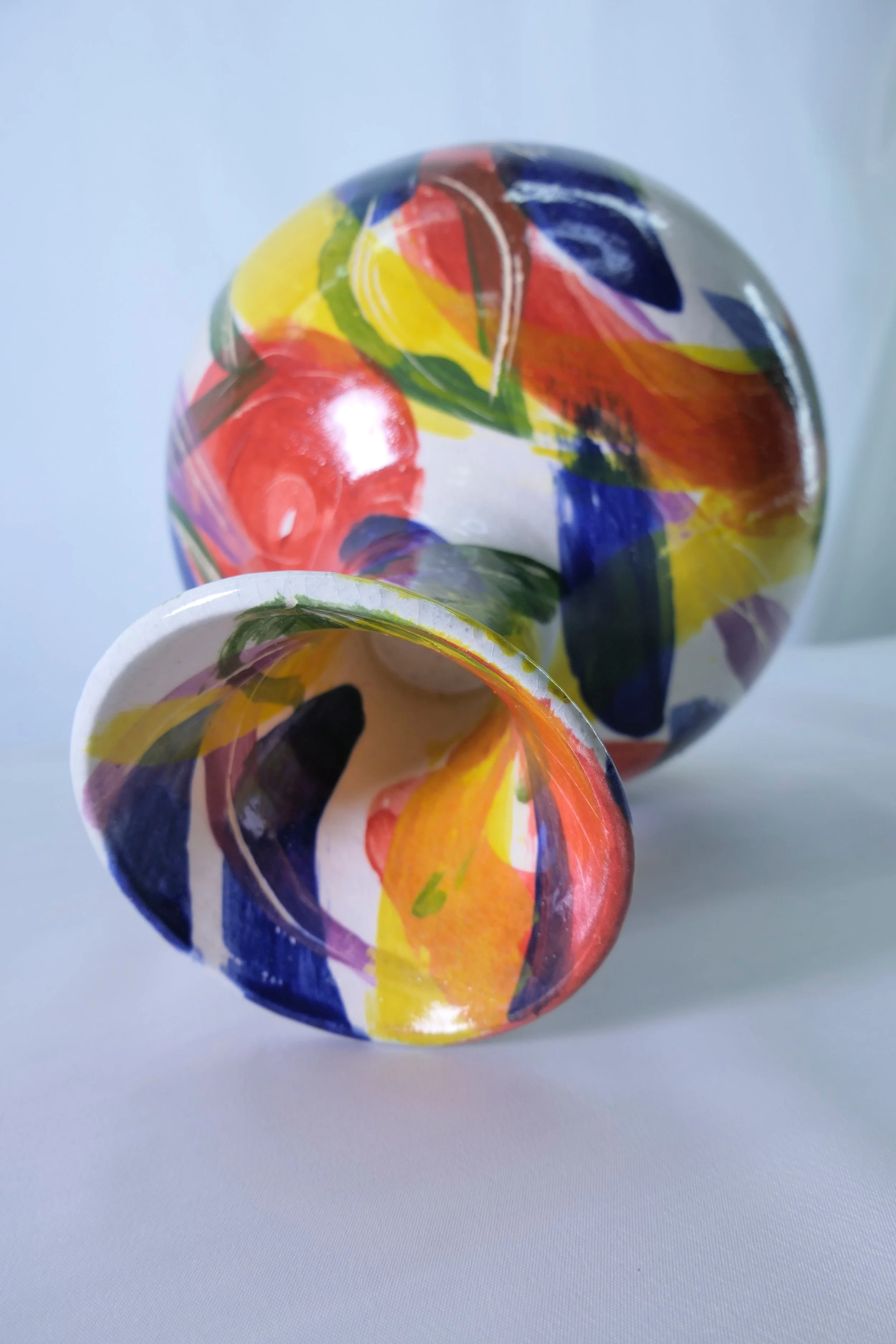
Play became part of the practice again.
Permission to Play grew from an experiment in letting colour lead rather than asking the vessel to carry a serious conceptual burden.
The body was formed over a mould taken from one of my grandmother’s dishes, then built upward with additional handbuilt and thrown sections. The long neck was added separately and does not open into the main body, making the vessel slightly deceptive in construction.
The surface came from looking at the uninhibited way children use markers — bold colour, overlapping marks, no anxiety about whether one stroke belongs beside another. I worked in the same spirit, allowing each colour and gesture to suggest the next.
What began as a technical experiment became a reminder that play is not separate from practice. Sometimes it is the thing that allows practice to move again.
The bright palette, glossy surface and slightly theatrical form are deliberately uncomplicated. This piece does not ask to be solemn. It asks what becomes possible when making is allowed to be enjoyable.
Beginning Again · 2026
Coil-built stoneware, mixed ceramic surface treatments
Individual works:
Largest — 20 × 19 cm · 1,634 g — CA$250
Second — 20 × 16 cm · 1,290 g — CA$250
Tube-and-cube top — 12.5 × 12.5 cm · 639 g — CA$200
Little drop-shaped vessel — 11.5 × 10 cm · 512 g — CA$200
All Available
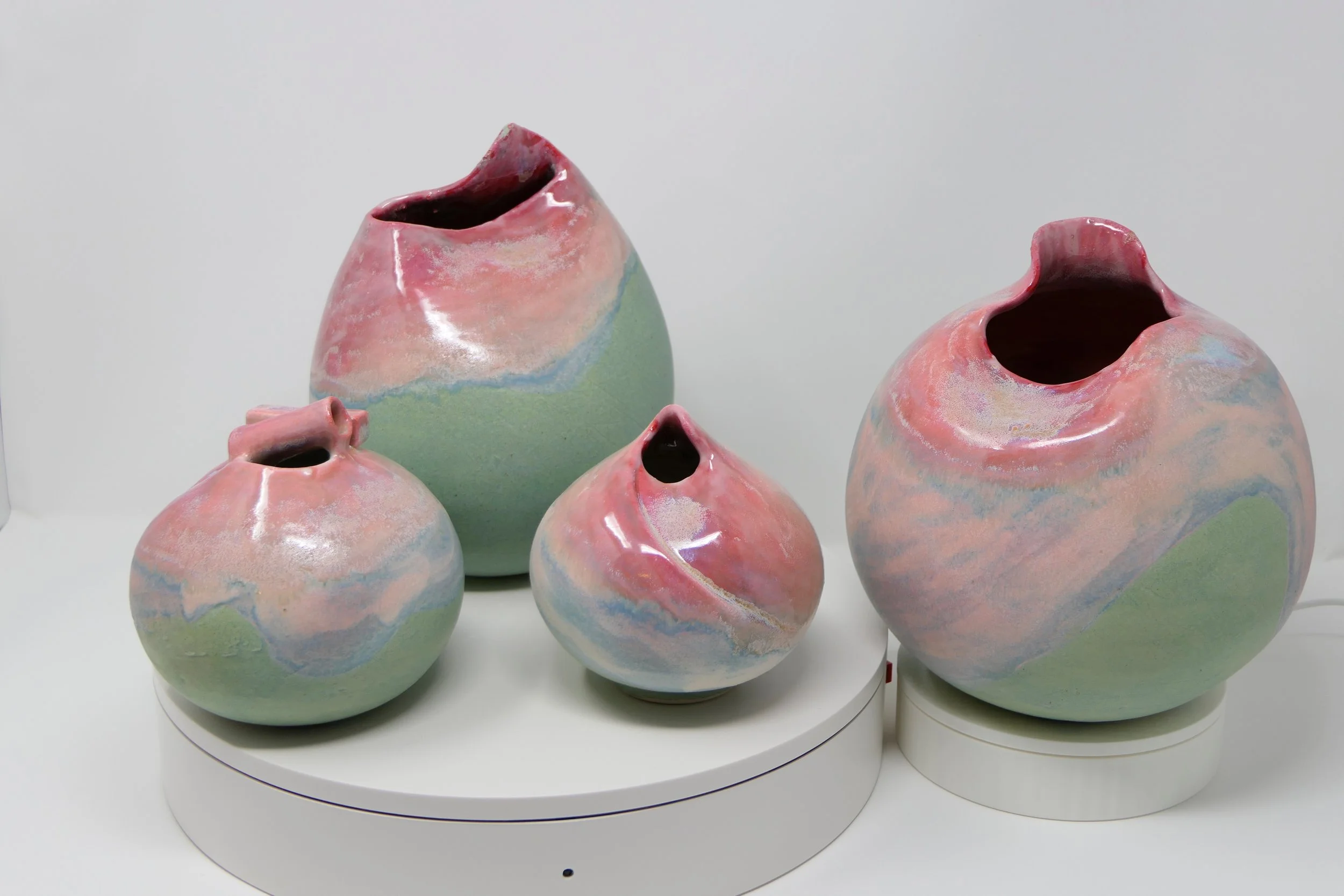
Beginning Again — One surface. Four forms. Four possibilities.
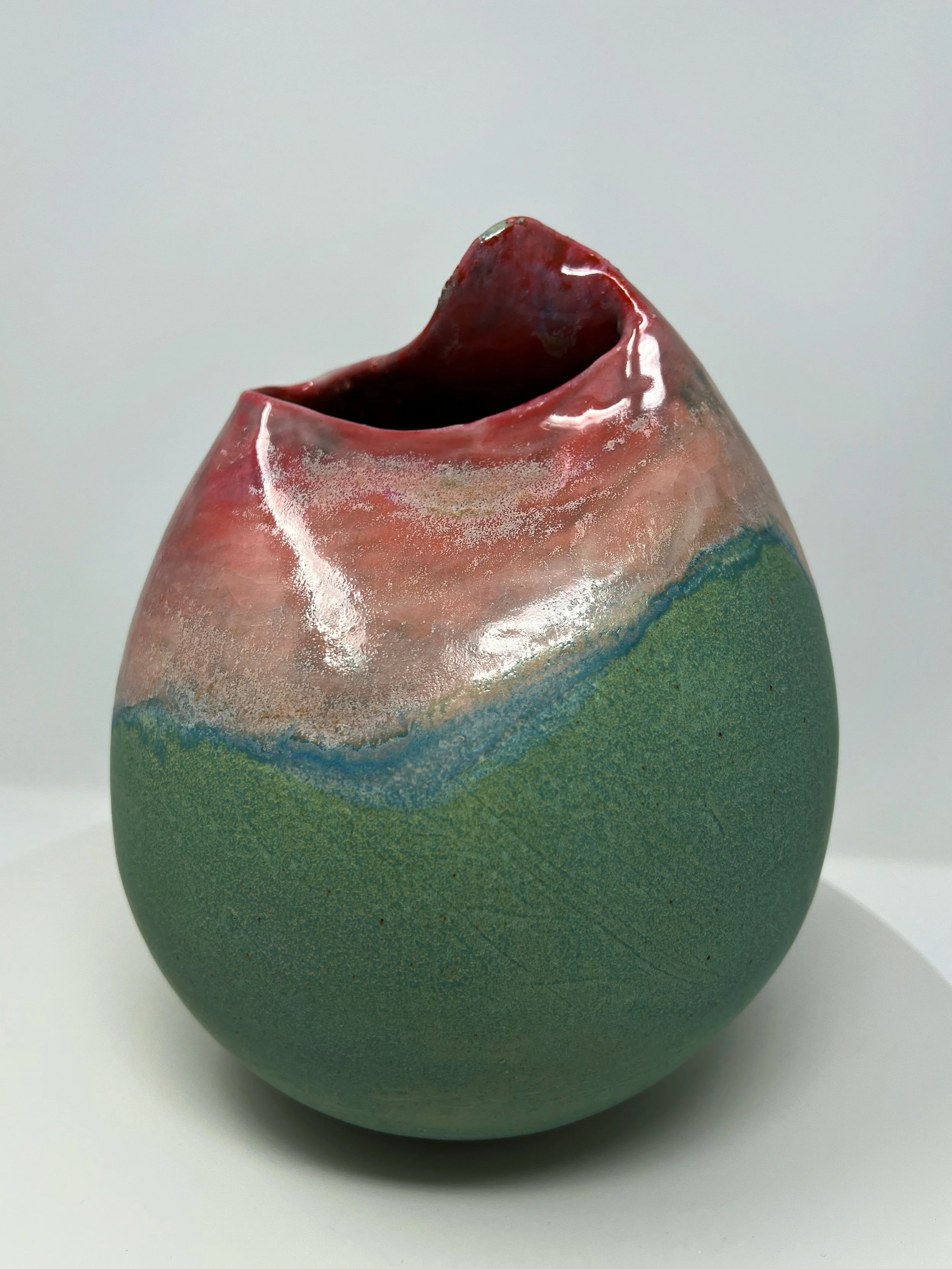
The same marks find a different rhythm on every vessel.
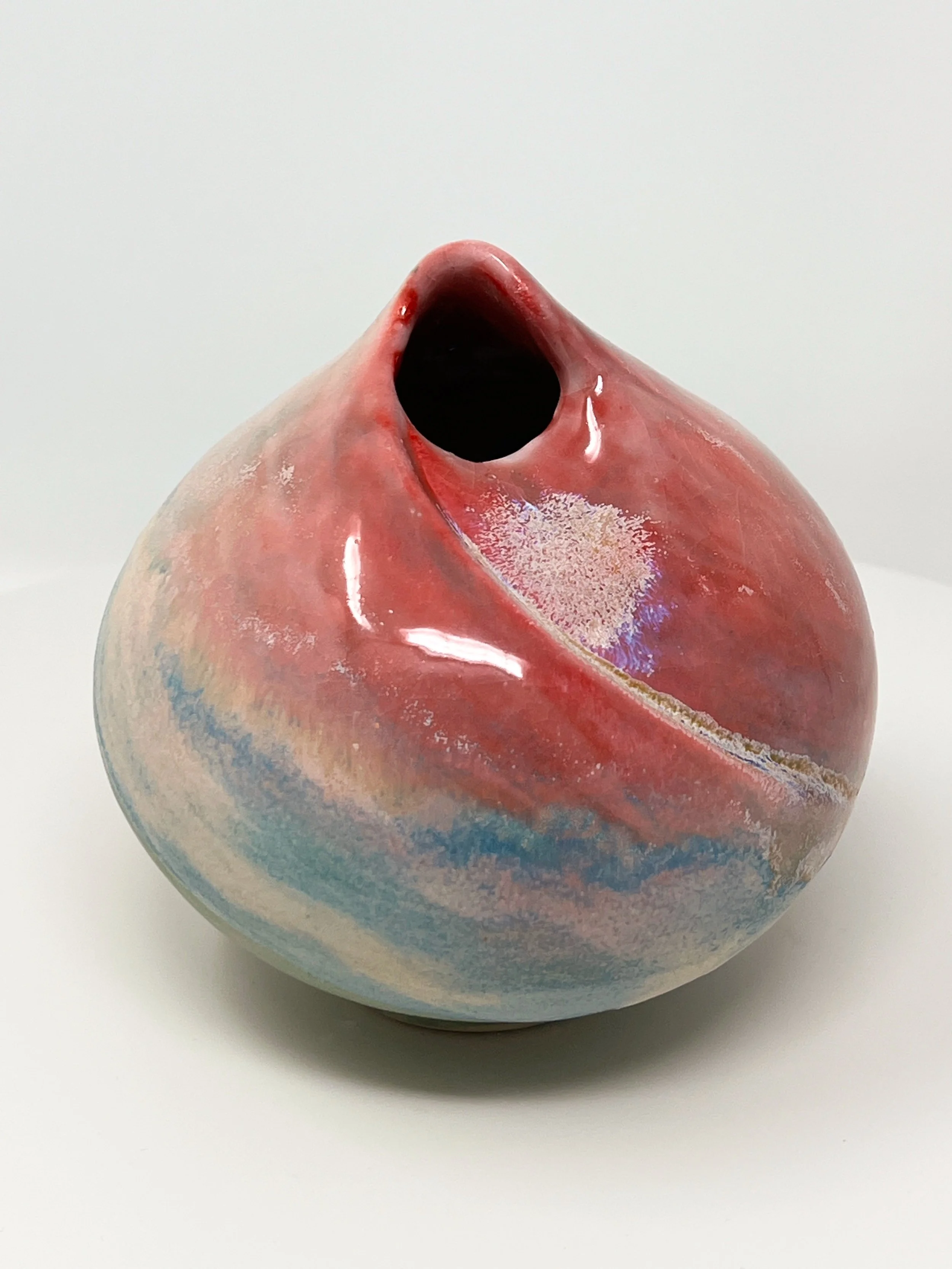
Changing the form changes everything the surface has to say.
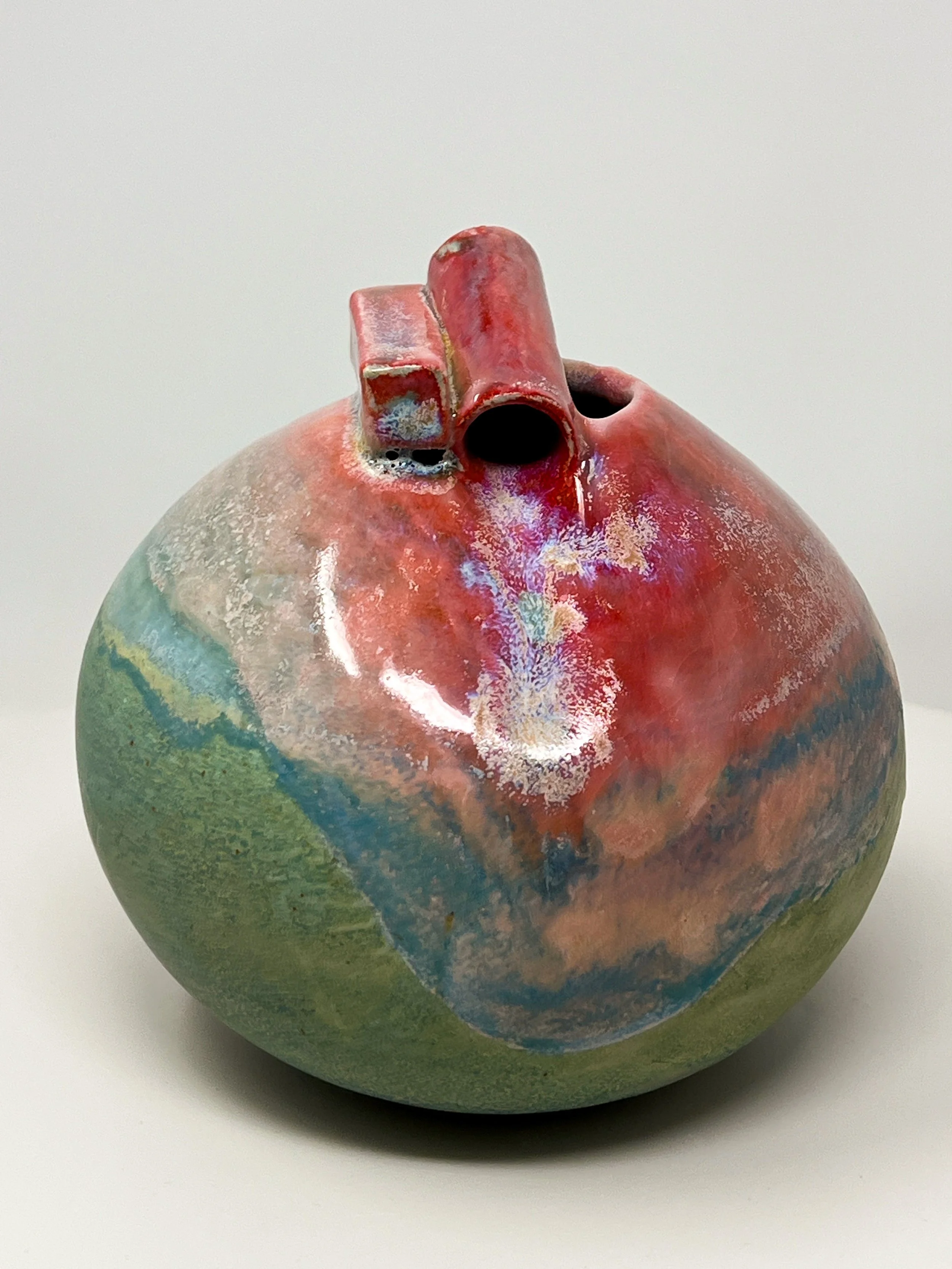
Each vessel becomes another chapter in the same exploration.
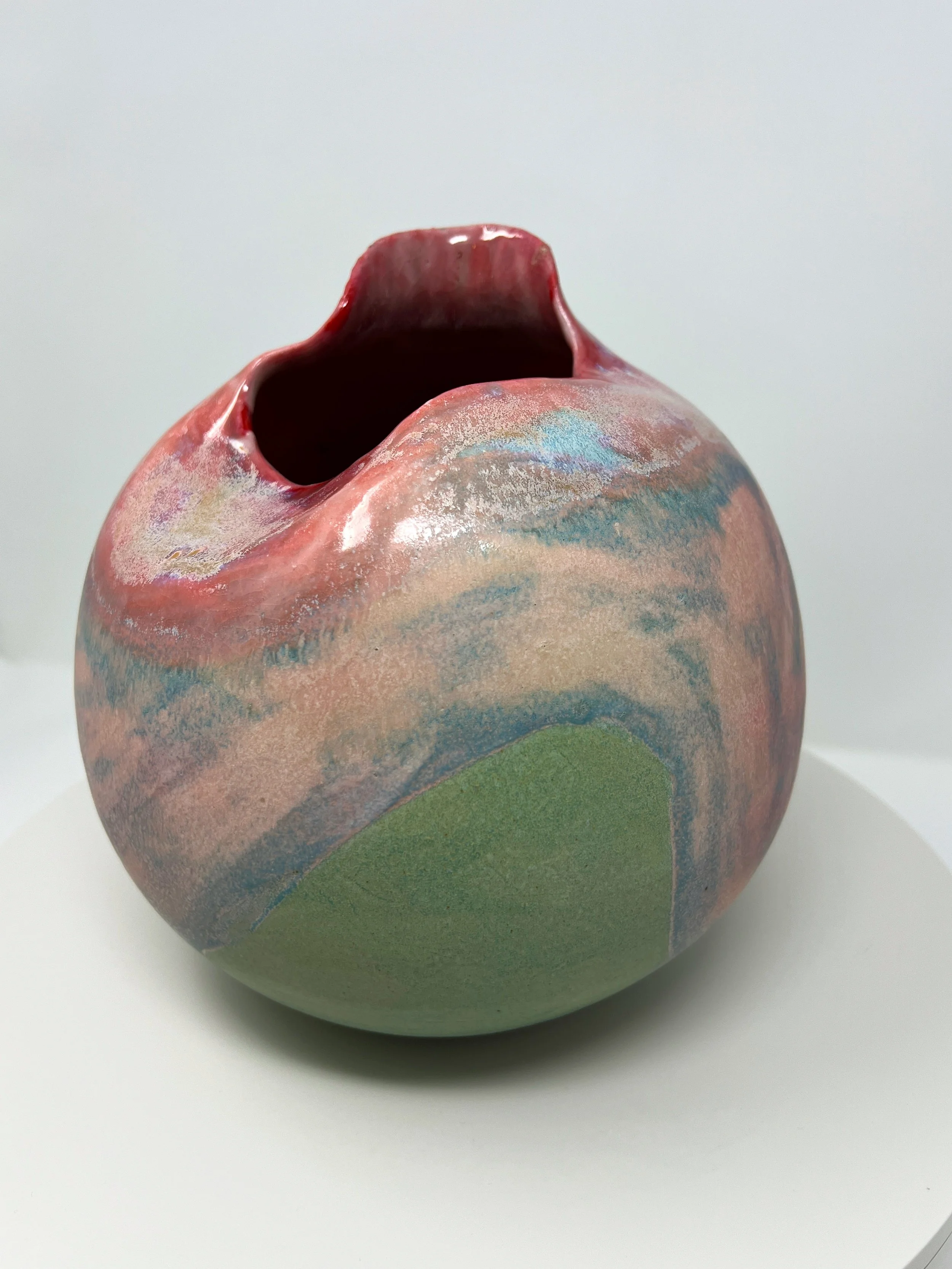
The language remains the same; the conversation changes.
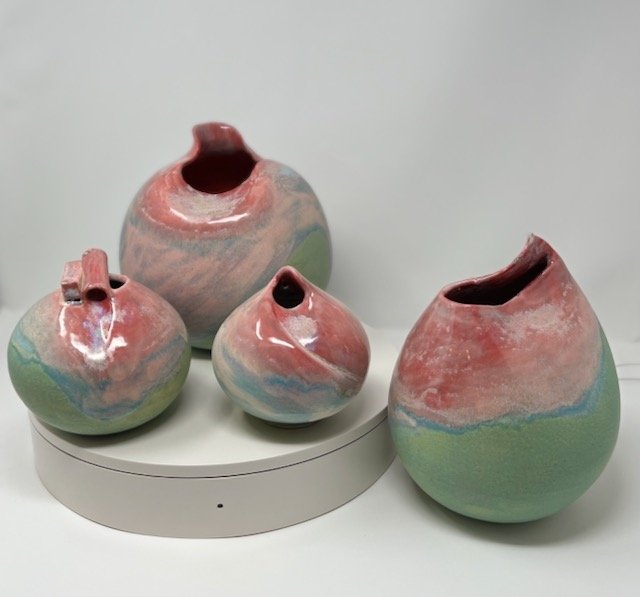
Sometimes discovery comes from repeating the question, not changing it.
Beginning Again marks a return to experimentation without needing every piece to carry a heavy conceptual burden.
These vessels began as studies in form, surface, colour and repetition. I worked with related shapes and similar surface treatments, then allowed each vessel to shift slightly through proportion, gesture and glaze. Repeating the same visual language across several forms became a way of noticing how small changes could completely alter the character of a piece.
They were also part of relearning how I wanted to work: less concerned with producing a perfect vessel and more interested in following curiosity. Some forms became quieter, some more animated, some awkward, some unexpectedly successful.
Together they record the early stages of returning to clay on my own terms—testing, repeating, adjusting and beginning again.
Golden Hour · 2025
Coil-built stoneware, layered ceramic surface treatments
Large vessel
24 cm H × 27 cm W × 23 cm D · 3,097 g — CA$450
Middle vessel
17 cm H × 19 cm W × 19 cm D · 1,264 g — CA$375
Smaller/darker vessel
17 cm H × 18 cm W · 1,210 g — CA$250
($850 set of 3) · Available
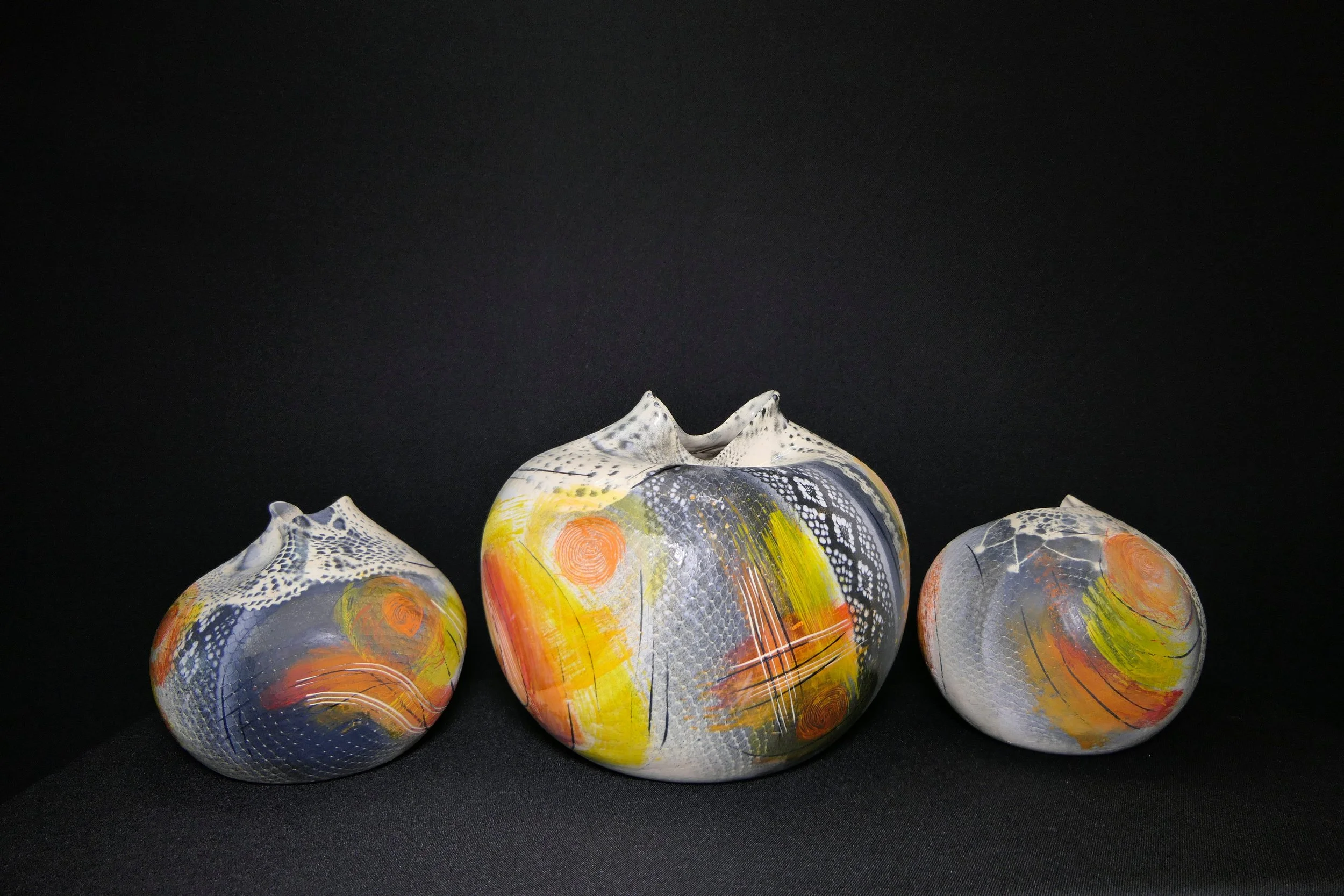
Golden Hour — Warmth, movement, and layered marks carried across three related forms.
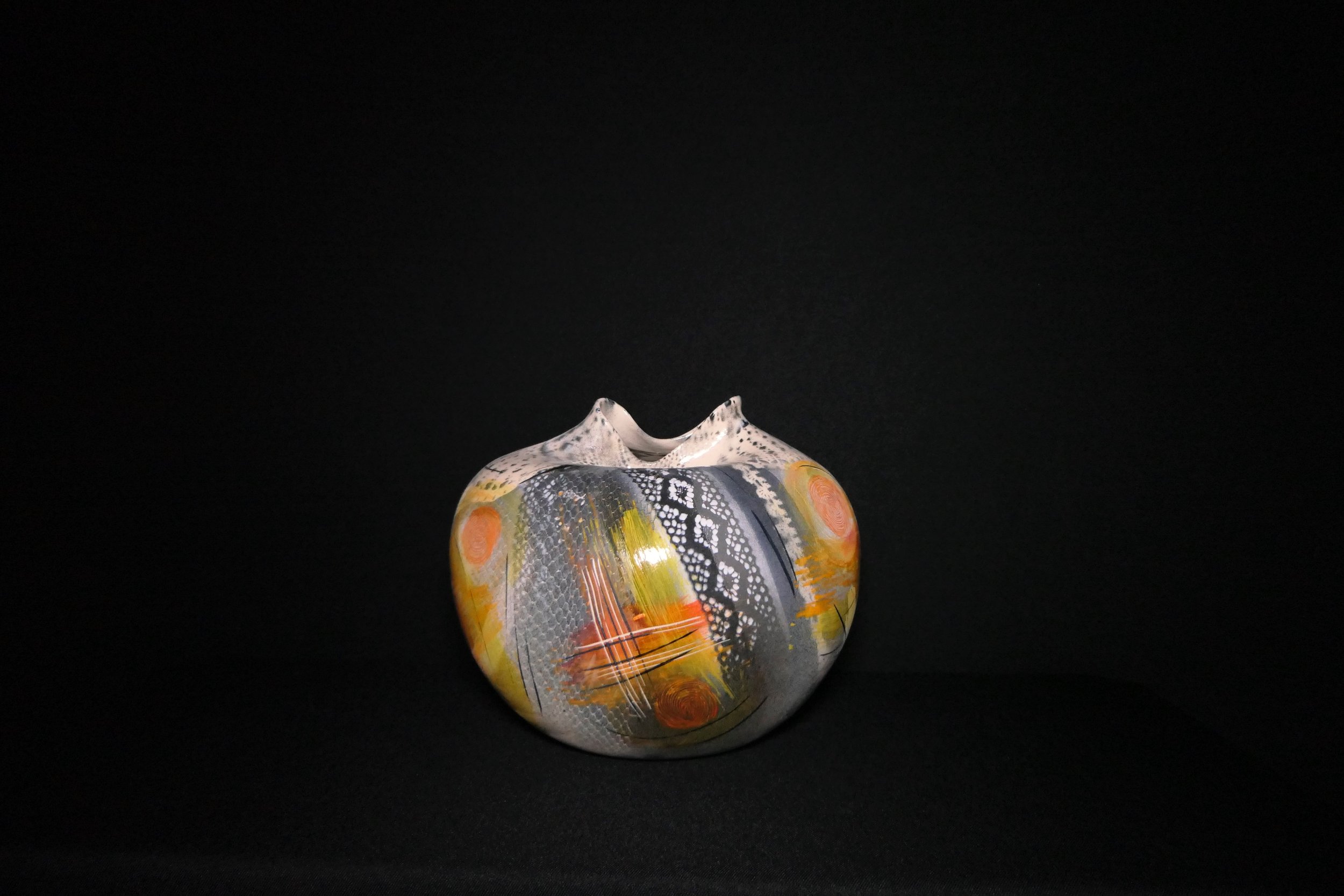
The same surface language shifts as the vessel changes shape.
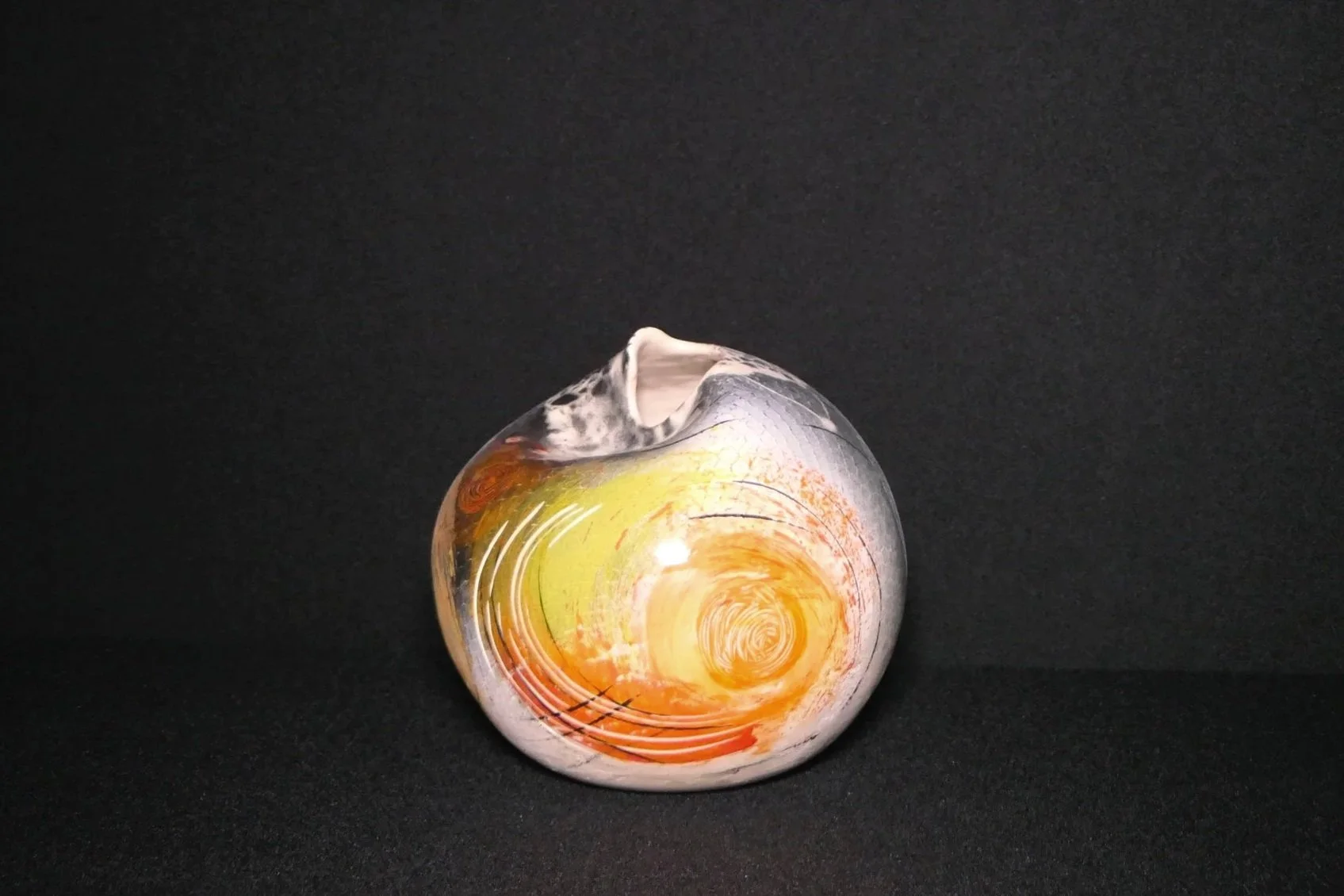
Circles, scratches, and colour build rhythm across the rounded form.
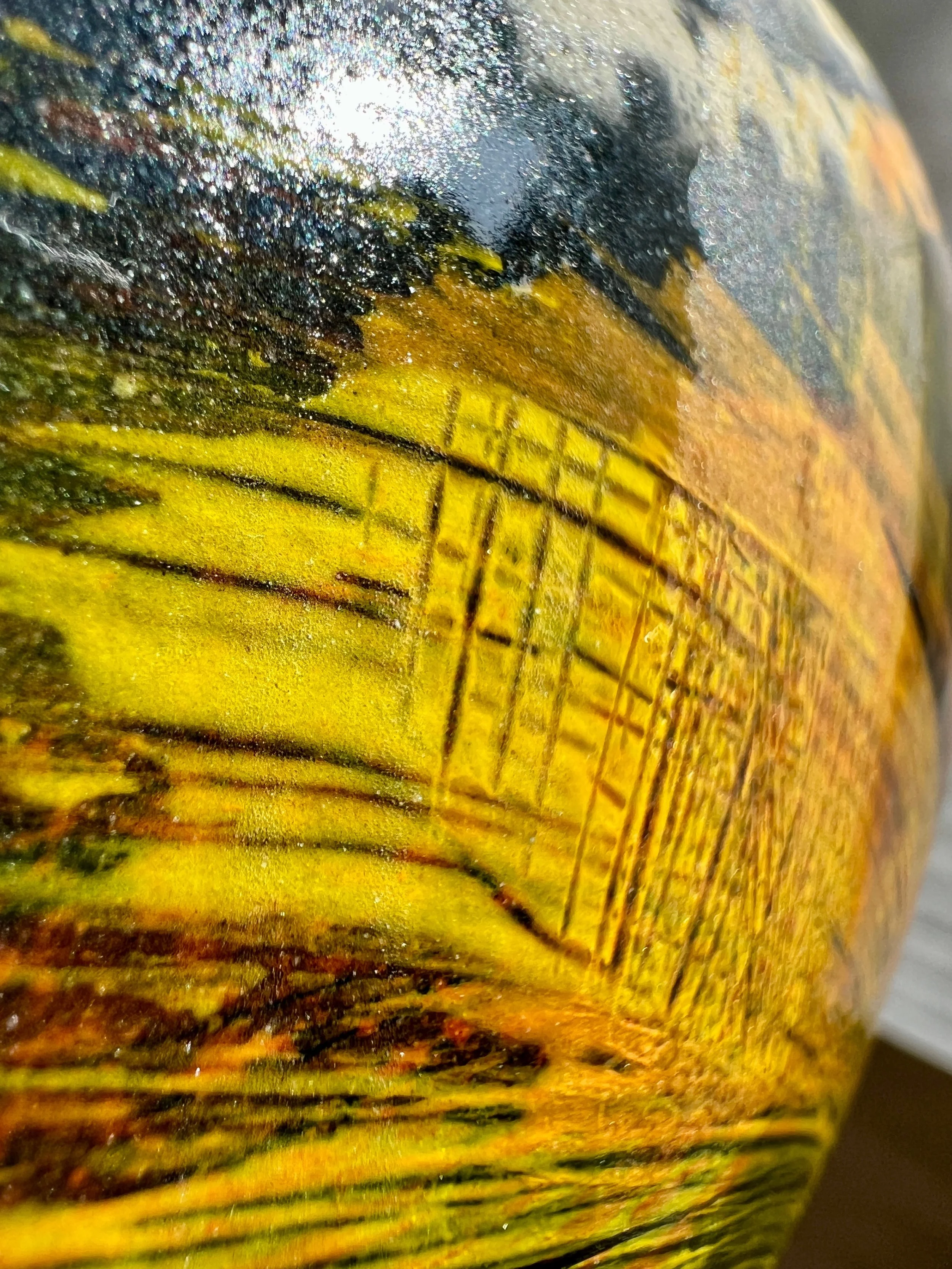
Close up, the surface becomes landscape: scored lines, layered colour, and traces of making.
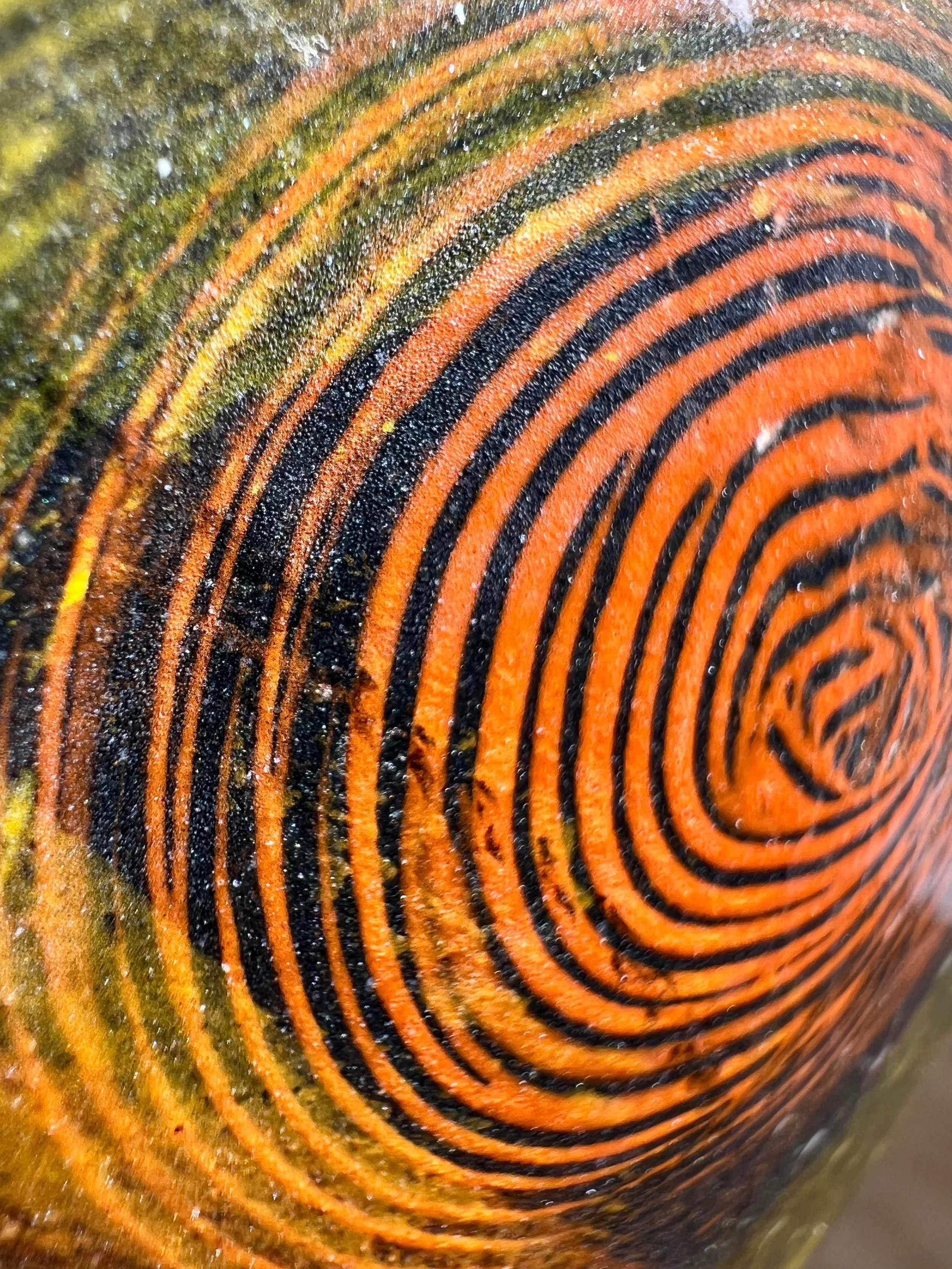
Repetition gathers into movement — almost like a pulse travelling through the clay.
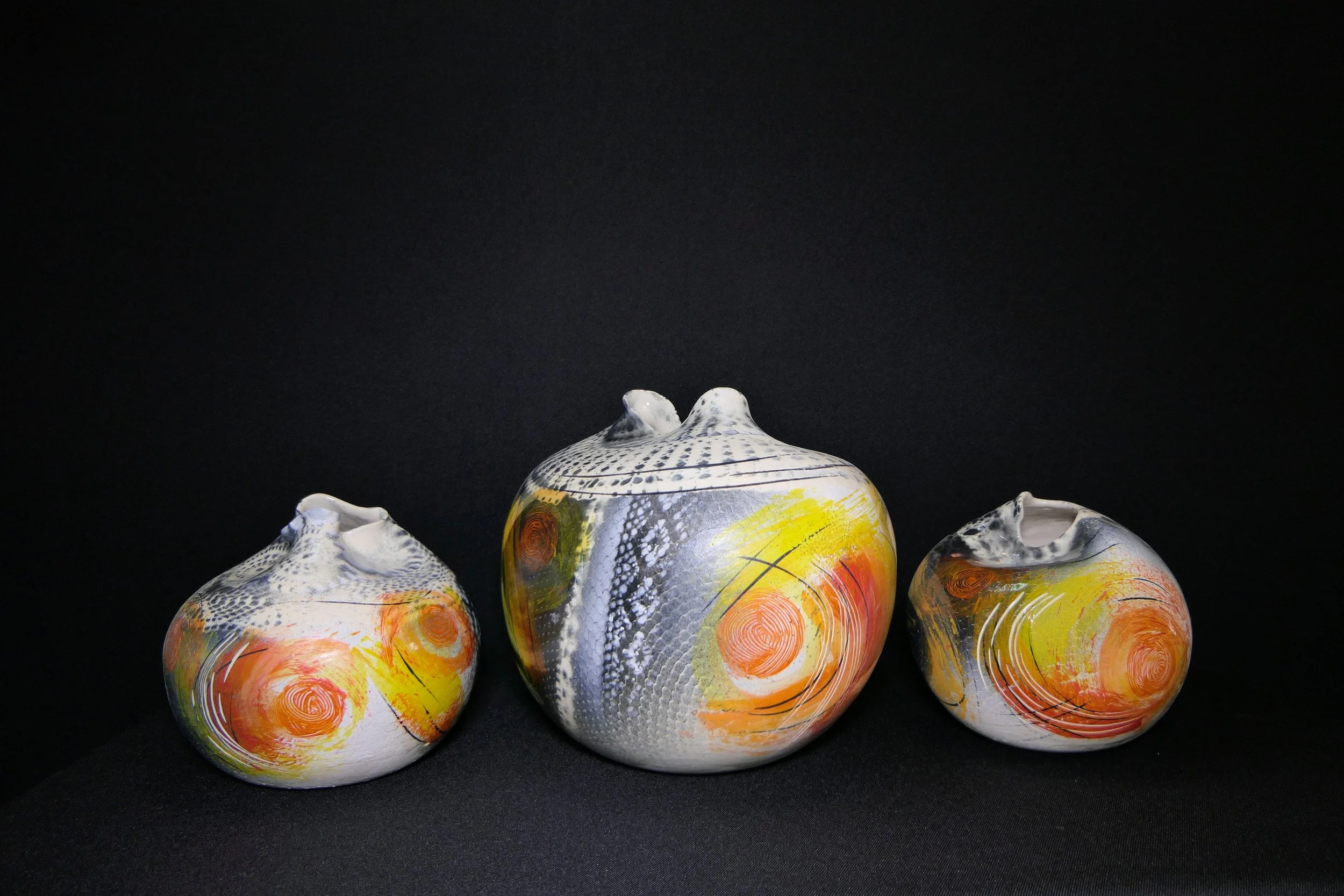
Together, the three vessels hold one visual language, each carrying it differently.
Golden Hour grew from my fascination with what happens when colour, line and gesture are allowed to travel around a form rather than sit neatly on its surface.
Warm yellows and oranges are layered with greys, blacks, scratched lines, circular marks and areas of exposed clay. Some marks were brushed, some carved, some rubbed back, and others emerged through the firing. The vessels share the same surface language, but each form changes the way that language is read.
What interests me most in this group is movement. The eye circles the vessels much as the marks circle the clay. No single view contains the whole piece; the surface reveals itself gradually as the vessel turns.
These were part of my early return to making, before I fully understood how important layered, responsive surfaces would become in my work. Looking back, I can see many of the ideas I continue to explore now beginning here.
RADIANCE · 2025
Coil-thrown stoneware, layered underglaze, resist, crackle glaze and India ink
Individual sculptural vessels · Available
Radiance I — 27 cm H × 20 cm W · 1,539 g — CA$425
Radiance II — 27 cm H × 22 cm W · 1,921 g — CA$450
Radiance III — 25 cm H × 15 cm W · 1,224 g — CA$375
Radiance IV — 11 × 11 cm · 403 g — CA$200
Radiance V — 10 × 11 cm · 306 g — CA$175
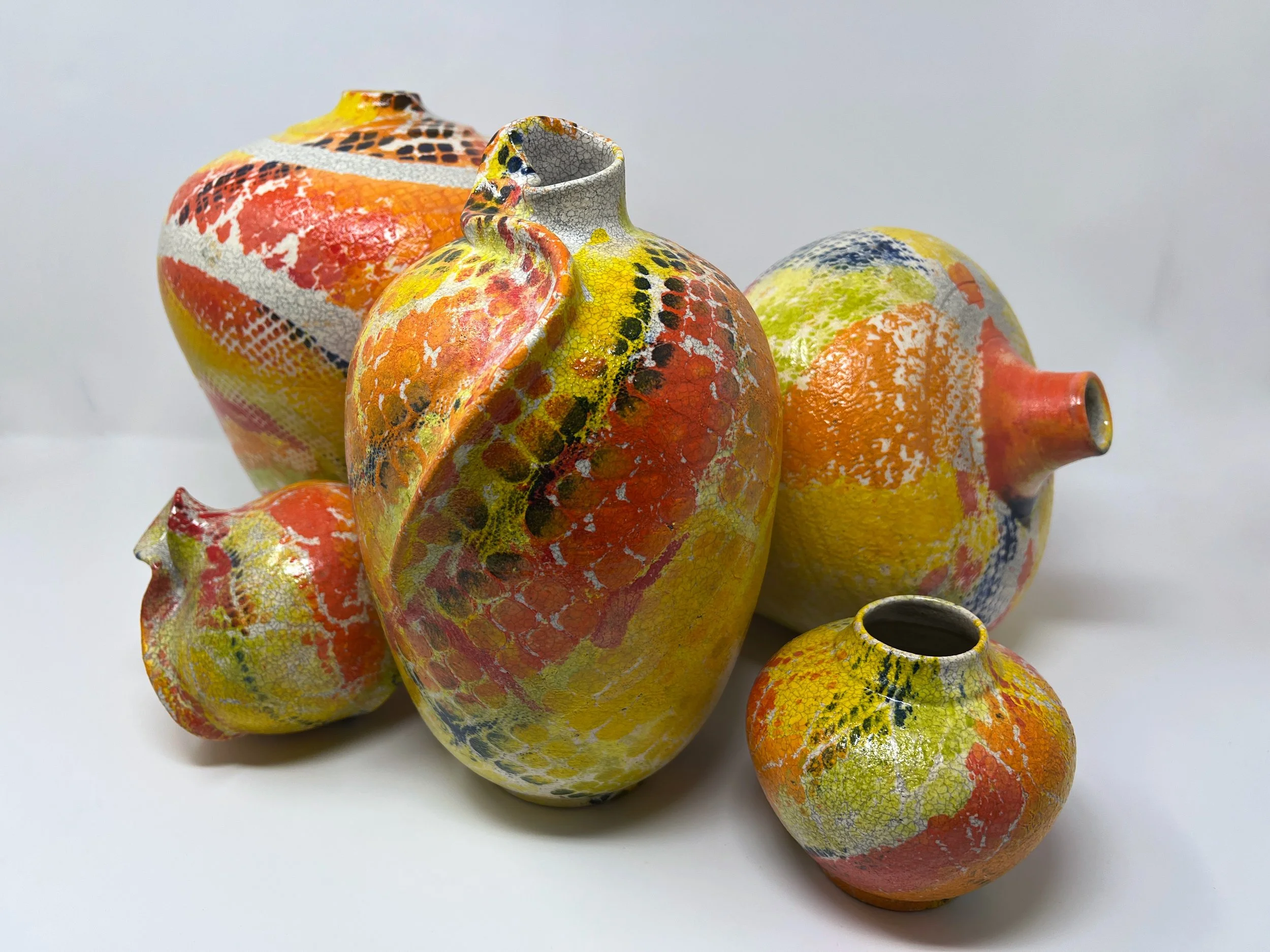
Radiance — Exploring how colour can energize form.
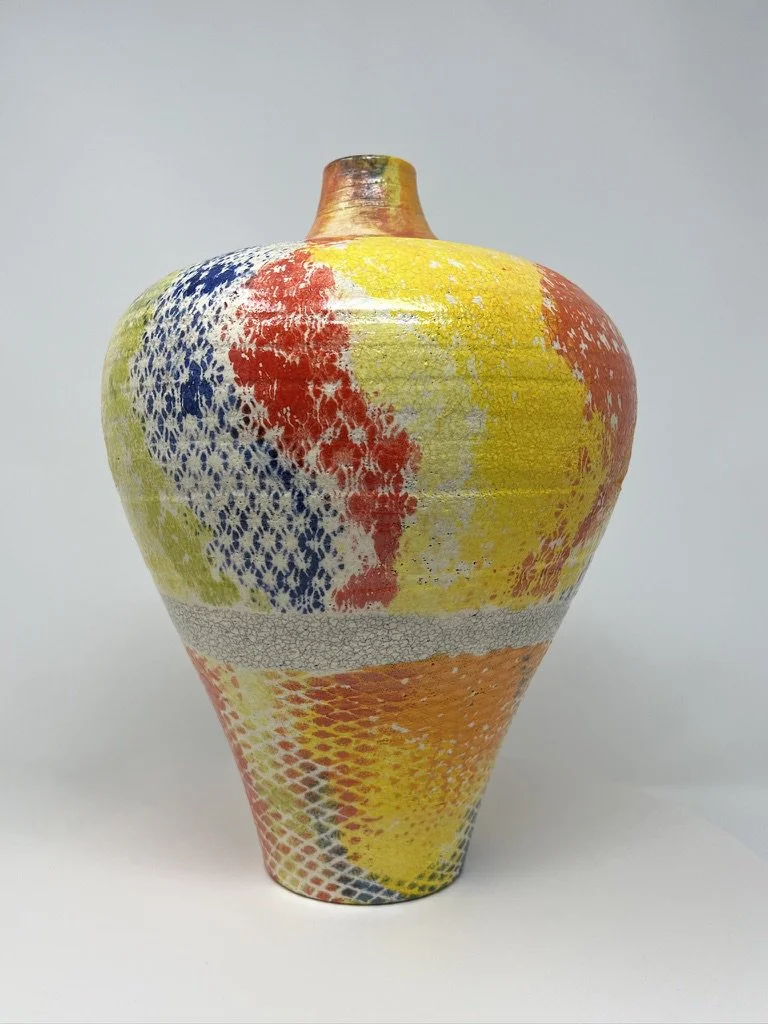
Layer by layer, light, texture, and pattern emerge.
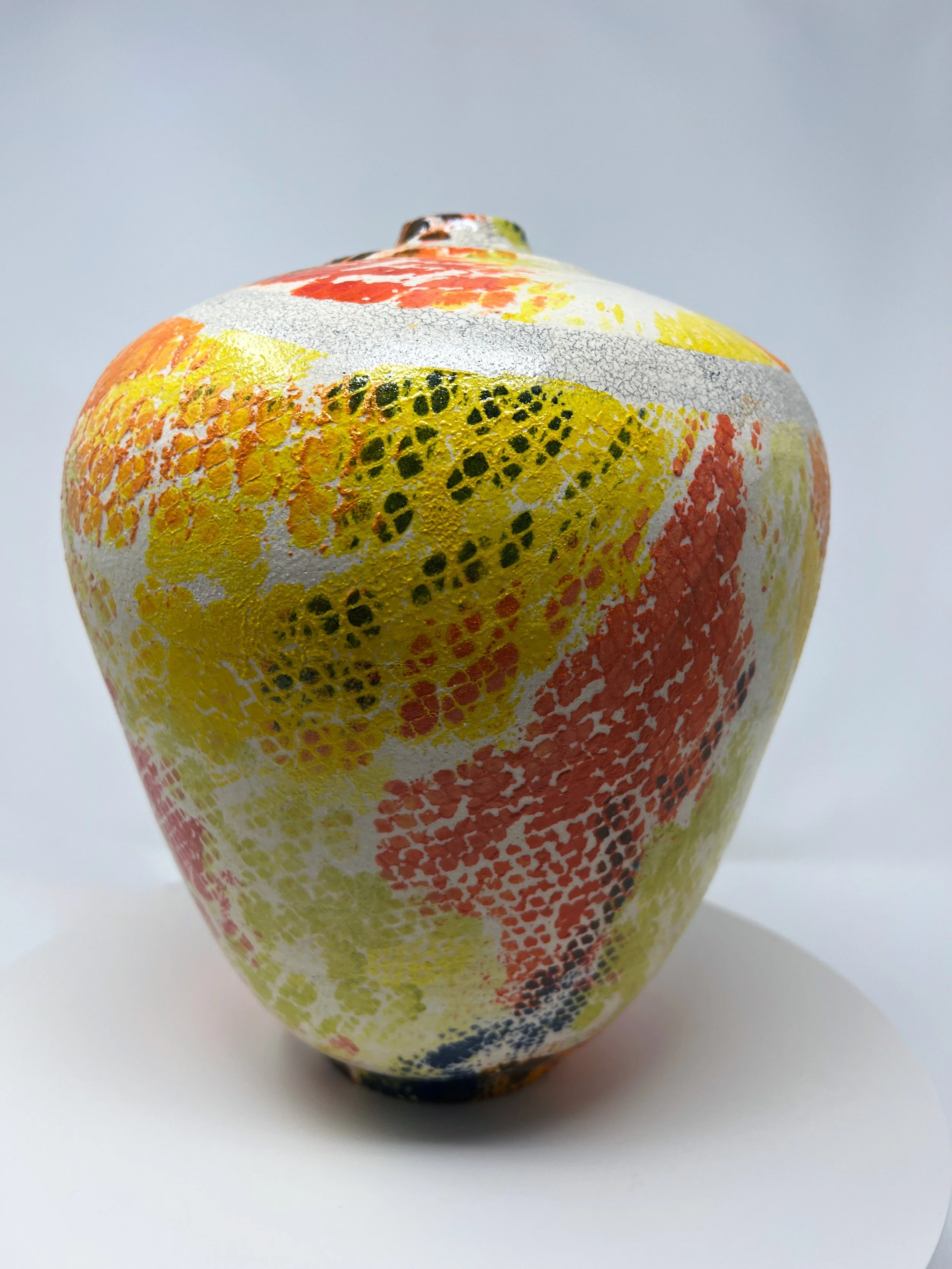
Every turn reveals another layer.
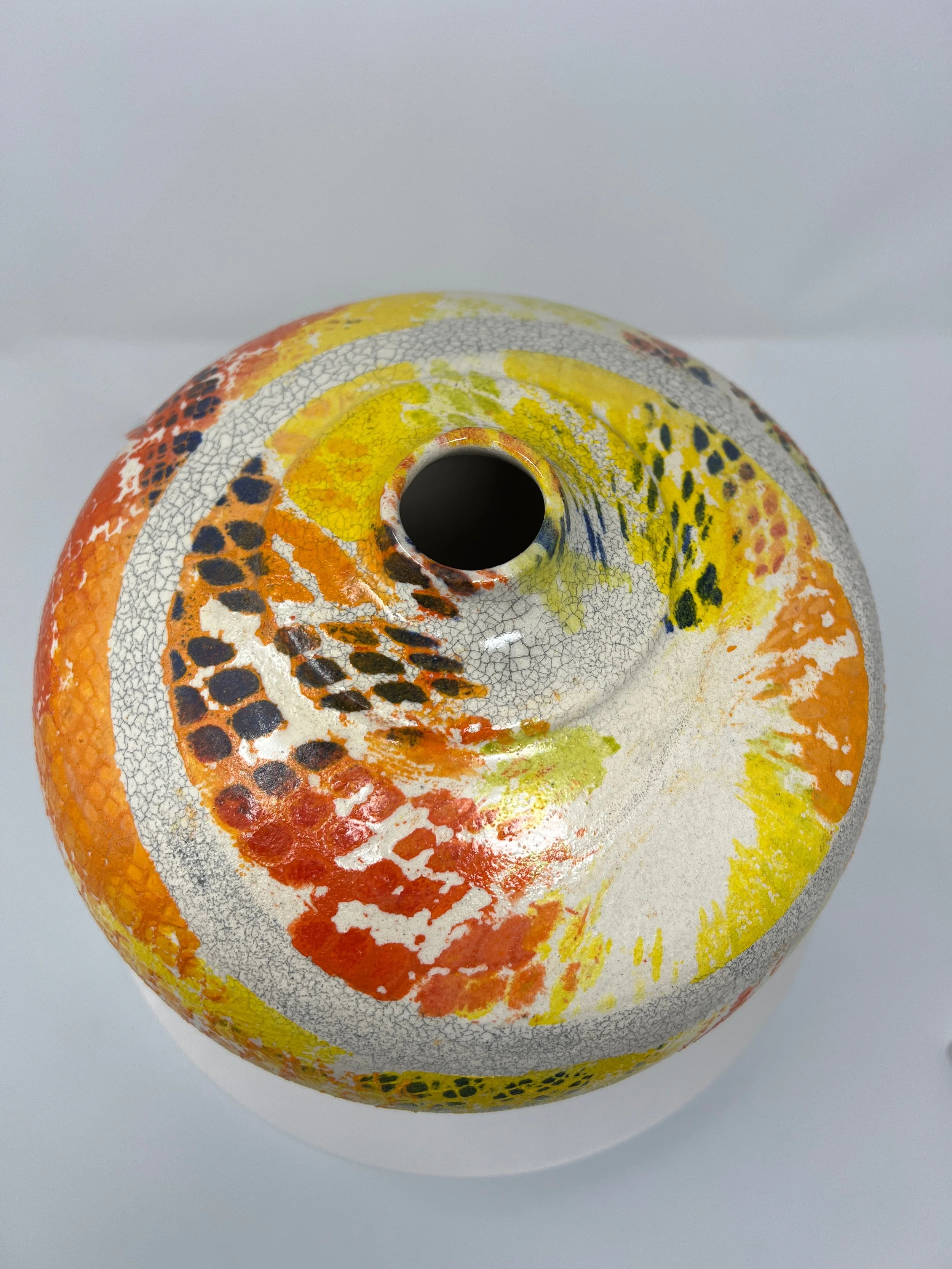
Movement emerges through surface rather than shape.
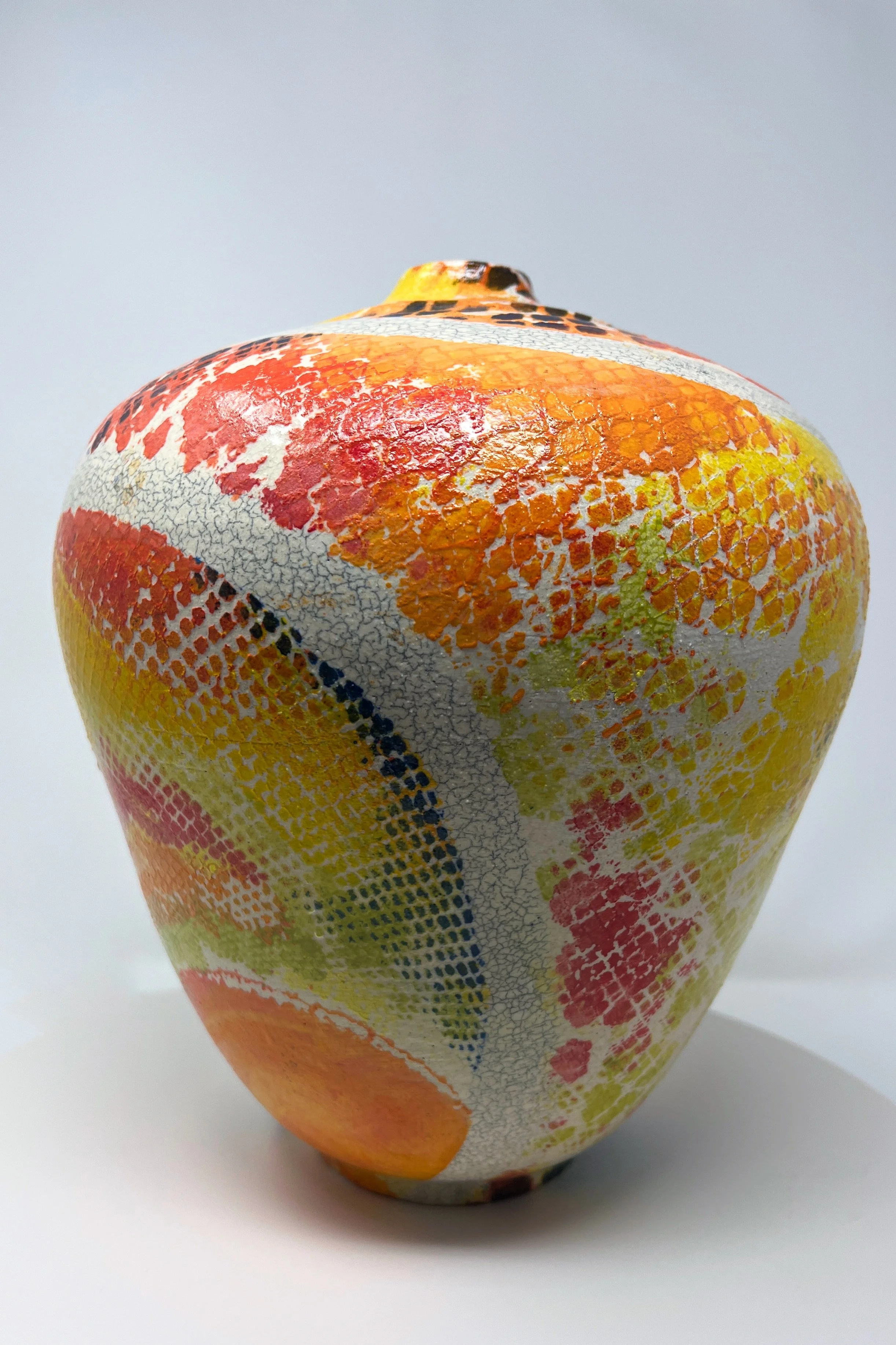
Colour became another way of making marks.
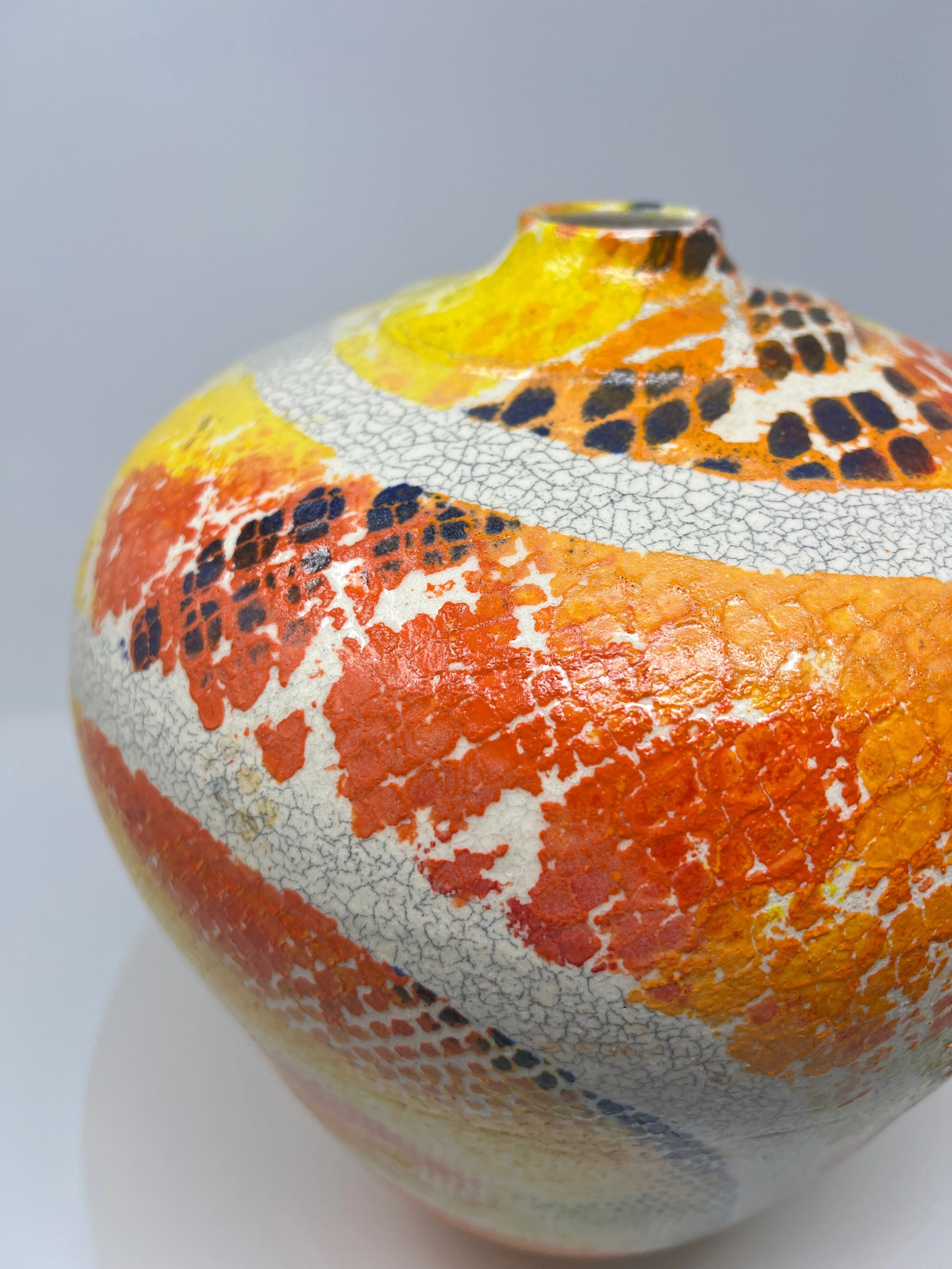
Some vessels seem to hold light. Others seem to become it.
Radiance grew from a period of concentrated experimentation as I learned to coil-throw larger forms and explore how colour and pattern could travel around a vessel.
Warm yellows, oranges and reds were layered with darker marks and areas of exposed clay. Stockings, mesh and found materials became resist tools; sprayed underglaze created broken fields of colour, while crackle glaze and India ink added another layer after firing.
These vessels were initially technical studies rather than concept-driven works. Repetition allowed me to change one thing at a time — proportion, opening, pattern, scale or surface — and discover how dramatically those decisions changed the finished form.
Looking back, I can see the beginnings of a surface language that continues in my work today: layered rather than pristine, responsive rather than predetermined, and willing to let accidents become part of the composition.
The colour was partly inspired by autumn dogwood branches — those brief moments when oranges, reds and yellows seem to hold their own light.
NEW YEAR · 2025
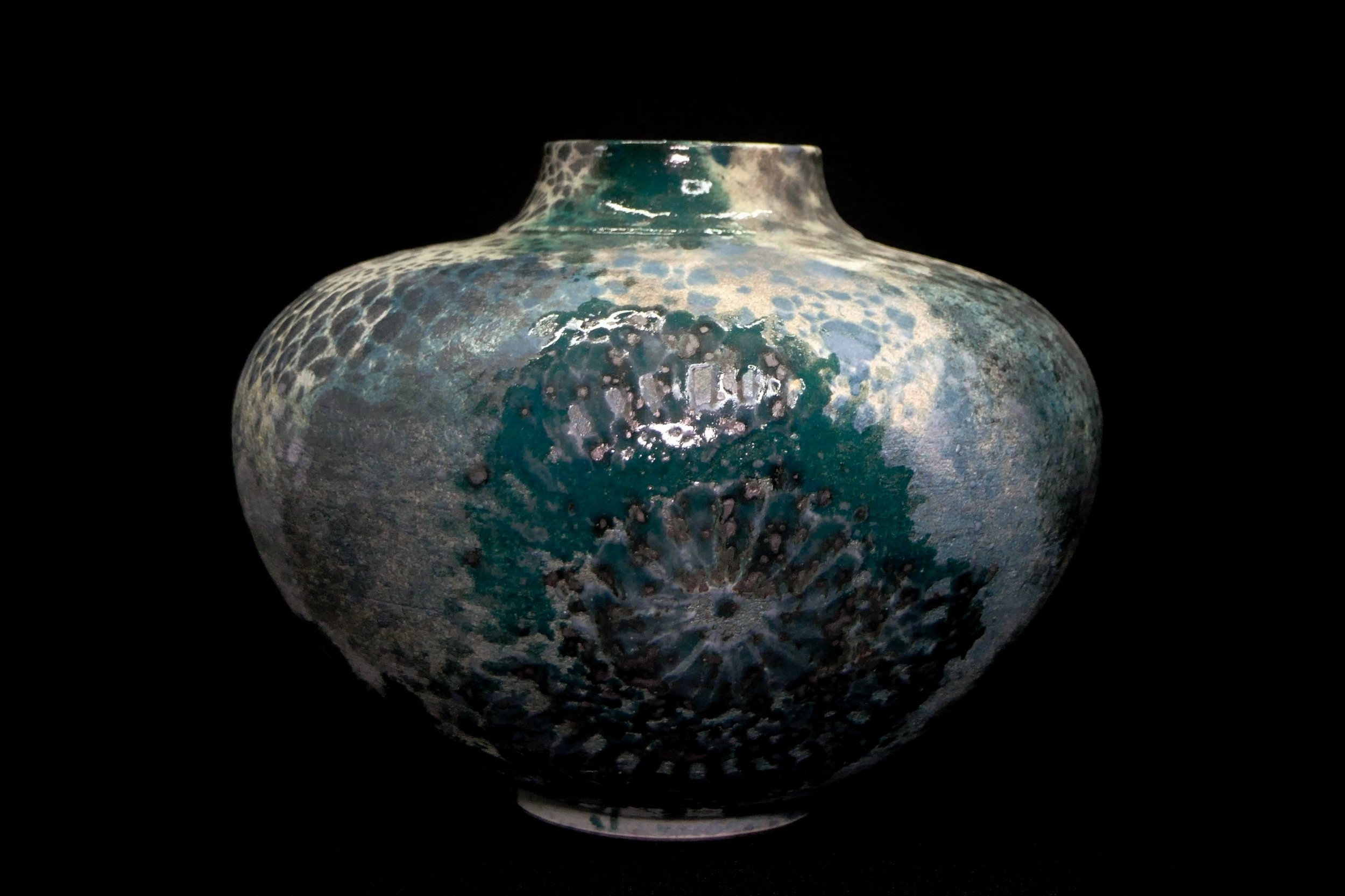
Coil-thrown stoneware; layered commercial glazes with resist techniques
19 × 25 × 25 cm
1,848 g / approximately 4.1 lb
CA$425 · Available
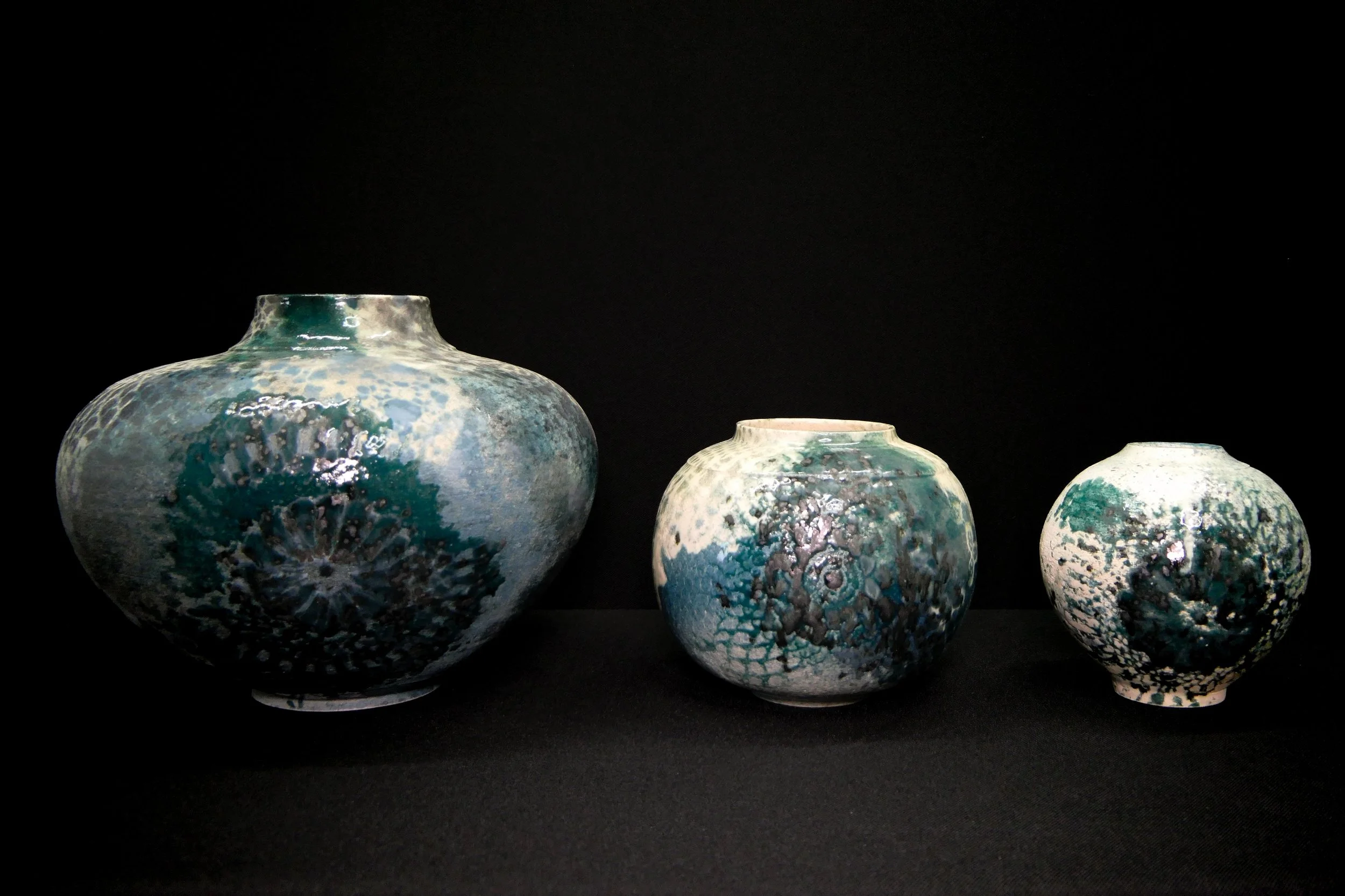
Un-Teal Then — One palette. Three forms. Endless surprises.
The same glaze never tells the same story twice.
Surface, shape, and fire each have a voice.
Curiosity often makes the best collaborator.
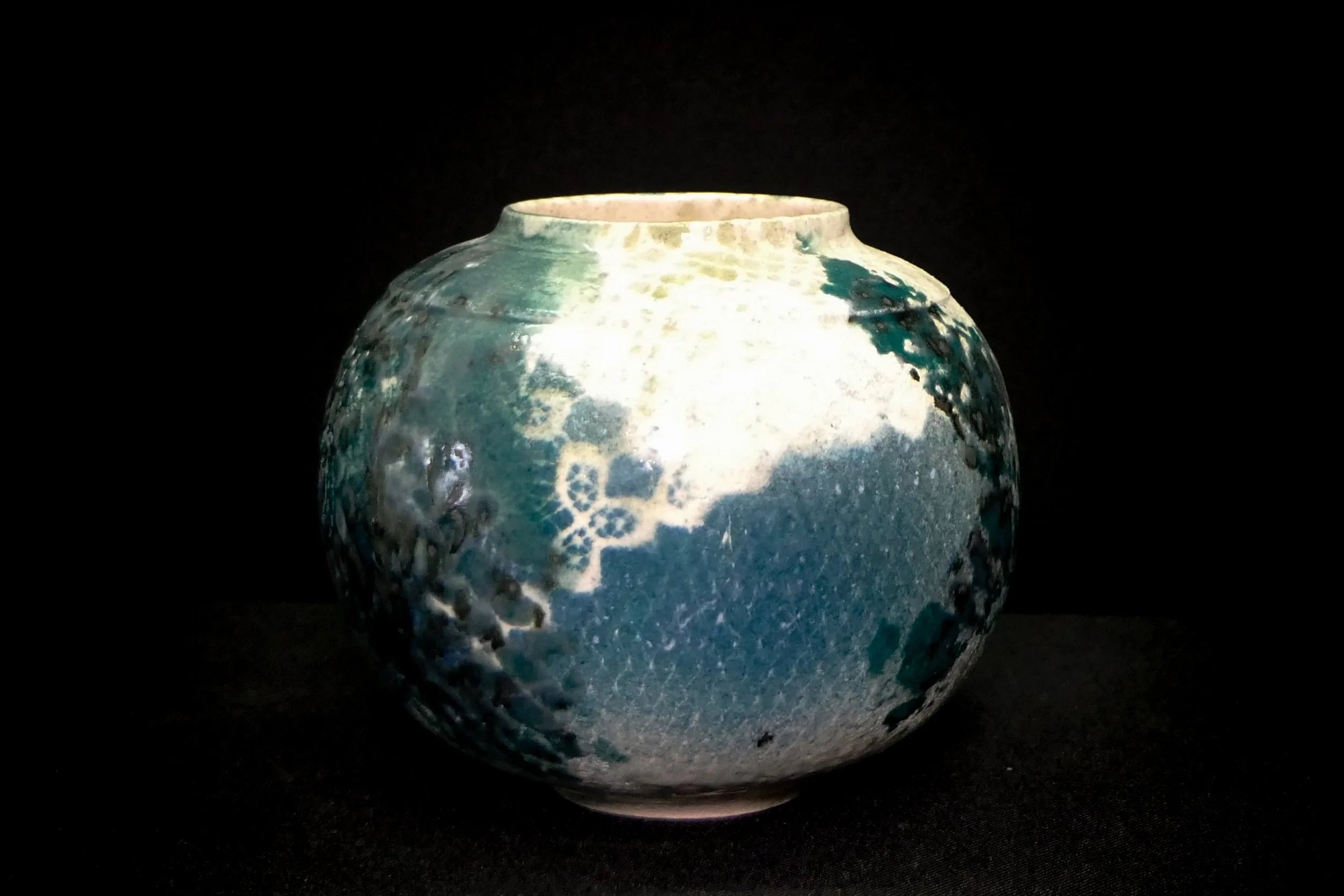
Every vessel reveals something unexpected.
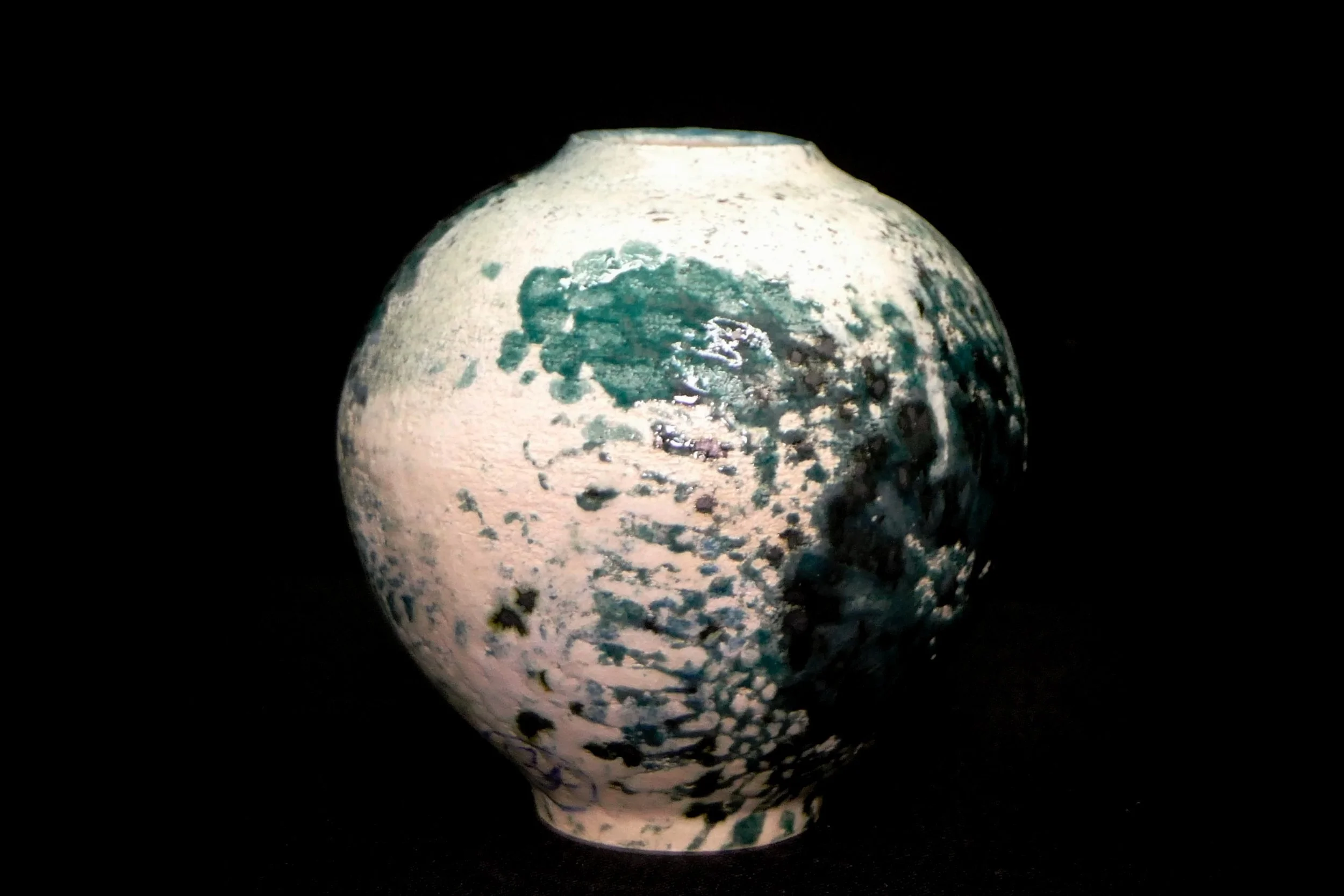
Sometimes the kiln has the final word.
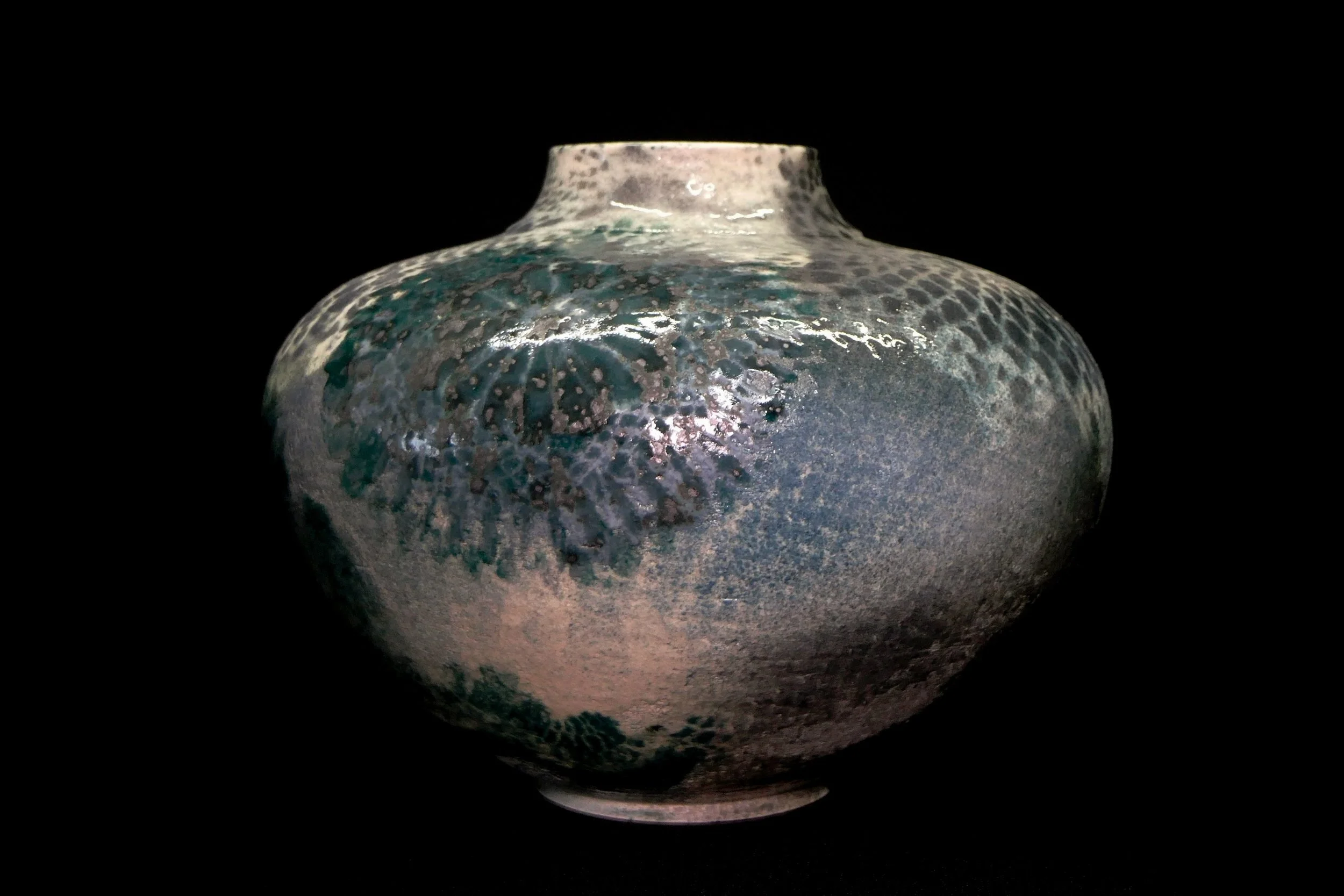
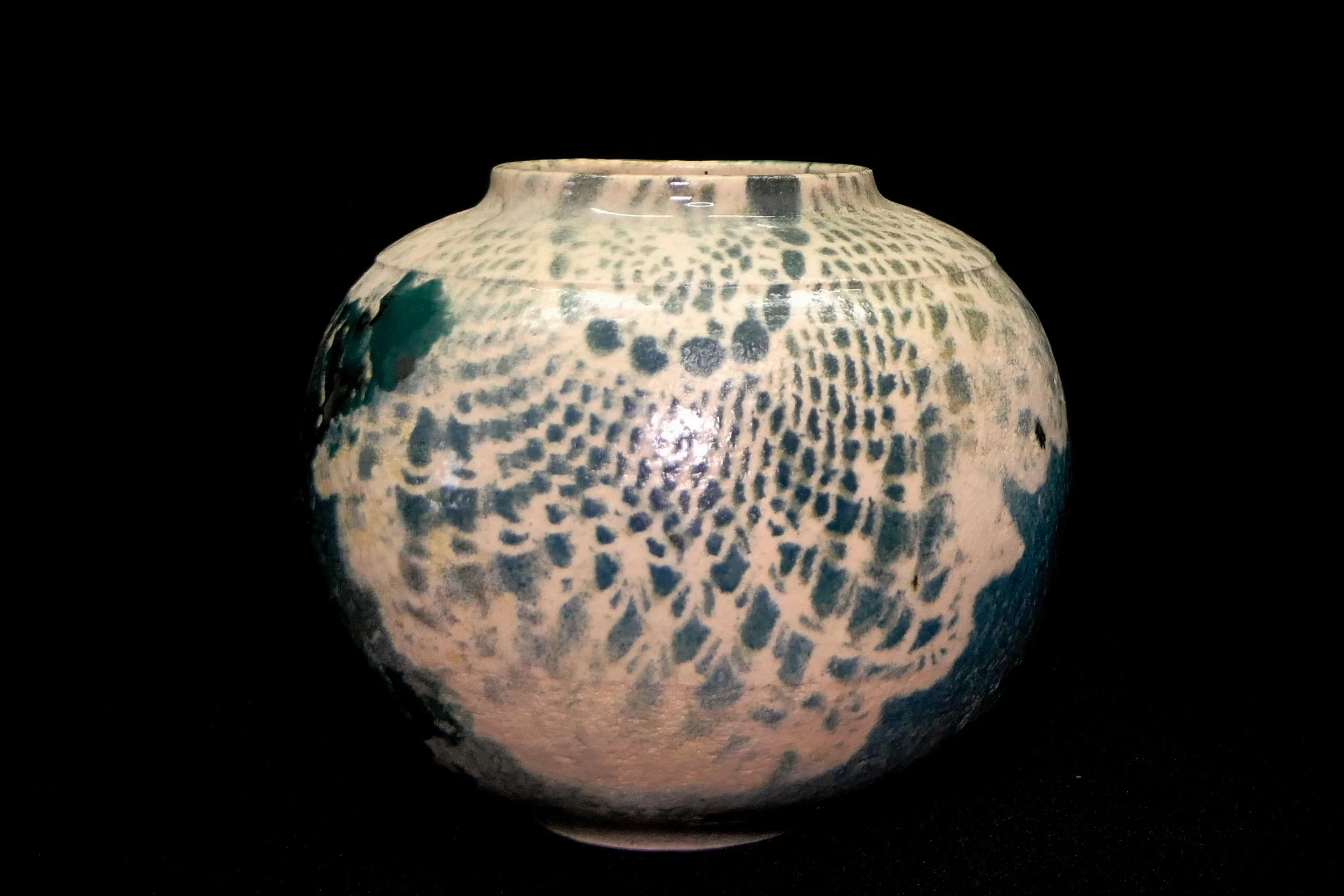
New Year began as one of three vessels made while I was testing how glaze could transform a familiar surface language.
The form was coil-thrown as I continued learning to build thinner, lighter vessels. Across the surface, resist patterns created crisp areas of interruption while layers of commercial glaze pooled, shifted and reacted during firing.
The result was not what I expected. Some areas became heavily glassy and teal; others broke across the clay in quieter greys and creams. At first, I resisted what the kiln had done. Over time, the largest vessel began to separate itself from the two smaller studies.
What remained was a useful reminder that a work does not have to follow the original plan to become resolved. Sometimes the kiln changes the conversation entirely.
New Year carries that moment forward: the point where experimentation stopped being about getting the glaze “right” and became another way of discovering what the material could offer.
Coral Garden · 2025
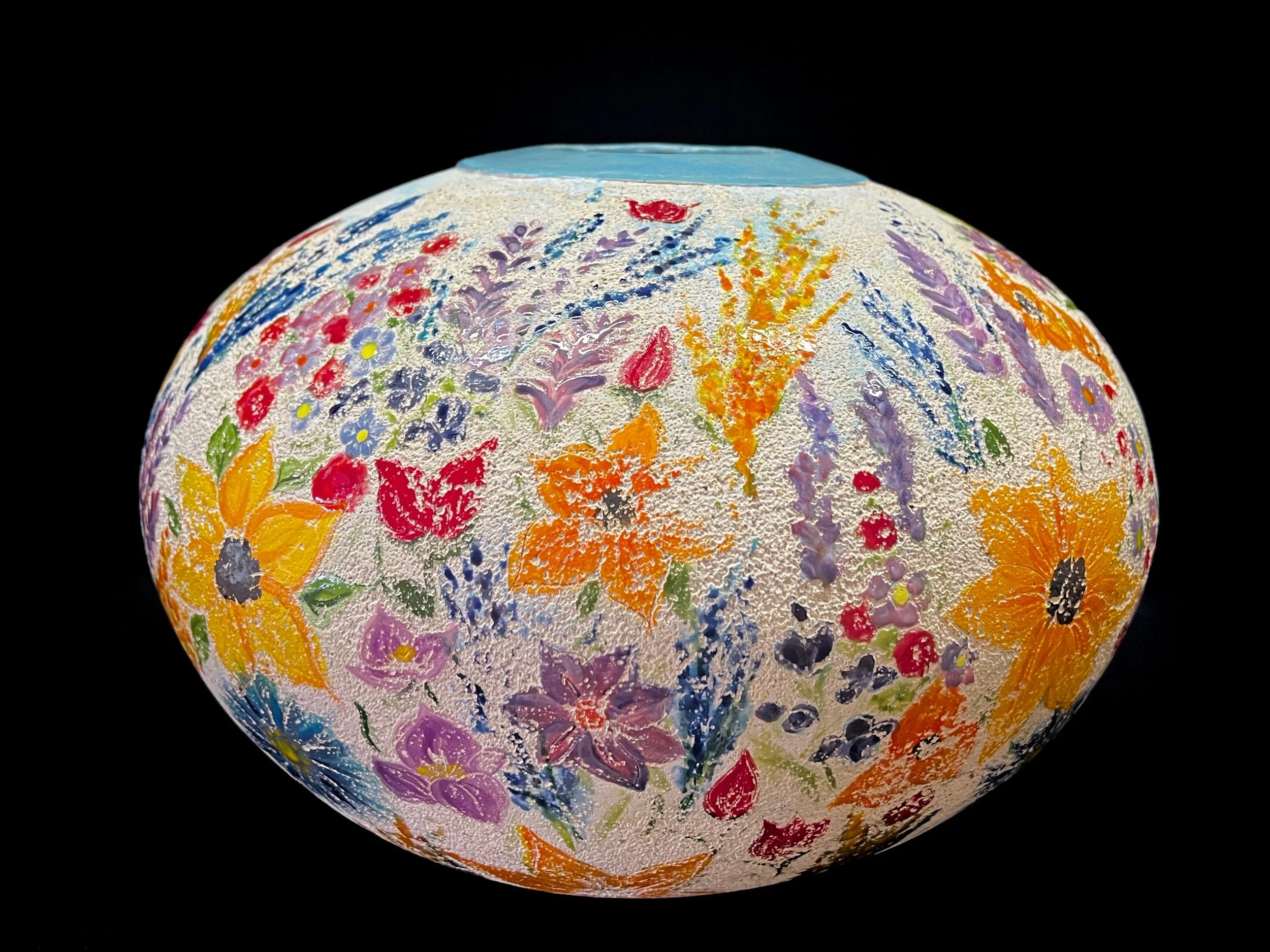
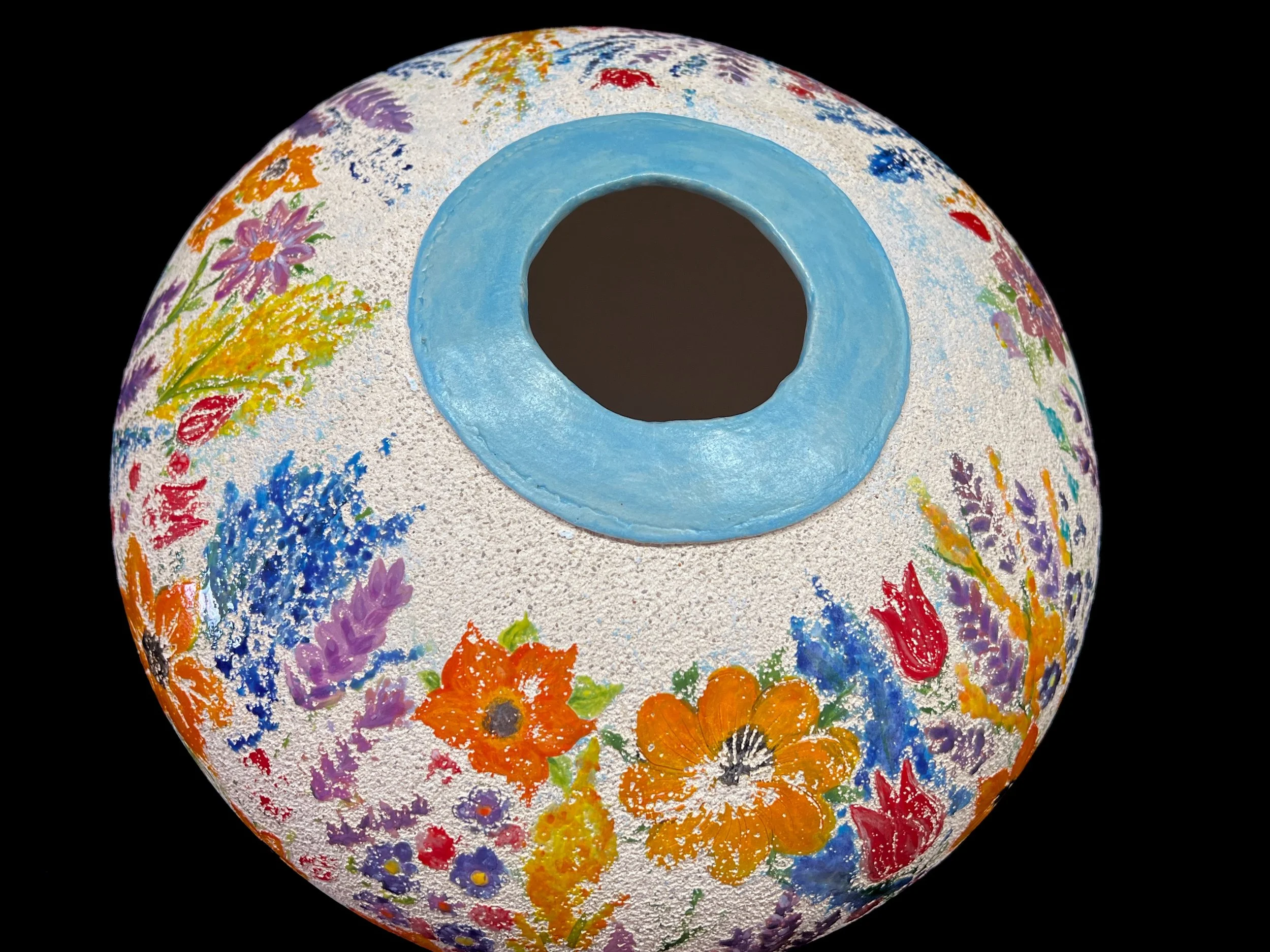
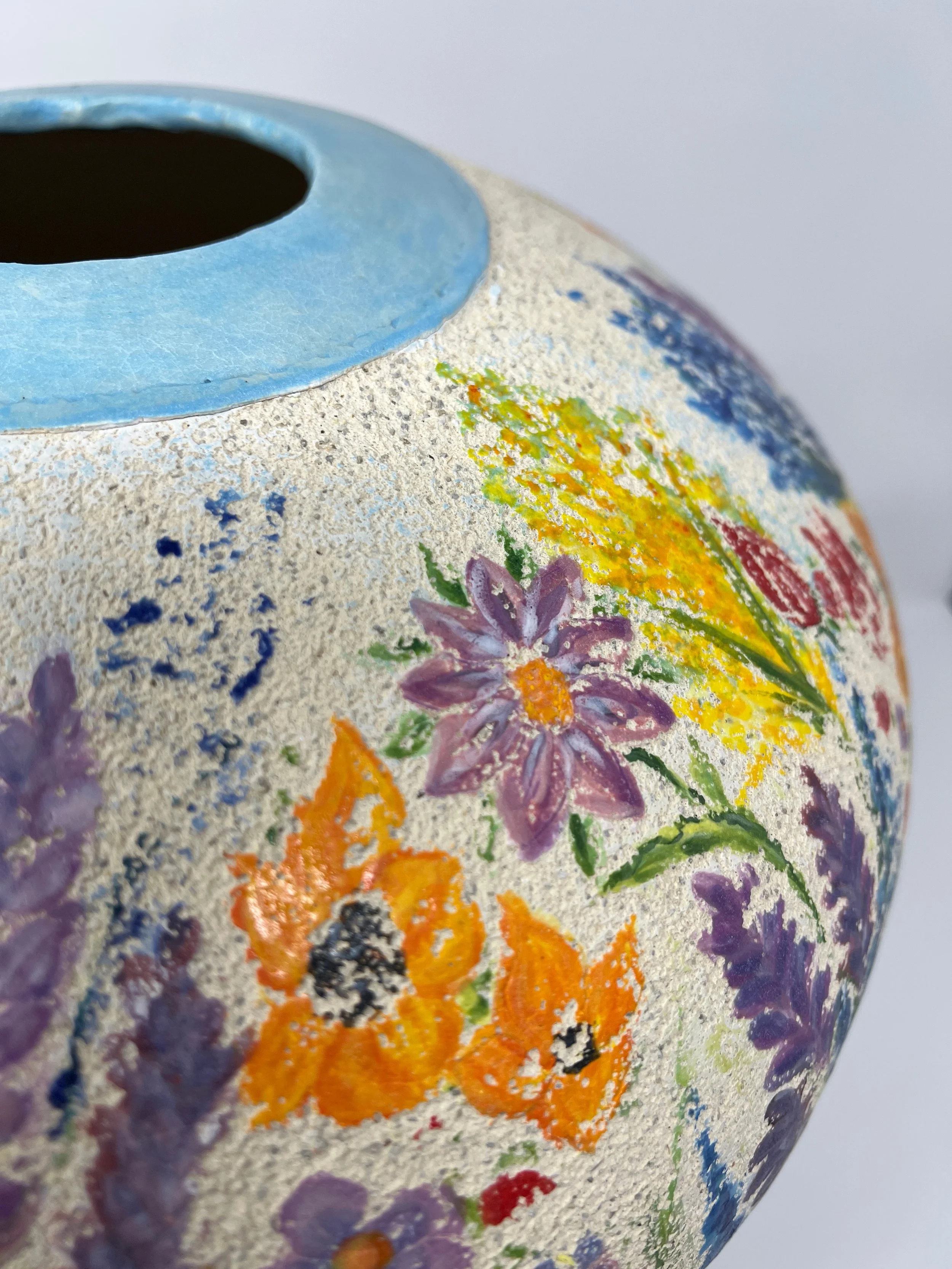
Ceramic vessel, layered underglazes, glaze, sandblasted fired surface
23 × 34 cm · 4,043 g
Archive Study · Not for Sale
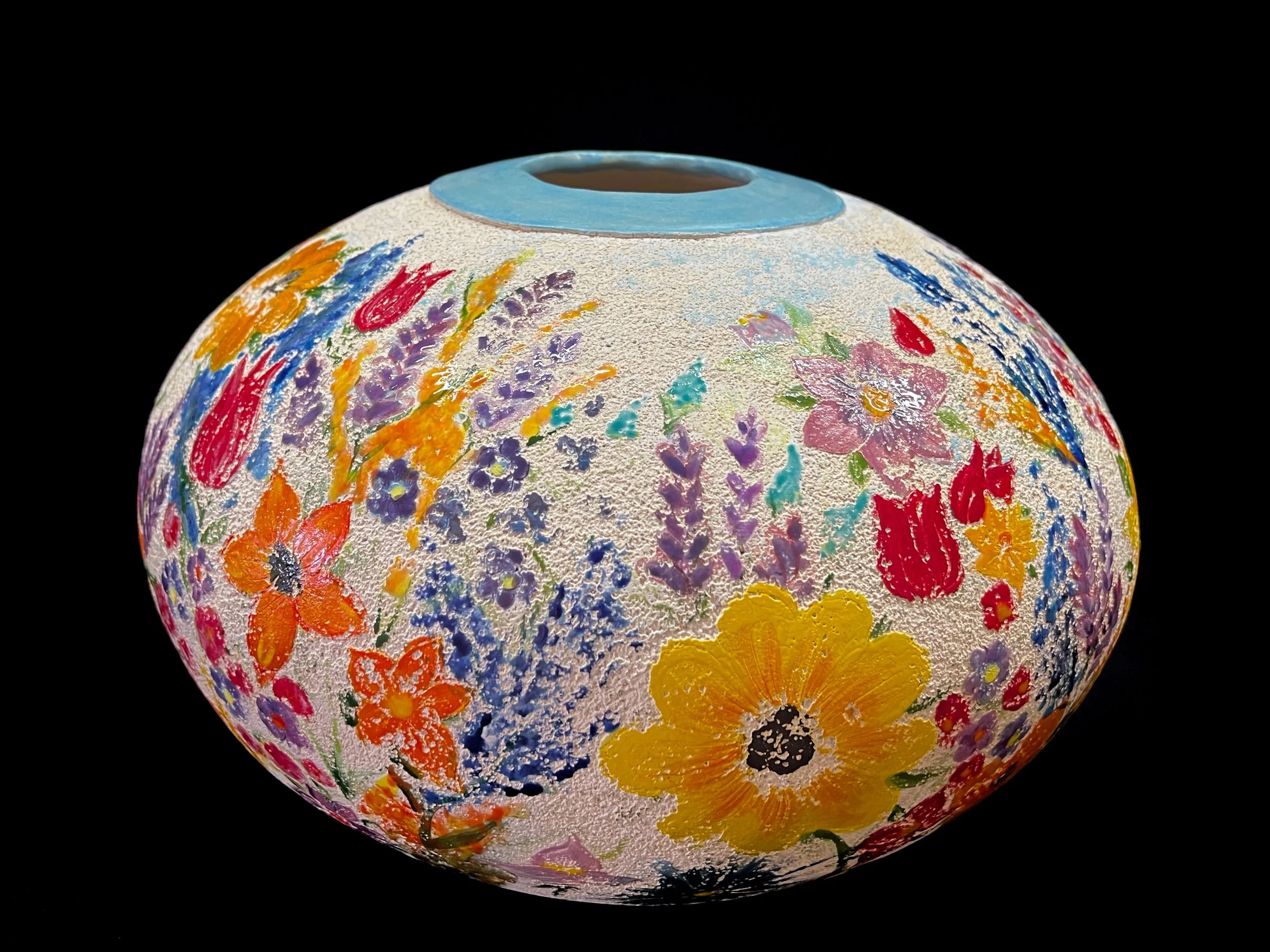
Coral Garden — A world revealed one detail at a time.
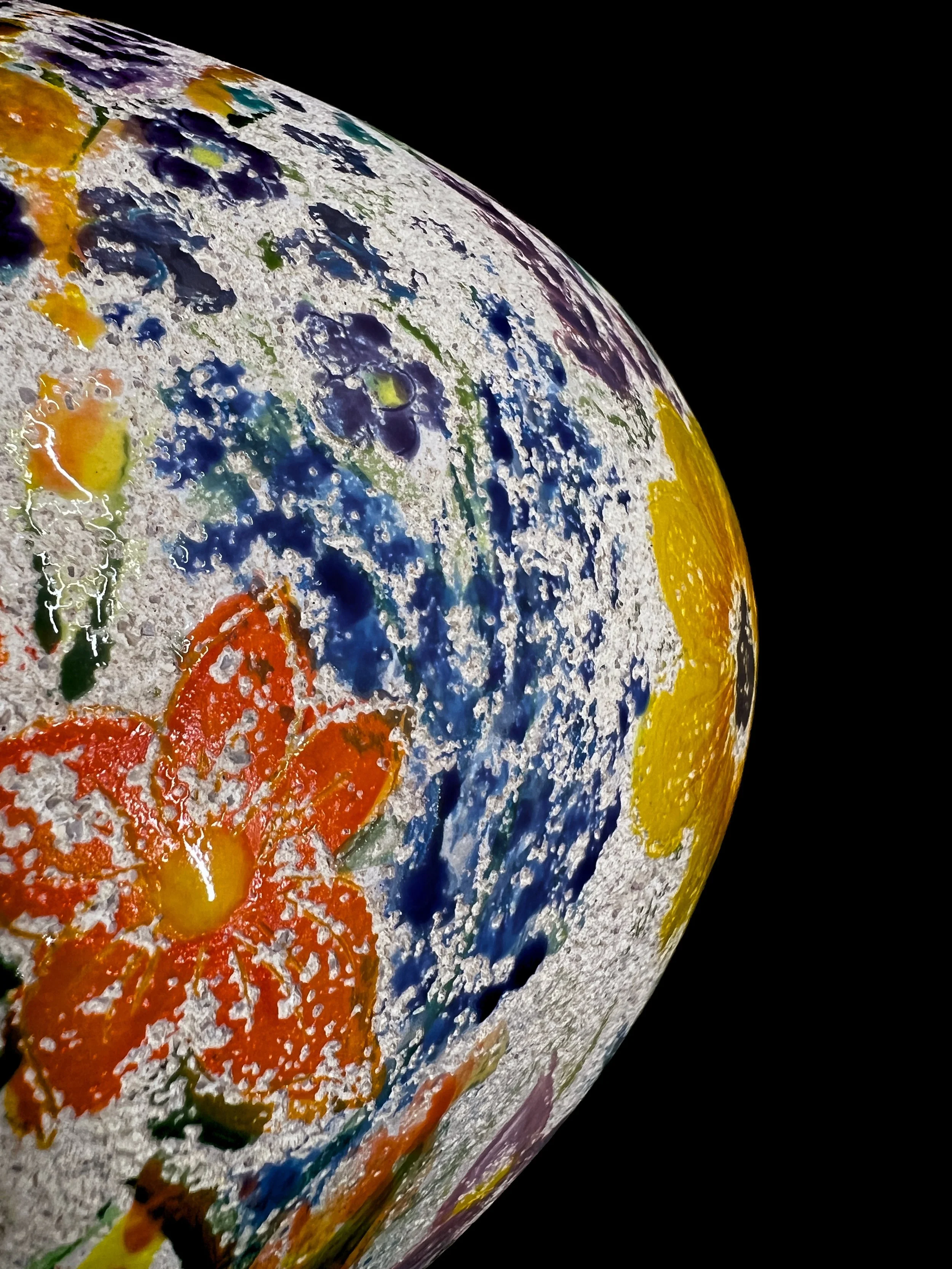
Every turn uncovers another hidden bloom.
Sandblasting allowed the layers to emerge.
Some landscapes are meant to be explored slowly.
The smallest details become part of the whole.
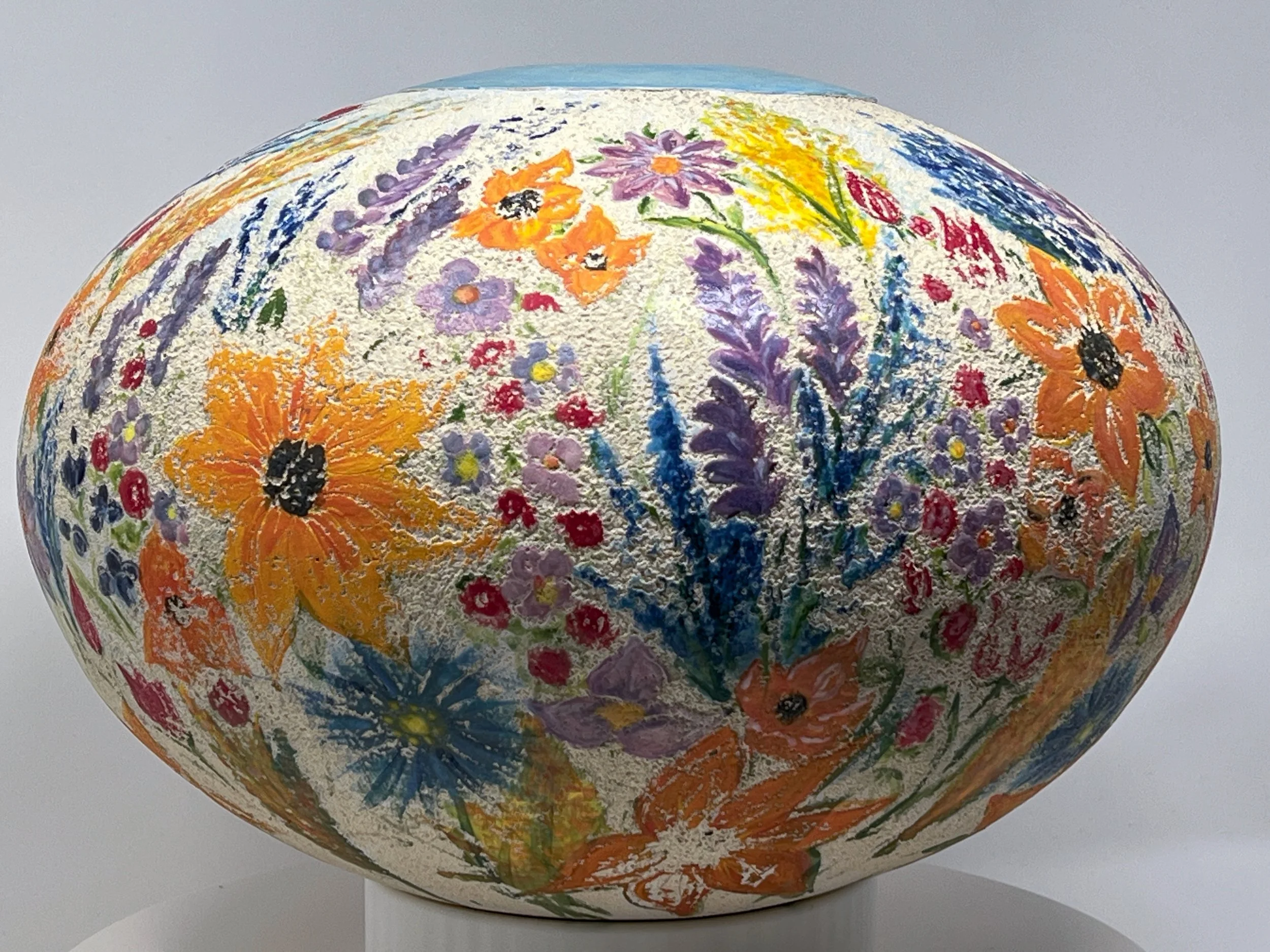
Wonder grows the longer we look.
Coral Garden. This vessel began with a floral surface that never quite resolved. Hours of layered underglaze became flatter and more decorative than I wanted, sitting on the clay rather than feeling integrated with it.
Sandblasting changed everything.
As the fired surface was eroded, glaze resisted differently from the clay beneath it. Fine ceramic material was removed, grog became exposed and raised, and the glaze developed a pitted, weathered surface. What began as an attempt to alter an unsuccessful finish became a much more valuable discovery.
The resulting texture feels closer to coral, stone and erosion than painted decoration. It taught me that removing part of a finished surface can sometimes reveal something far more interesting underneath.
Process Note
The most important discovery from this piece was selective sandblasting: using erosion deliberately to expose aggregate, interrupt glaze and create texture rather than simply decorating the surface.
Permission to Play Studies · 2026
Studio studies · Not for sale
Slab-built and coil-thrown stoneware, layered underglaze, clear glaze
Large: 24.5 × 26.5 cm · 2,219 g
Medium: 25.5 × 21.5 cm · 1,779 g
Small: 21.5 × 20 cm · 1,458 g
Goblet 1: 16 × 15 cm · 700 g
Goblet 2: 15.5 × 13 cm · 671 g
Goblet 3: 15 × 12.5 cm · 488 g
Goblet 4: 16 × 13 cm · 593 g
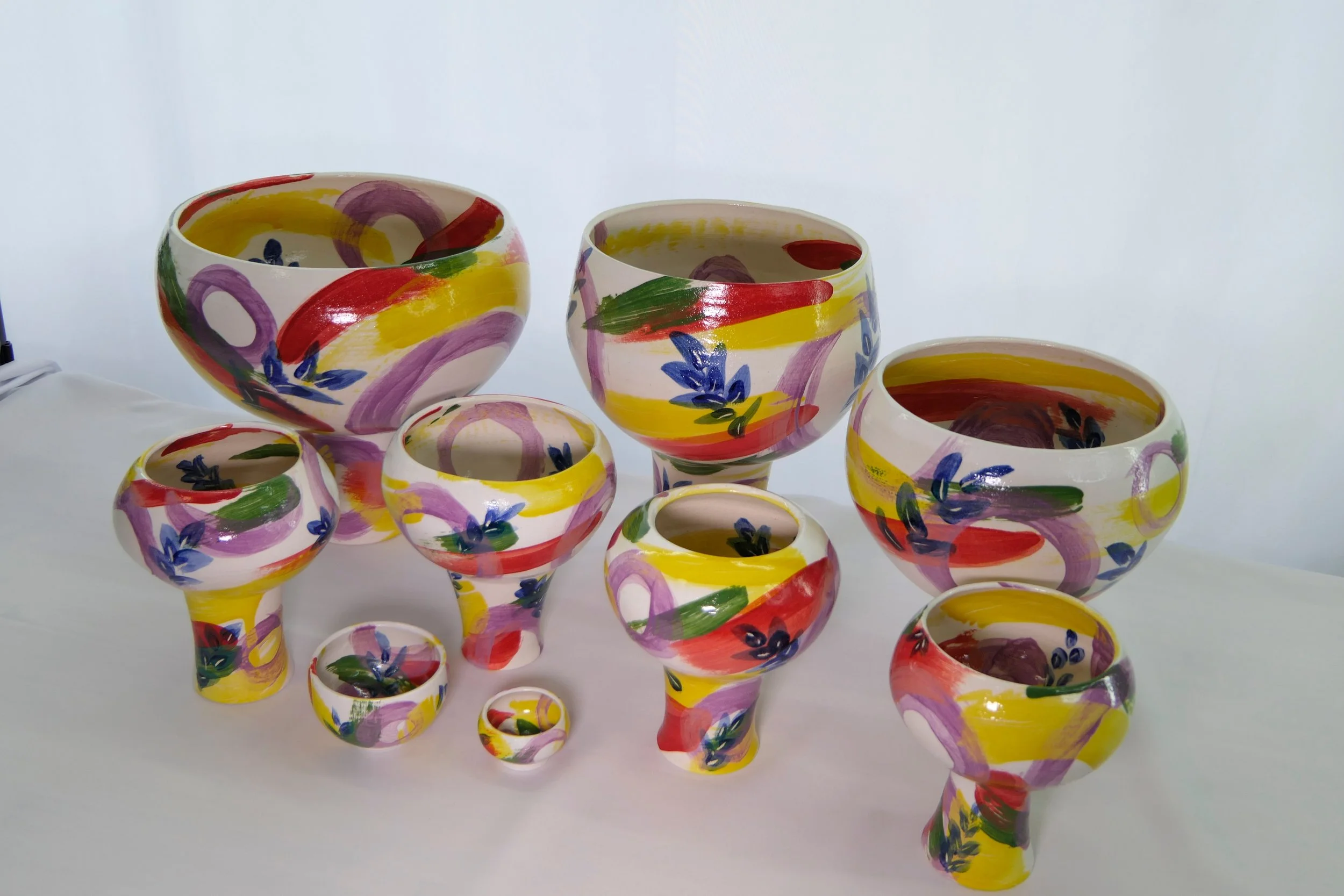
Remembering Play — Inspired by the fearless colour of childhood.
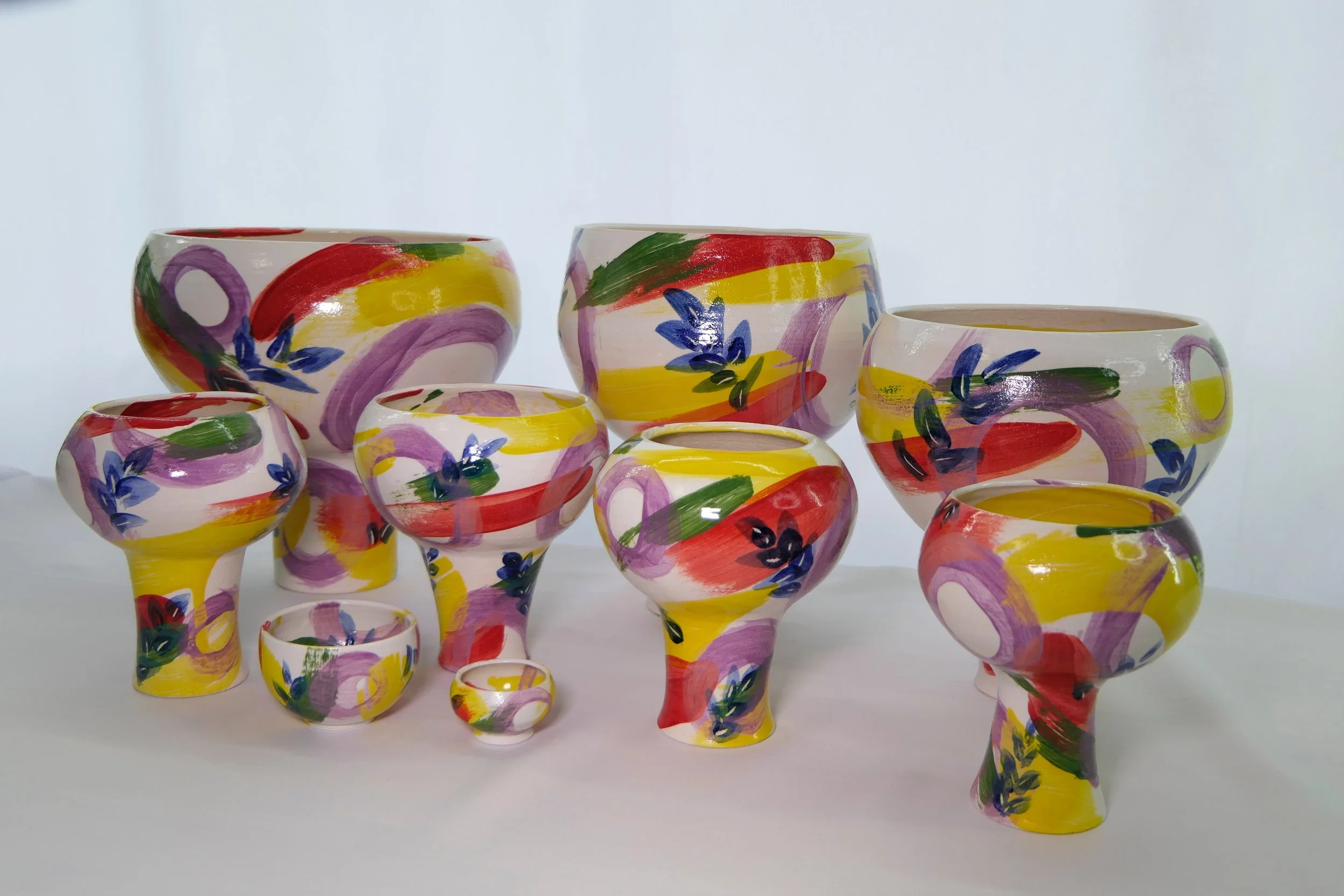
A simple palette became an invitation rather than a limitation.
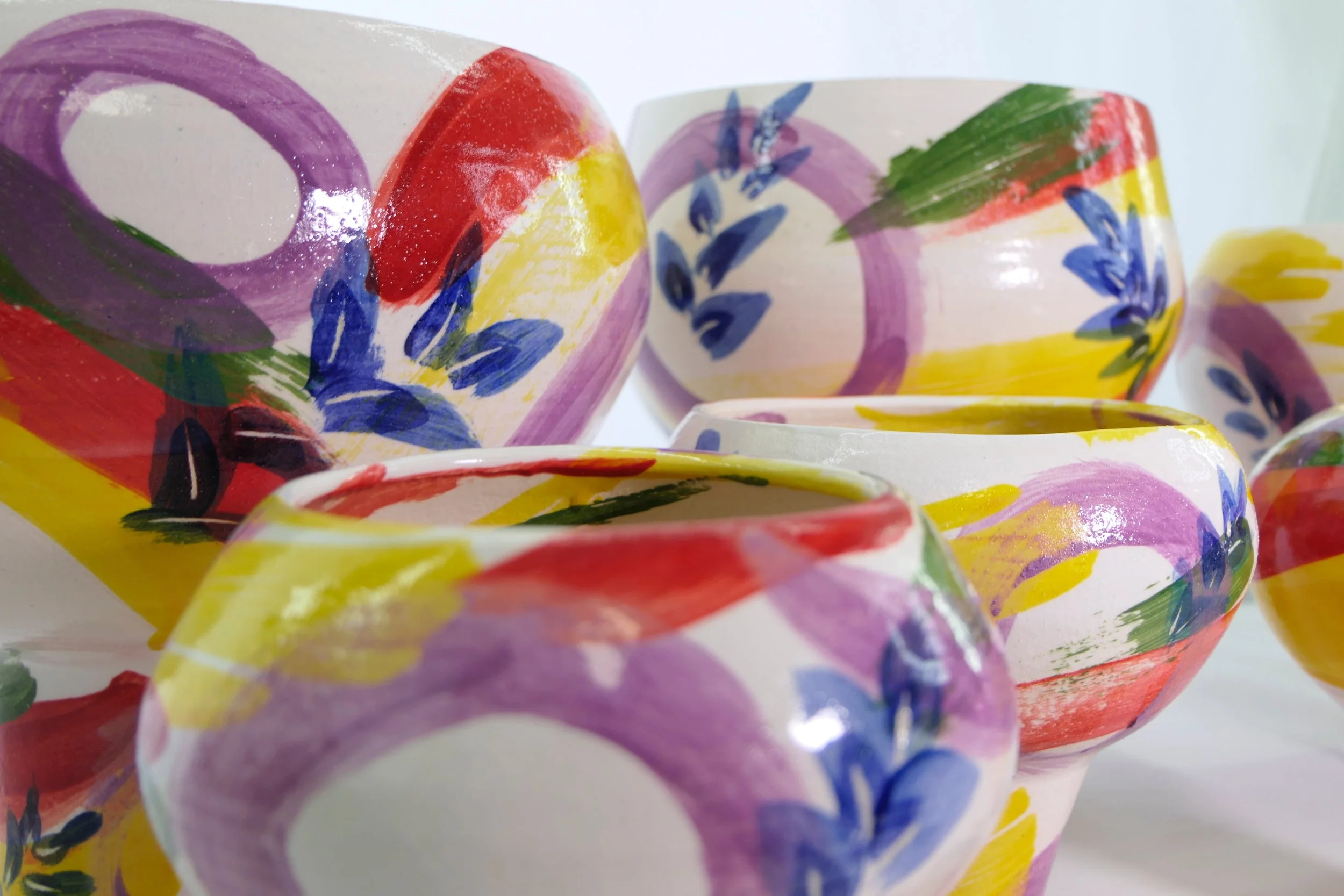
Every mark was made before the next one was decided.
Permission to Play Studies. These related studies grew from the same experiment in colour, repetition and sectional construction that led to Permission to Play.
Working repeatedly with the same bright palette allowed me to explore how scale, proportion and altered form changed the character of the surface. Some stacked, some nested, some behaved almost like oversized goblets. Together they became a small laboratory for learning how repeated visual language can move across very different forms.
Their greatest value was not in becoming a permanent series, but in what they taught me: how to construct in sections, how repetition can reveal differences, and how play can be useful without needing to become a long-term direction.