
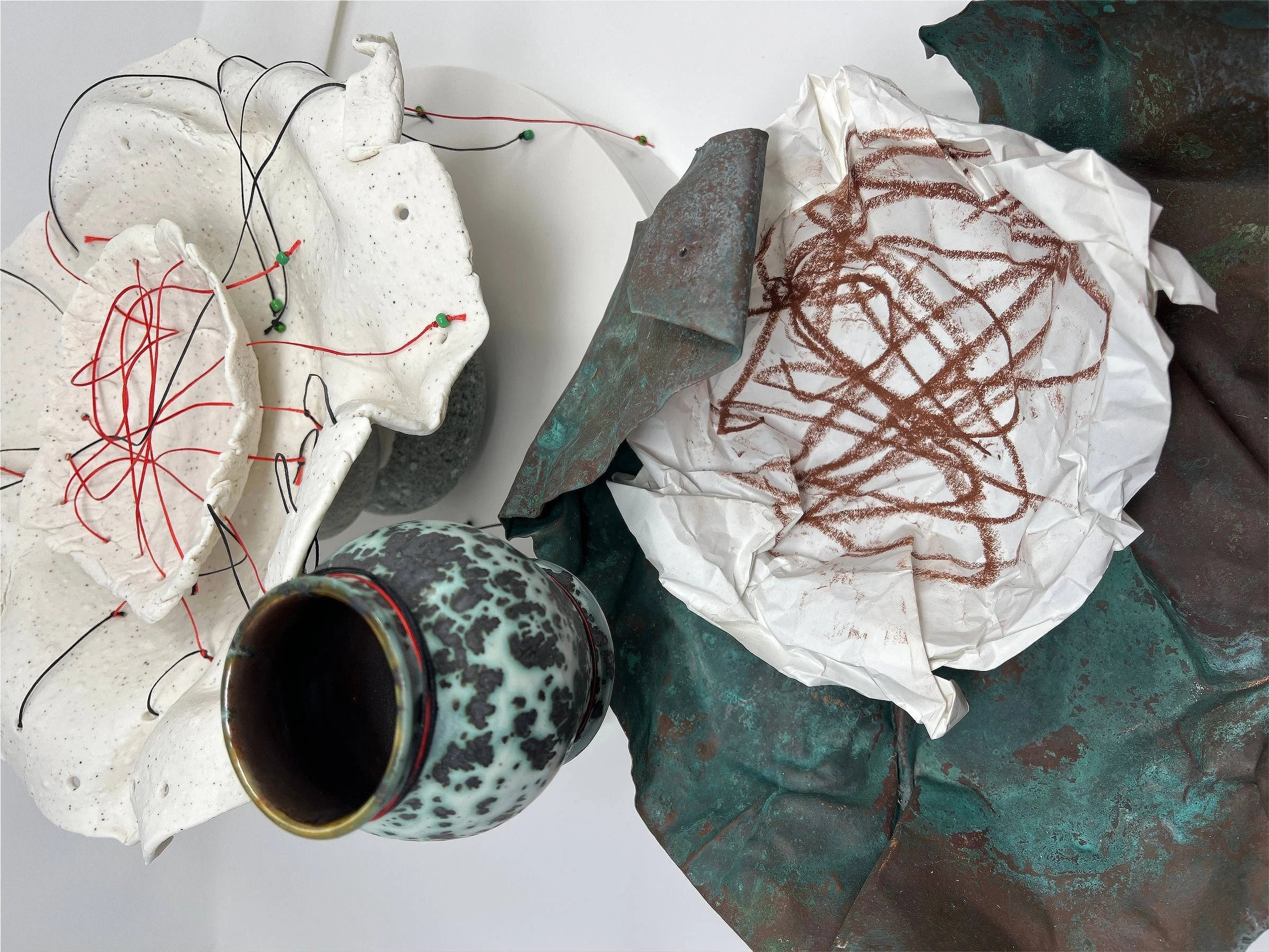
Form & Feeling
Please note:
Some works in this collection explore experiences of trauma, loss, abuse and healing. If you would prefer something quieter today, you may wish to visit Rhythm & Stillness, where the work turns toward balance, contemplation and renewal.
Form & Feeling
A collection exploring emotional landscapes through sculptural vessel forms—where containment, tension, vulnerability and resilience are given physical presence.
Clay remembers every touch. In these works, form becomes a language for experiences that are often difficult to articulate—holding, protecting, resisting, opening and repairing. Rather than illustrating emotion, each vessel allows it to be encountered through shape, balance, texture and space.
Some pieces feel grounded and quiet. Others lean, twist, fracture or appear almost unstable. Voids, apertures, layered surfaces and unexpected forms become ways of exploring vulnerability, protection, absence, weight and strength.
Together, these works reflect an ongoing question within my practice: how can form give shape to feeling?
Moment by Moment · 2025
Coil-built stoneware, ceramic glaze, ink and cold-finish wax
10 × 14 × 12 in
(approximately 25.4 × 35.6 × 30.5 cm)
7.1 lb / approximately 3.2 kg
CA$650 · Available
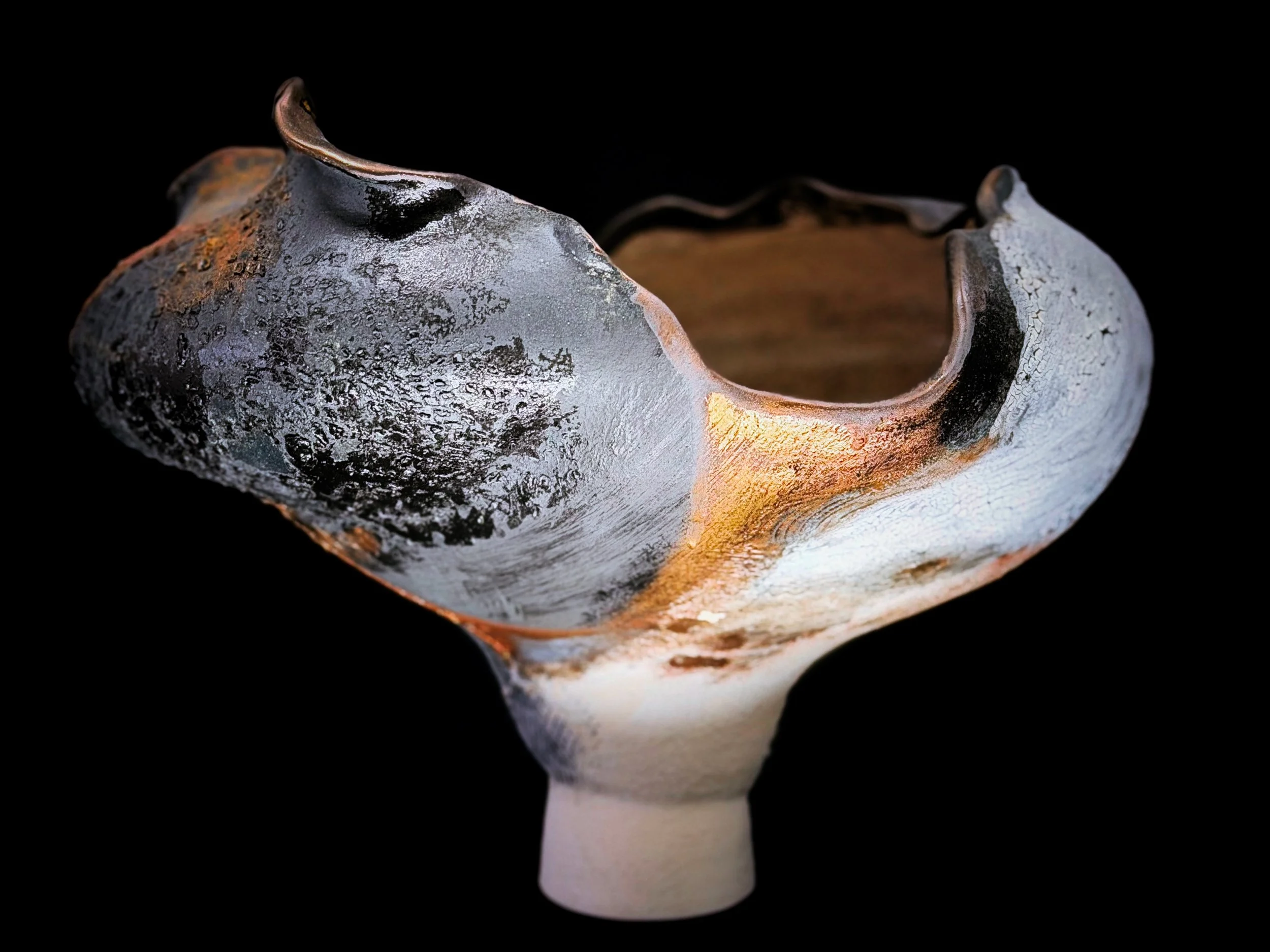
Moment by Moment — One decision leading to the next.
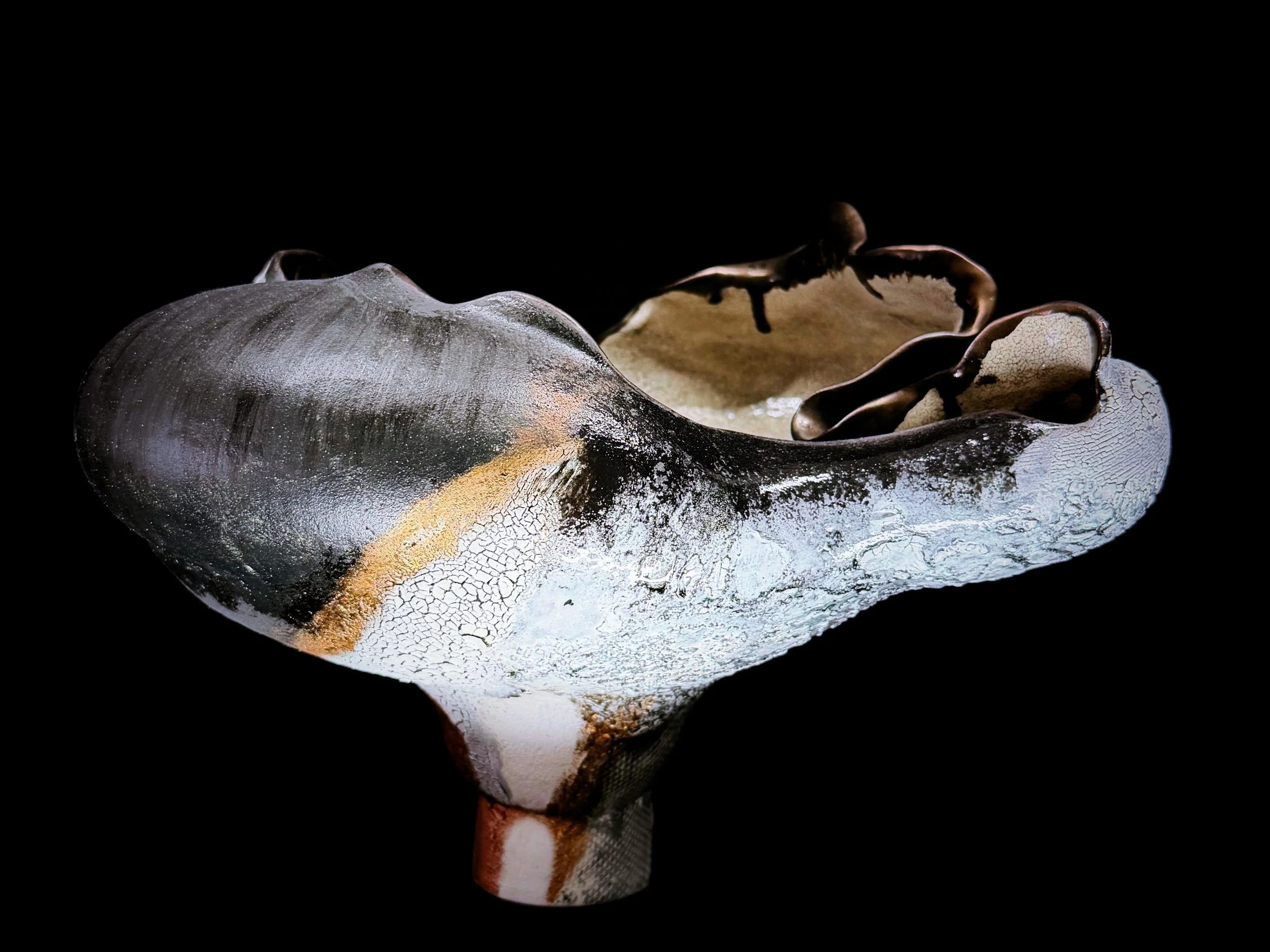
The vessel changed direction as the clay, gravity and kiln imposed their own limits.
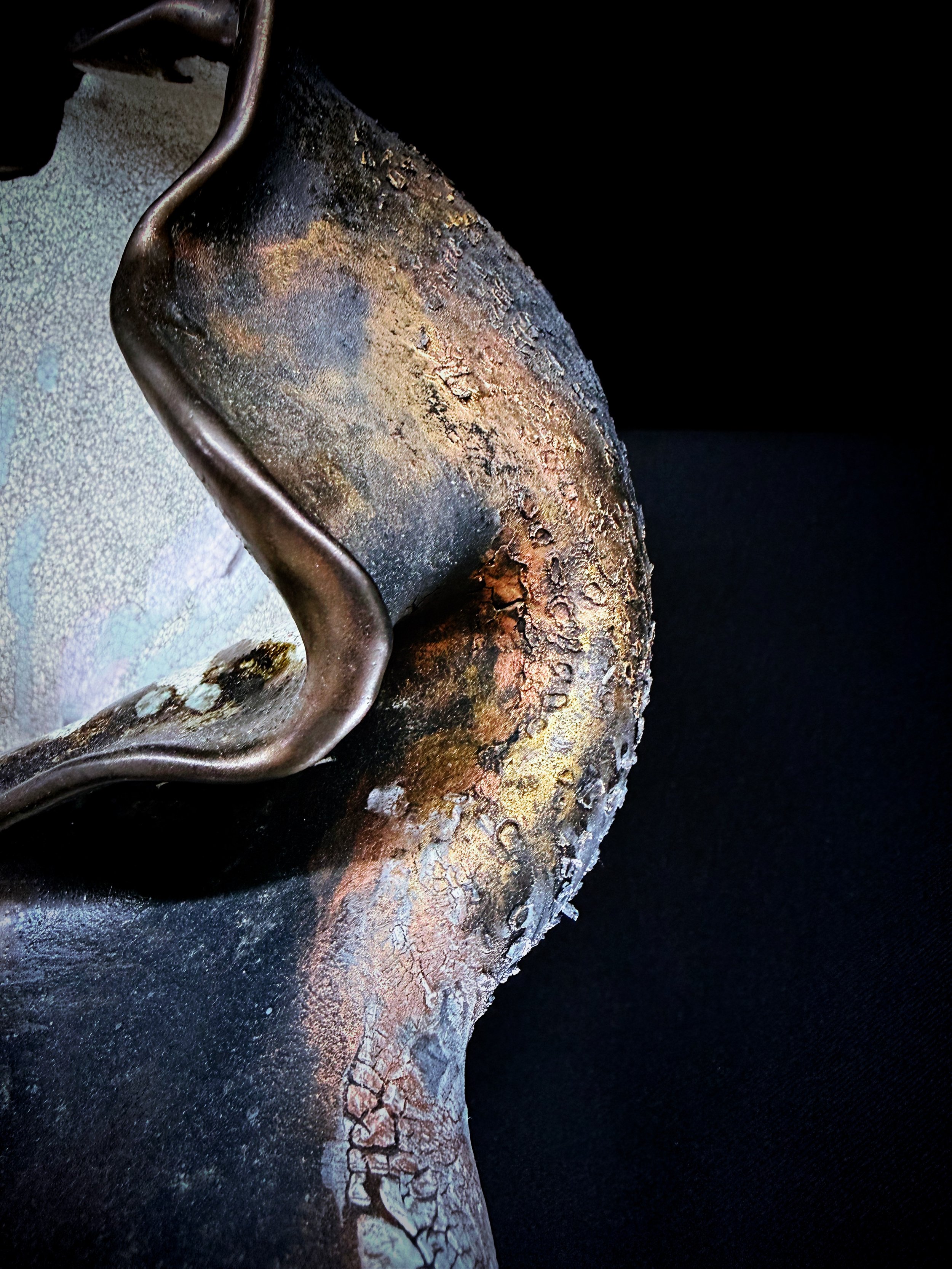
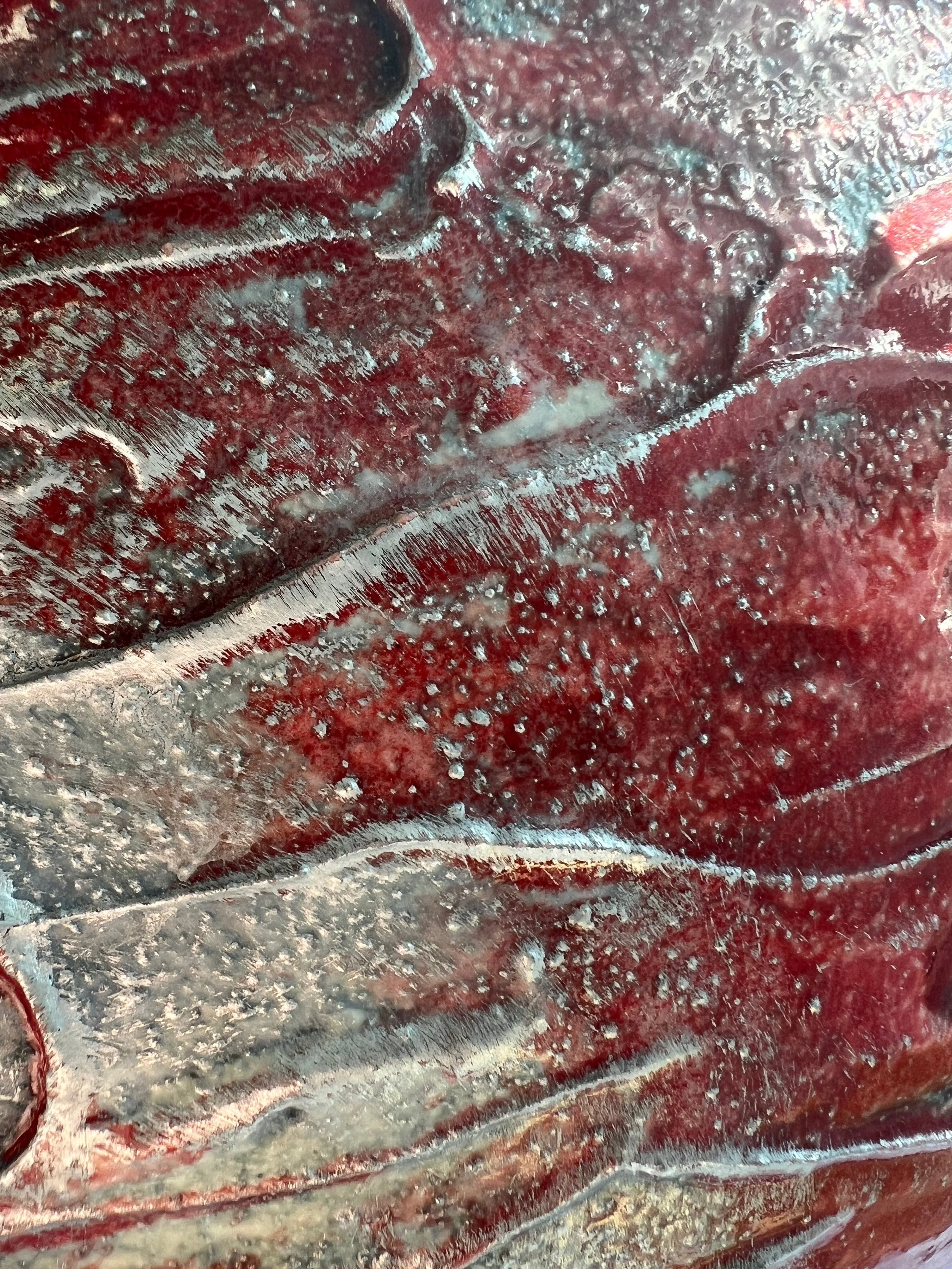
Metallic glaze gathers along edges and interruptions in the form.
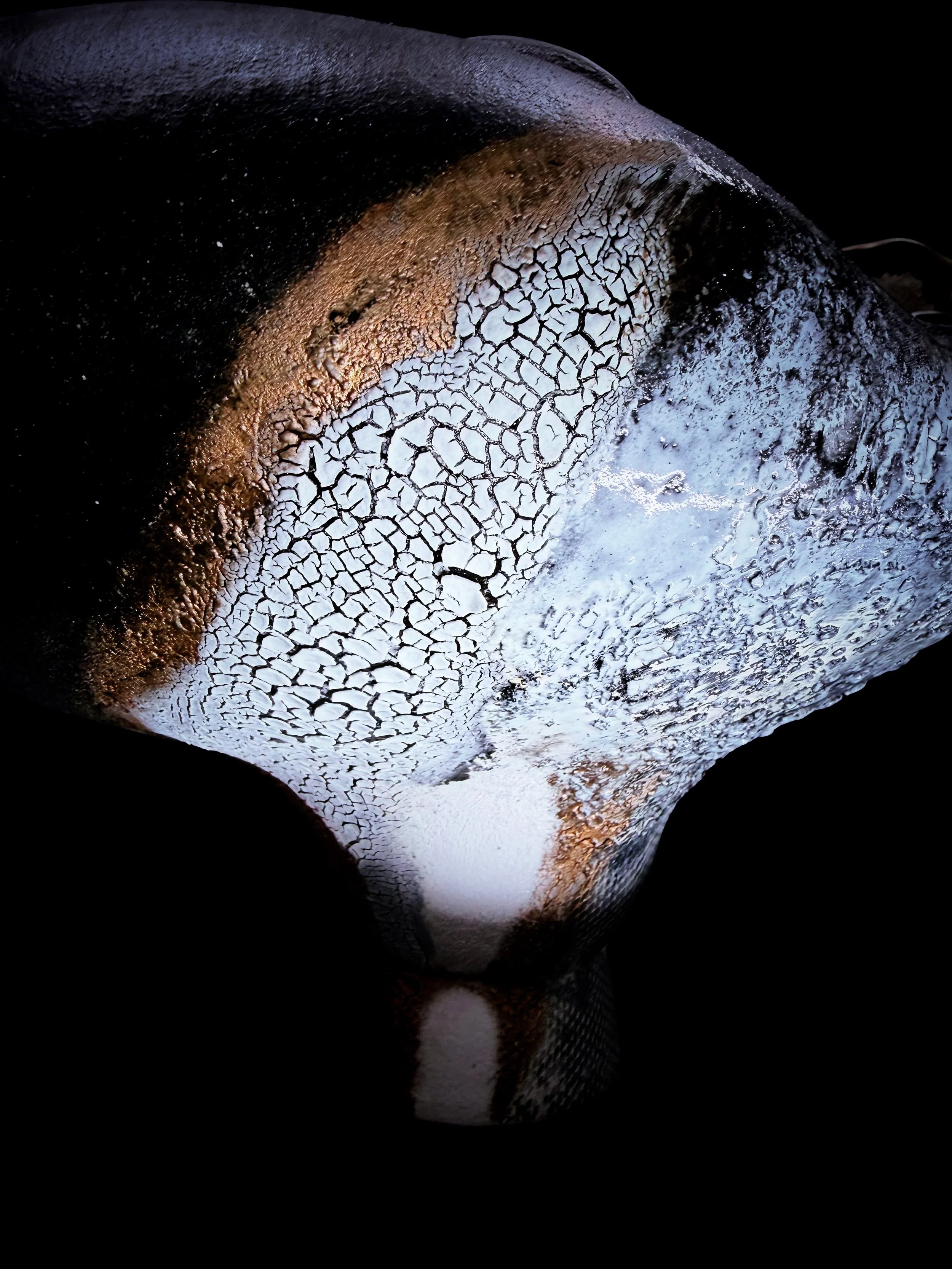
Burnished darkness, crackle and exposed clay record different stages of making.
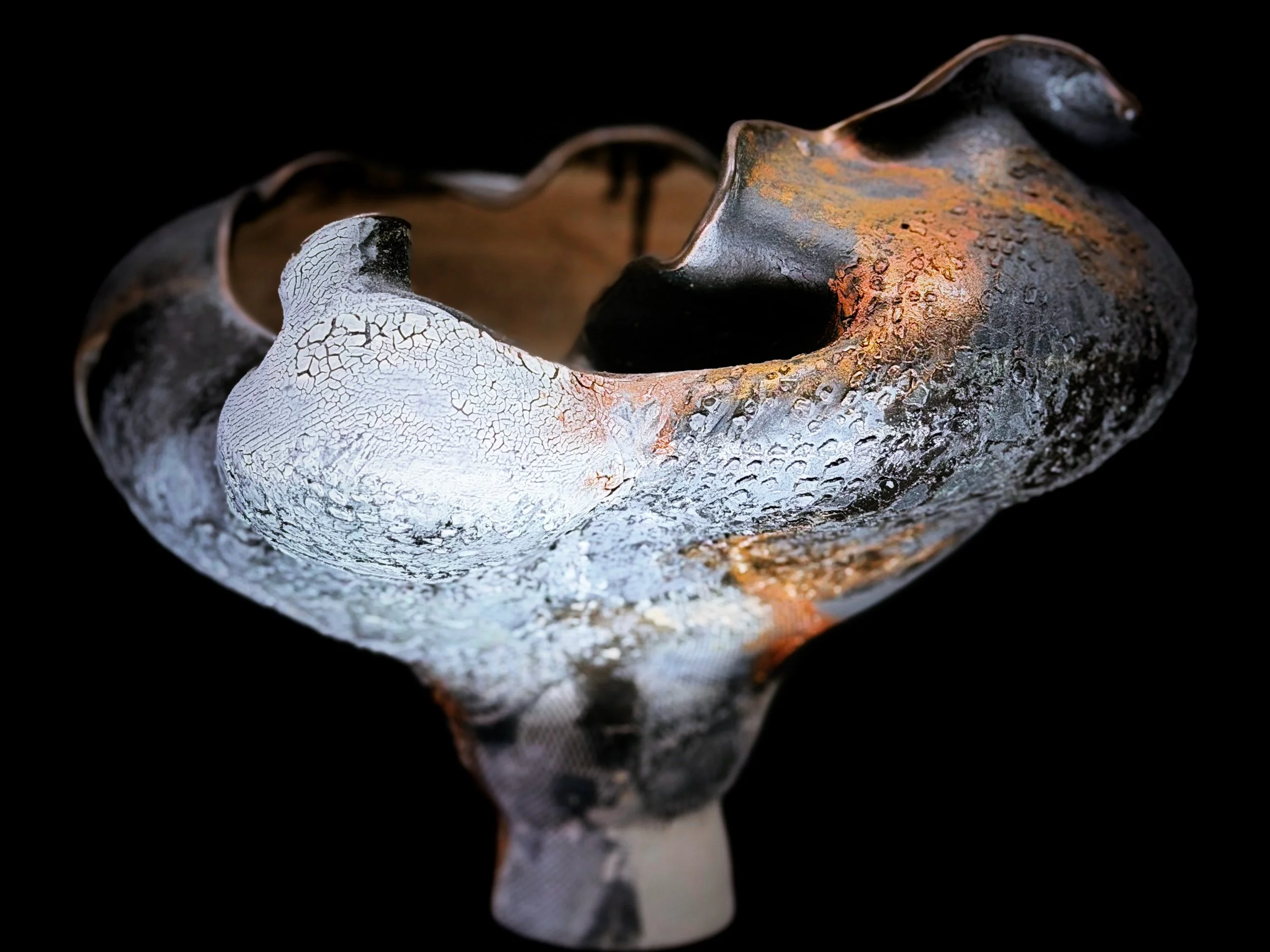
Each coil responded to what the previous one had become.
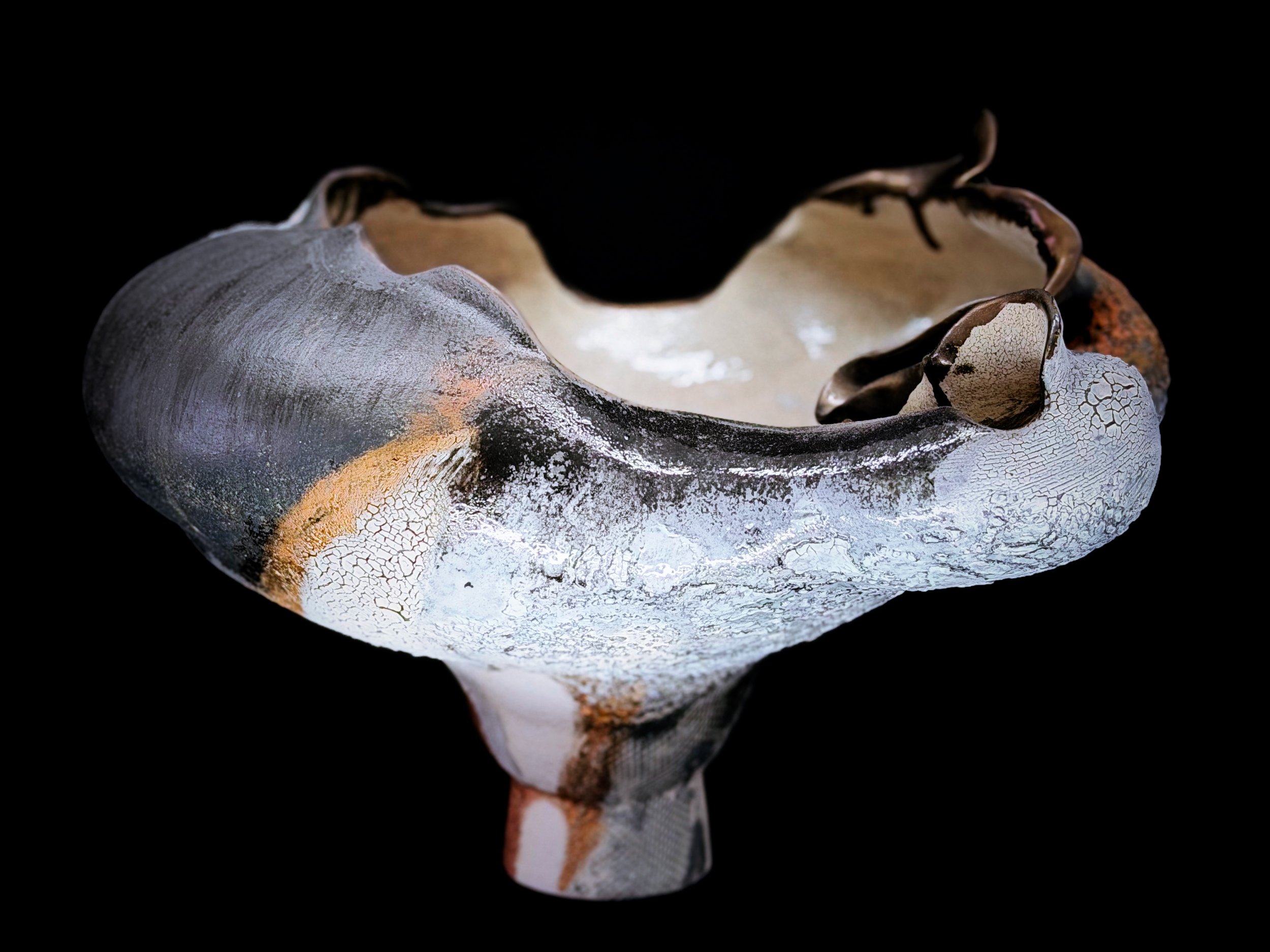
Completion did not mean control. It meant accepting what the process had become.
Moment by Moment was built as its title suggests: continuously, responsively, one decision leading to the next.
The vessel was not designed all at once. Each coil was added, compressed, blended and allowed to settle before I responded again. When a section stretched too far, I thickened it or redirected it. When the kiln imposed a height limit, the form widened instead. Constraints did not end the process; they changed its direction.
The surface developed in much the same way. Burnished slip, impressed texture, crackle glaze, metallic glaze and ink each behaved with some degree of unpredictability. Some effects were intentional; others emerged through firing and time.
Rather than correcting every irregularity, I began responding to what was already happening. The making became less about achieving a predetermined shape and more about staying in relationship with the process.
Moment by Moment holds a record of adaptation — coil by coil, layer by layer, one moment shaping the next.
Sketching-A-Void · 2025
Coil-built stoneware, underglaze pencil & glaze
29 × 24 × 24 cm · 3,100 g
$650 CAD · Available
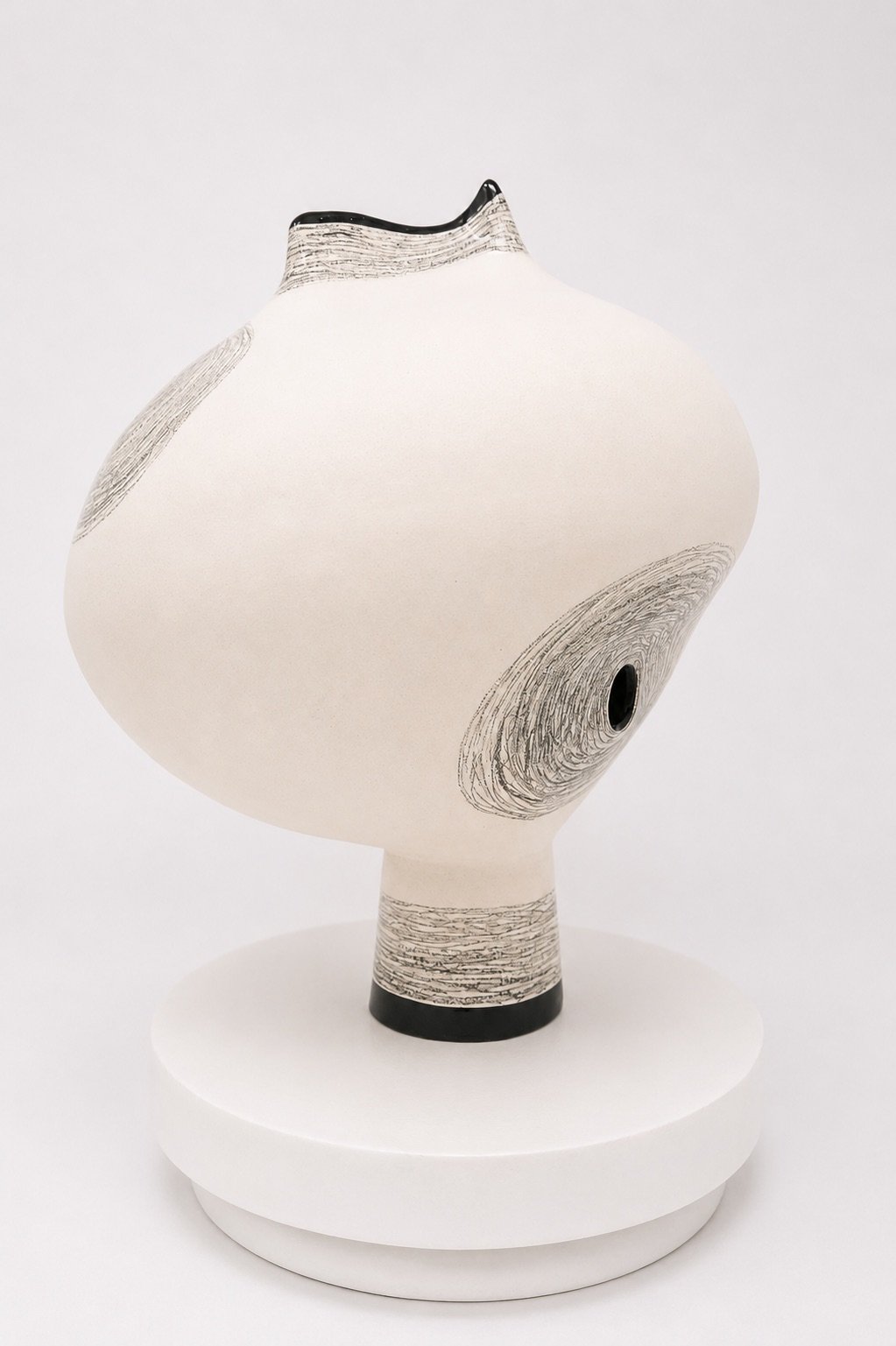
Sketching-A-Void — Attention gathers around what remains absent.
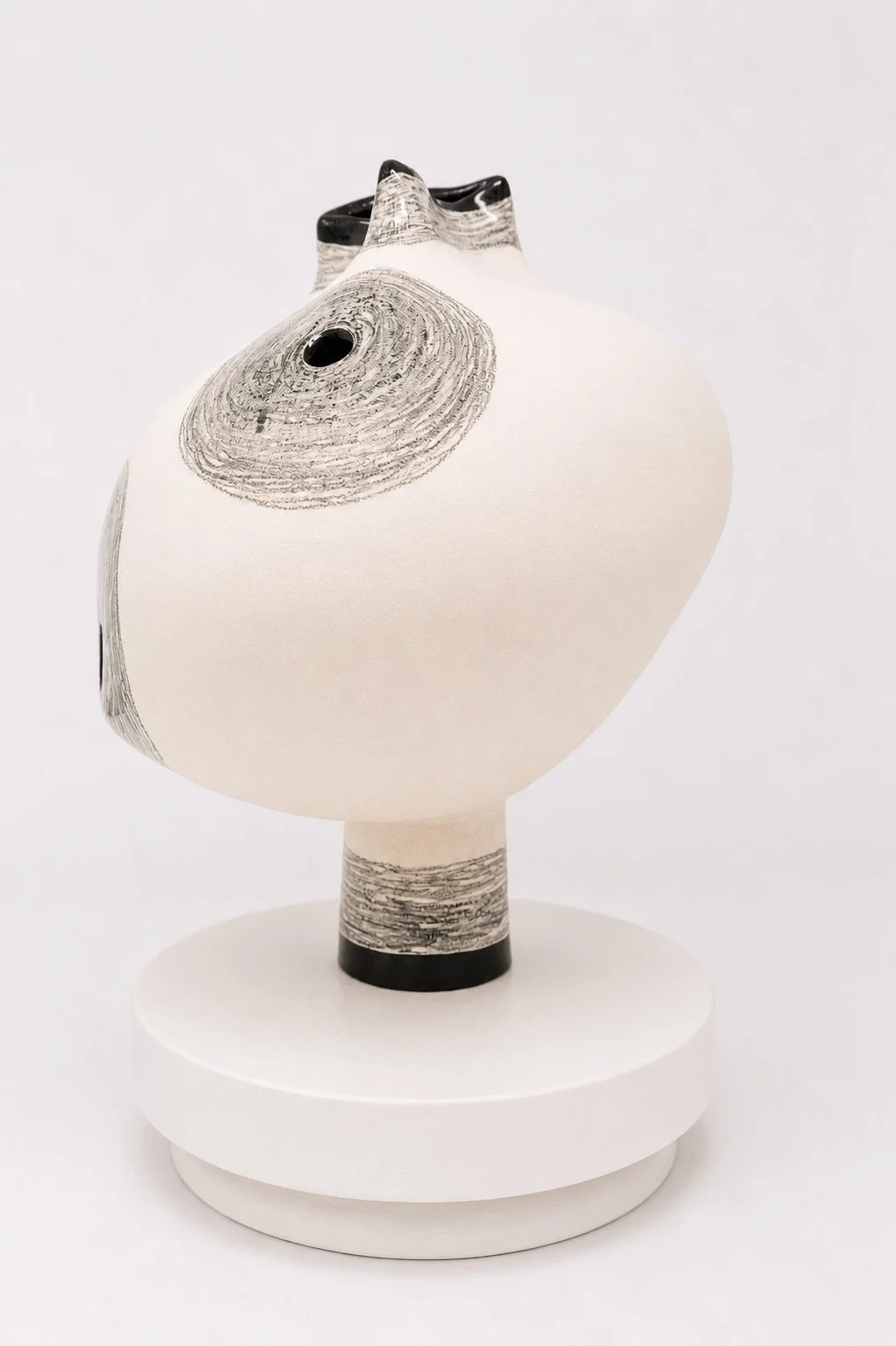
The voids were built into the vessel from the beginning.
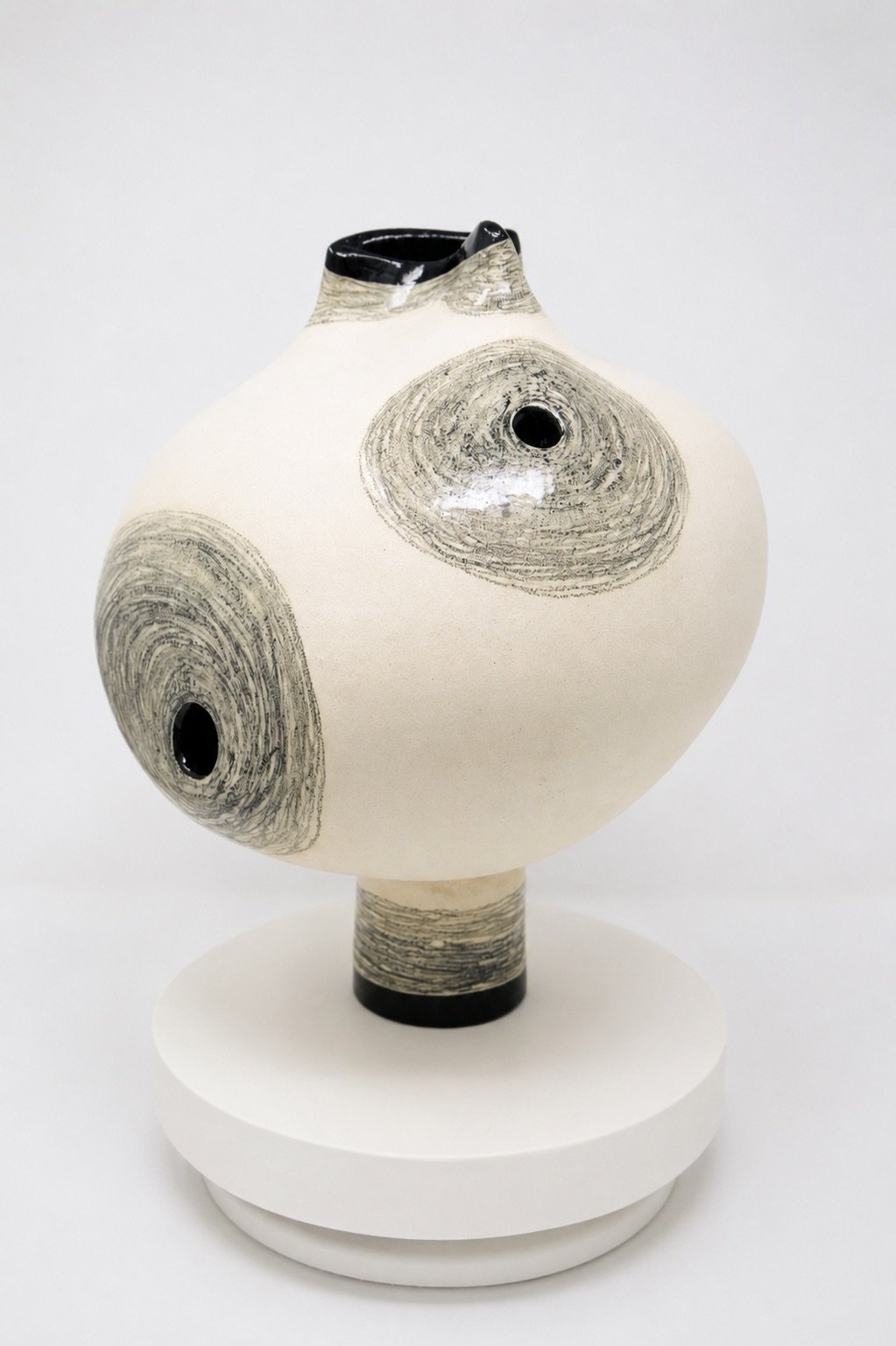
An internal bridge quietly connects one opening to another.
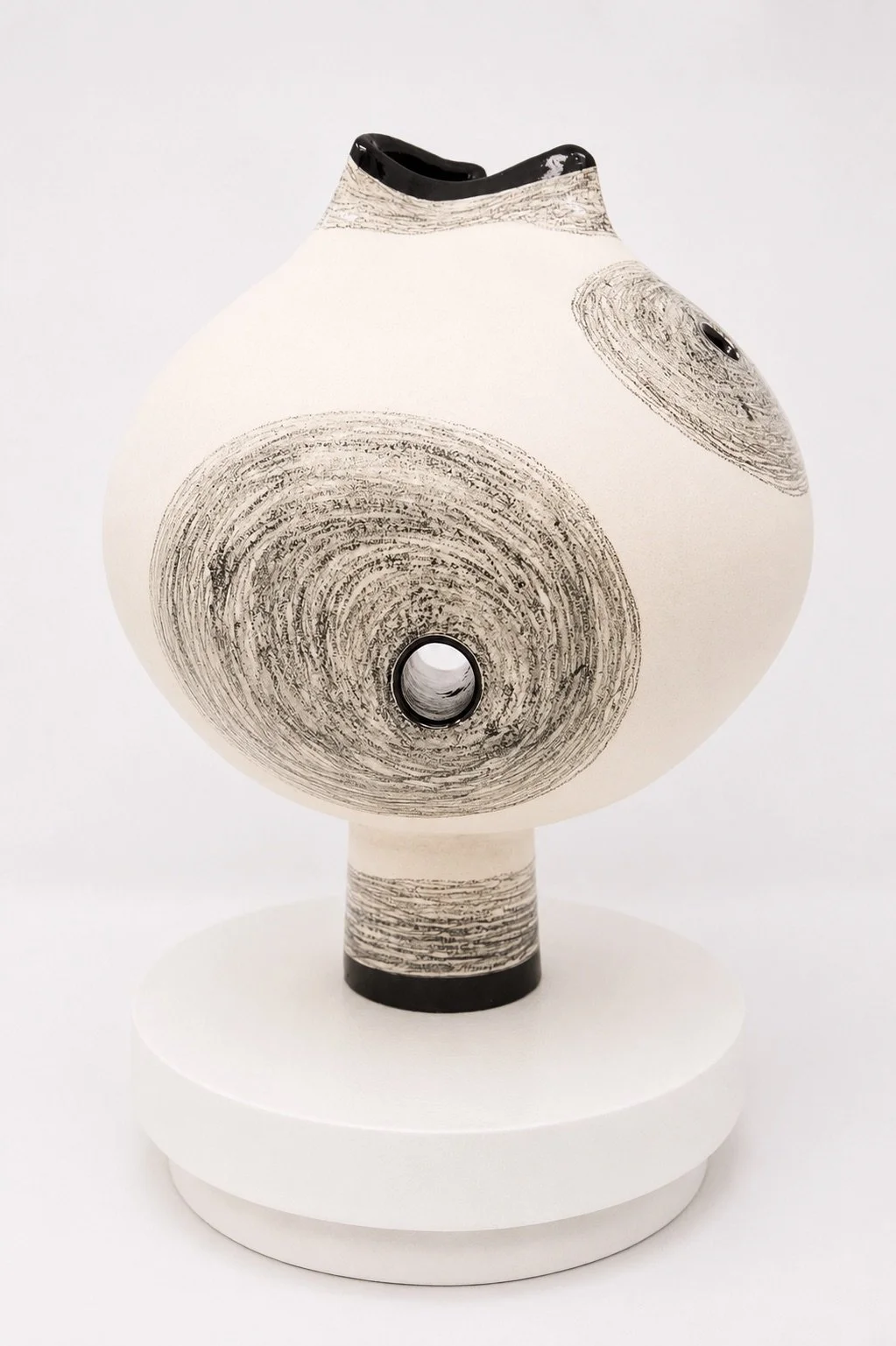
Repeated pencil lines record the act of returning to the same absence.
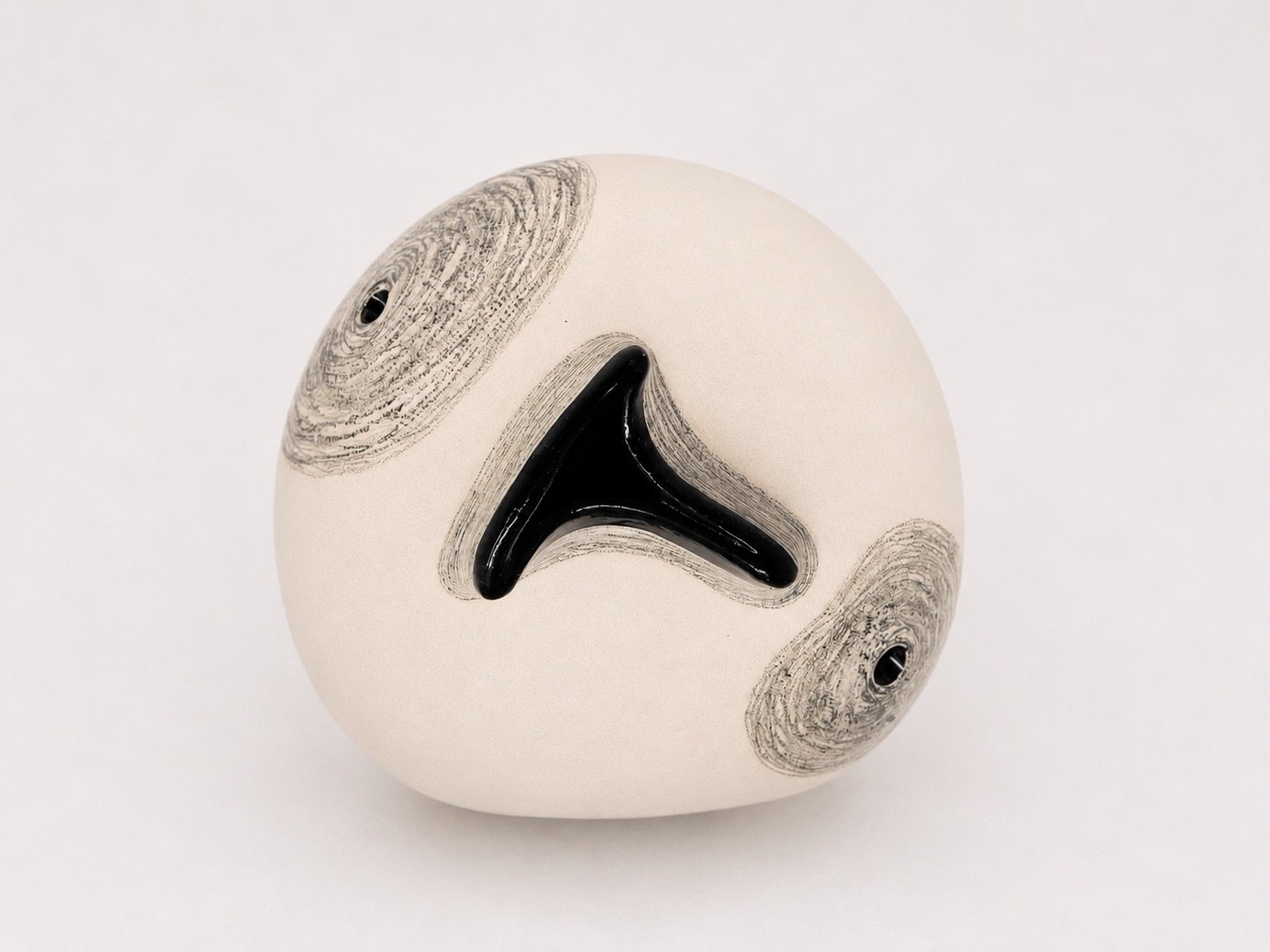
Each opening offers another perspective on what lies within.
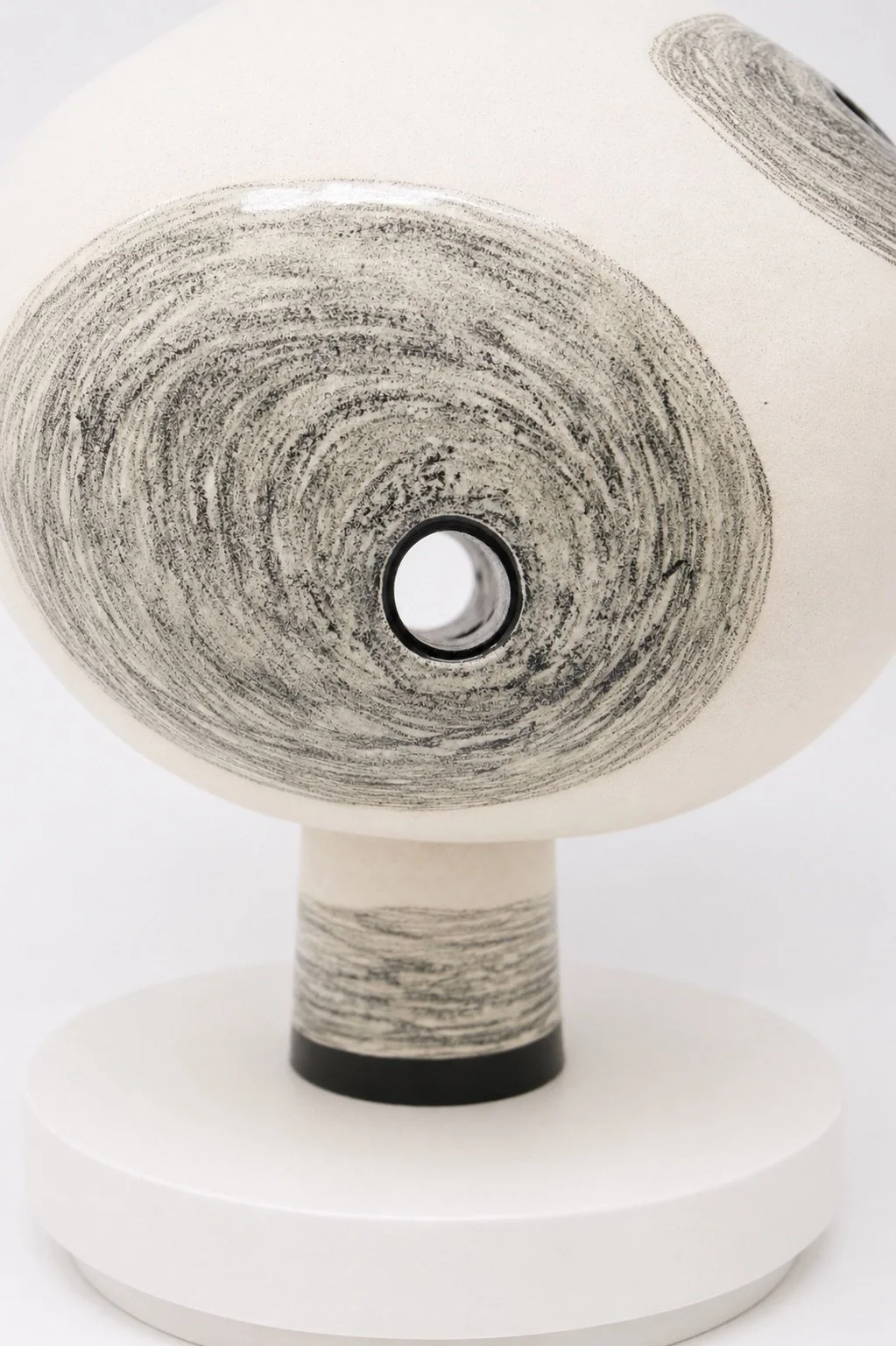
The void remains. Around it, the lines gather like growth rings around a missing branch.
Sketching-A-Void · 2025
Coil-built stoneware, underglaze pencil & glaze
29 × 24 × 24 cm · 3,100 g
$650 CAD · Available
Sketching-A-Void explores what happens when attention is given to absence rather than attempting to fill it.
The vessel was built slowly in coils, with the openings incorporated deliberately into the growing form rather than cut out afterwards. As the clay developed, each void began to influence the structure surrounding it.
Once the form was complete, I repeatedly traced around the openings with underglaze pencil. The lines accumulated like contour lines or growth rings, recording the act of returning to the same absence again and again.
The void is not repaired, disguised or filled. Instead, time gathers around it.
Light passes through the openings, changing them as the vessel is viewed from different positions. What appears empty becomes an active part of the form.
Sketching-A-Void considers absence not simply as something missing, but as something around which we continue to grow.
Responsibility · 2025
Coil-built WSO stoneware; grogged WSO slip, carved and impressed greenware, dry underglaze, oil pastel, washes and commercial textural glazes
Approximately 30 × 30 cm
5.3 kg
CA$850 · Available
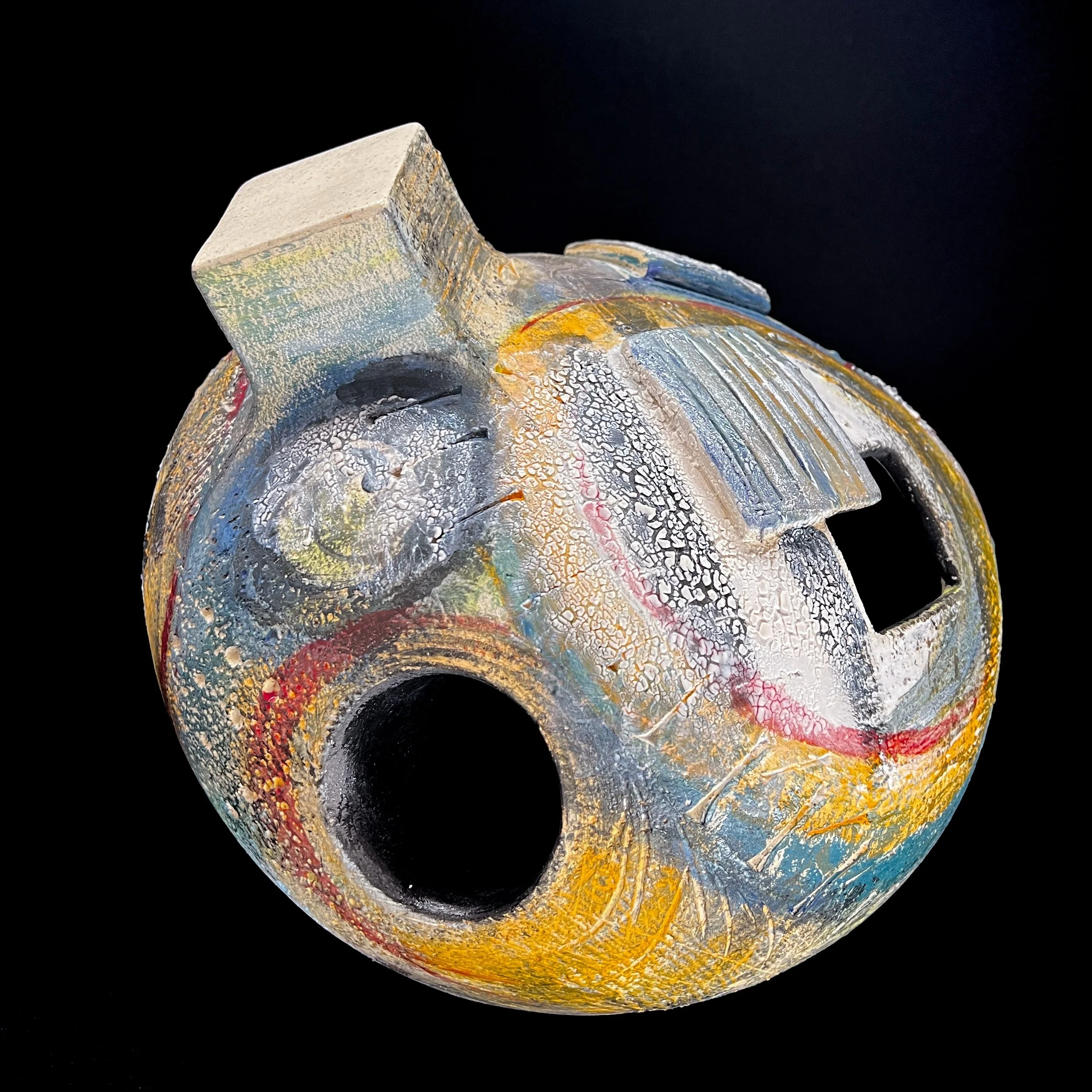
Responsibility — Weight made physical.
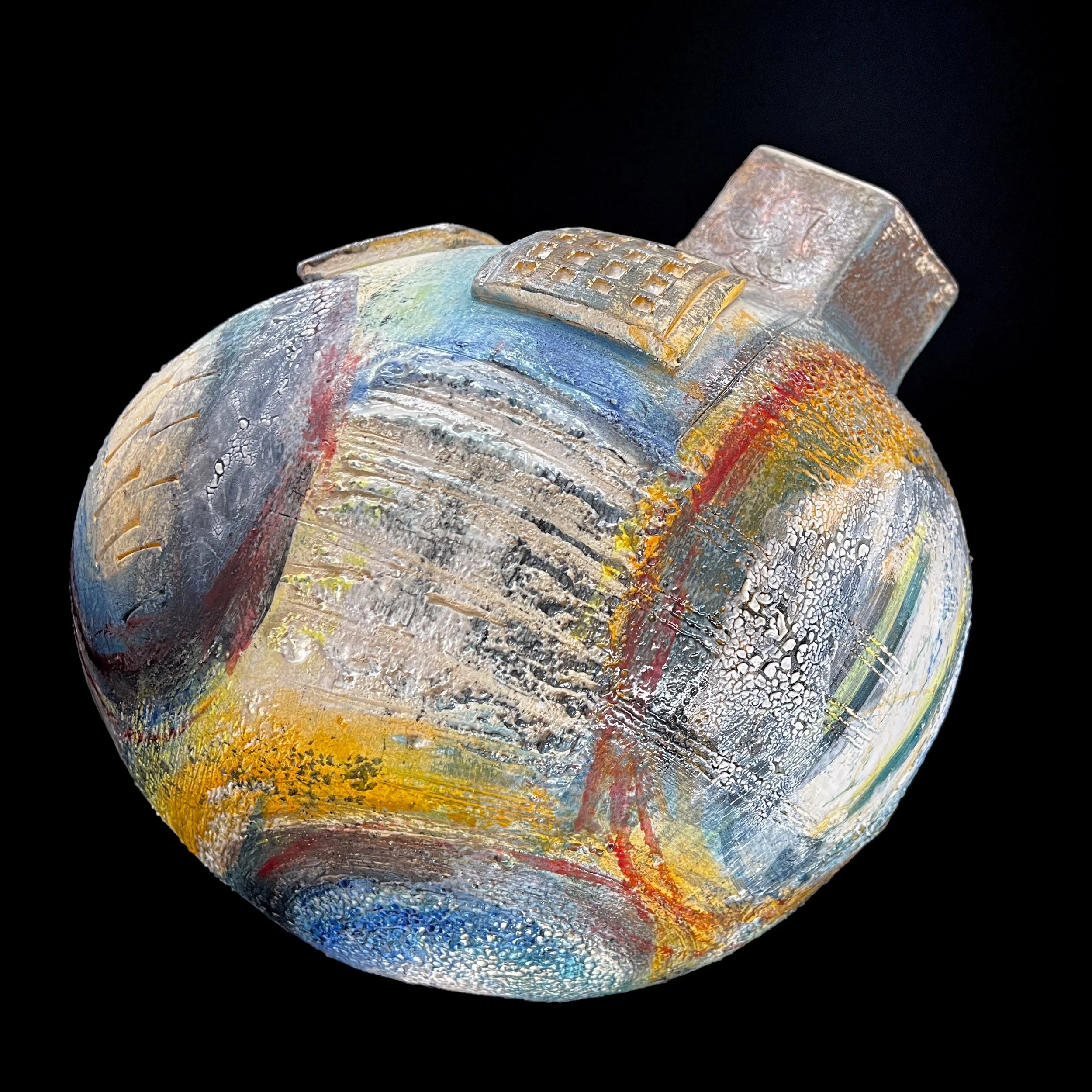
The vessel settles differently depending on where its weight takes it.
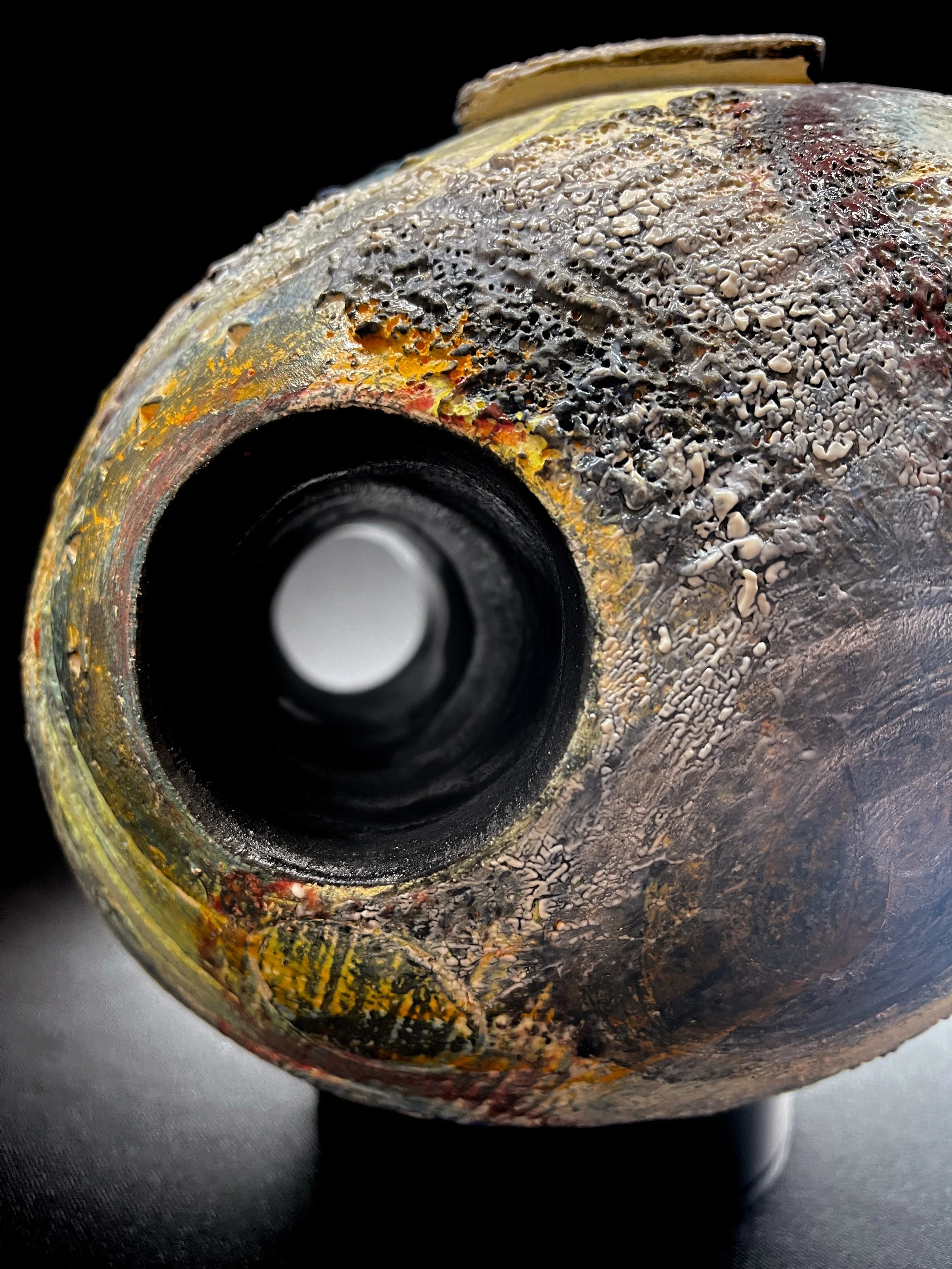
One opening passes completely through; another reveals a darker interior.
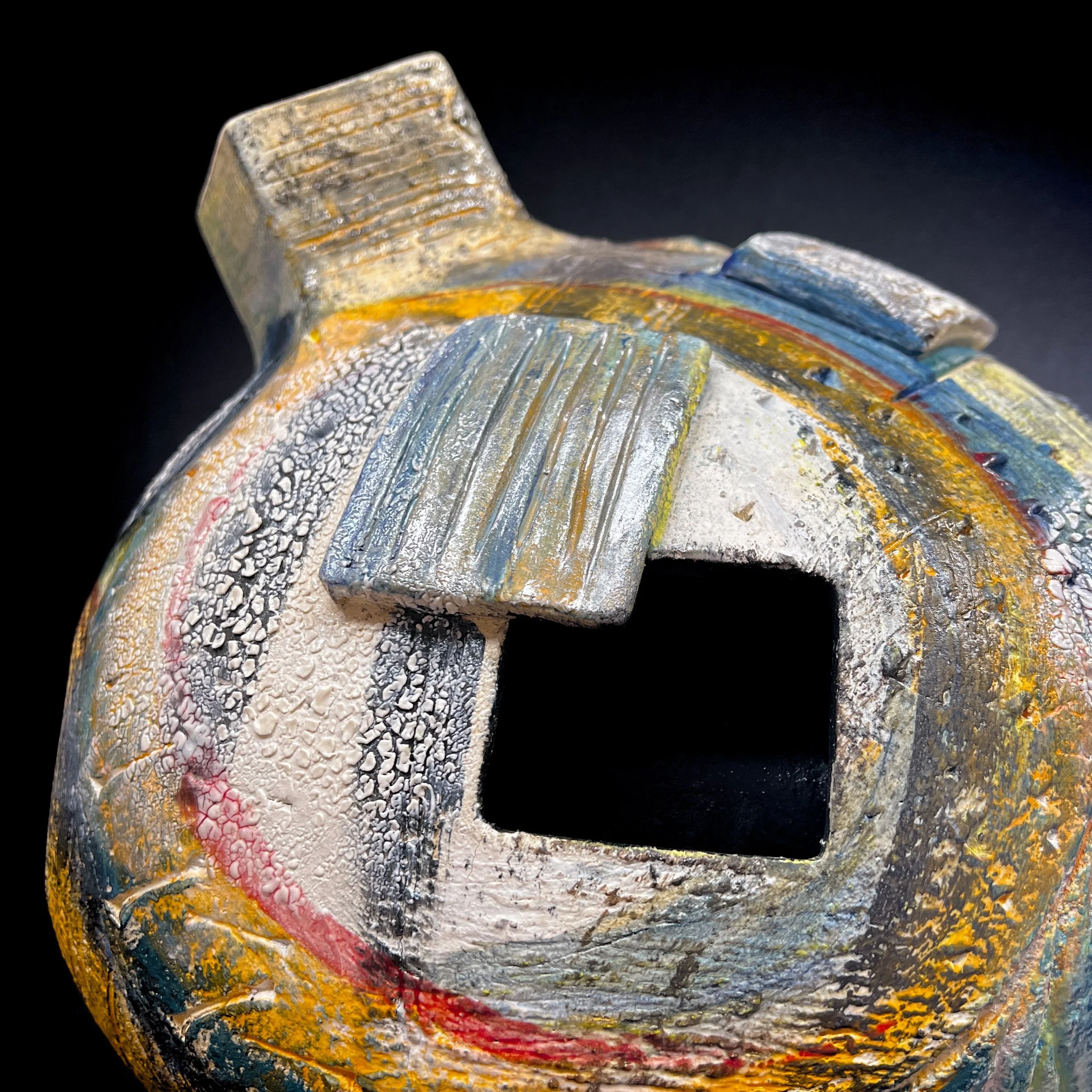
Texture was built into the clay while it was still green — carved, impressed, scratched and layered.
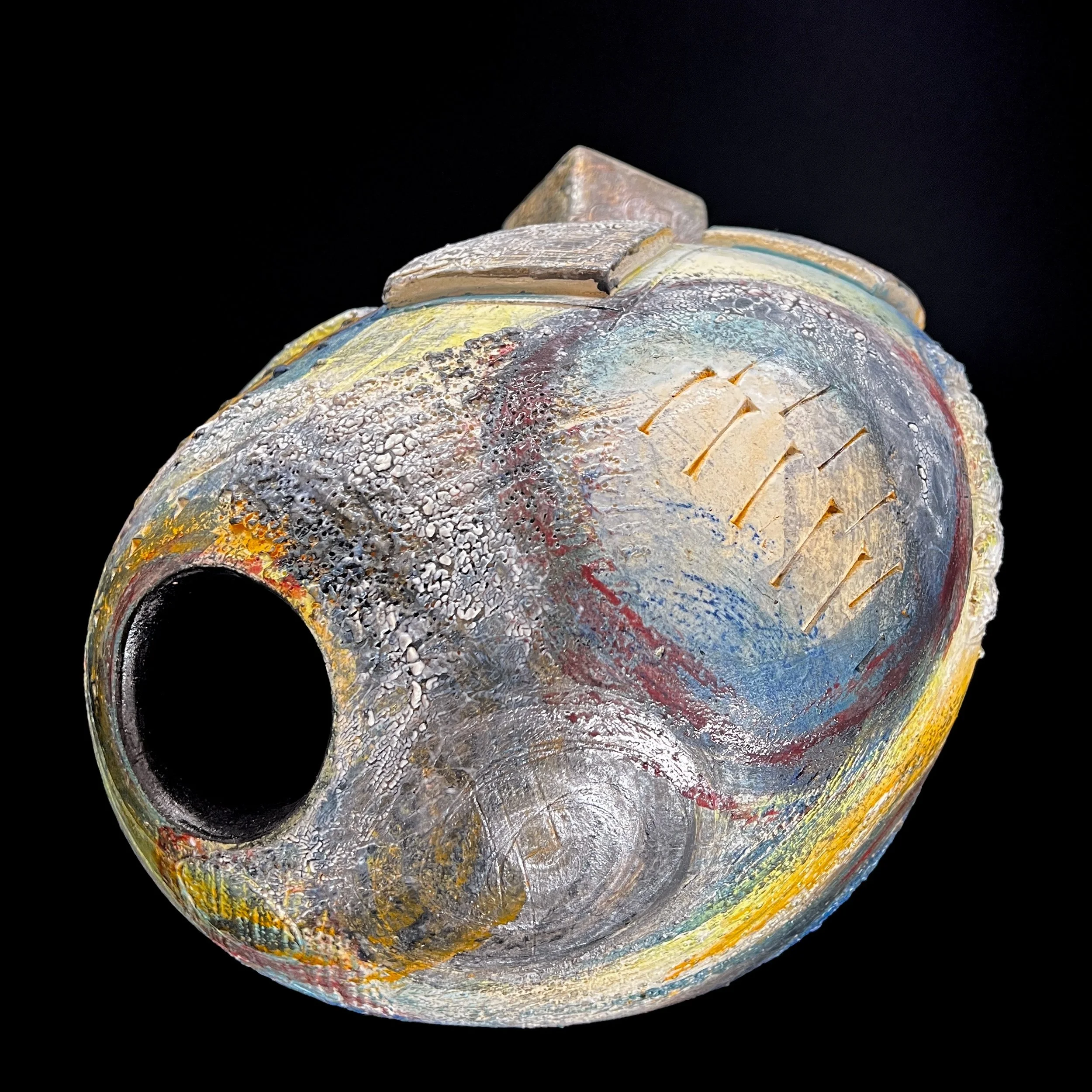
Rough, glazed, pitted and exposed surfaces accumulate across the body.
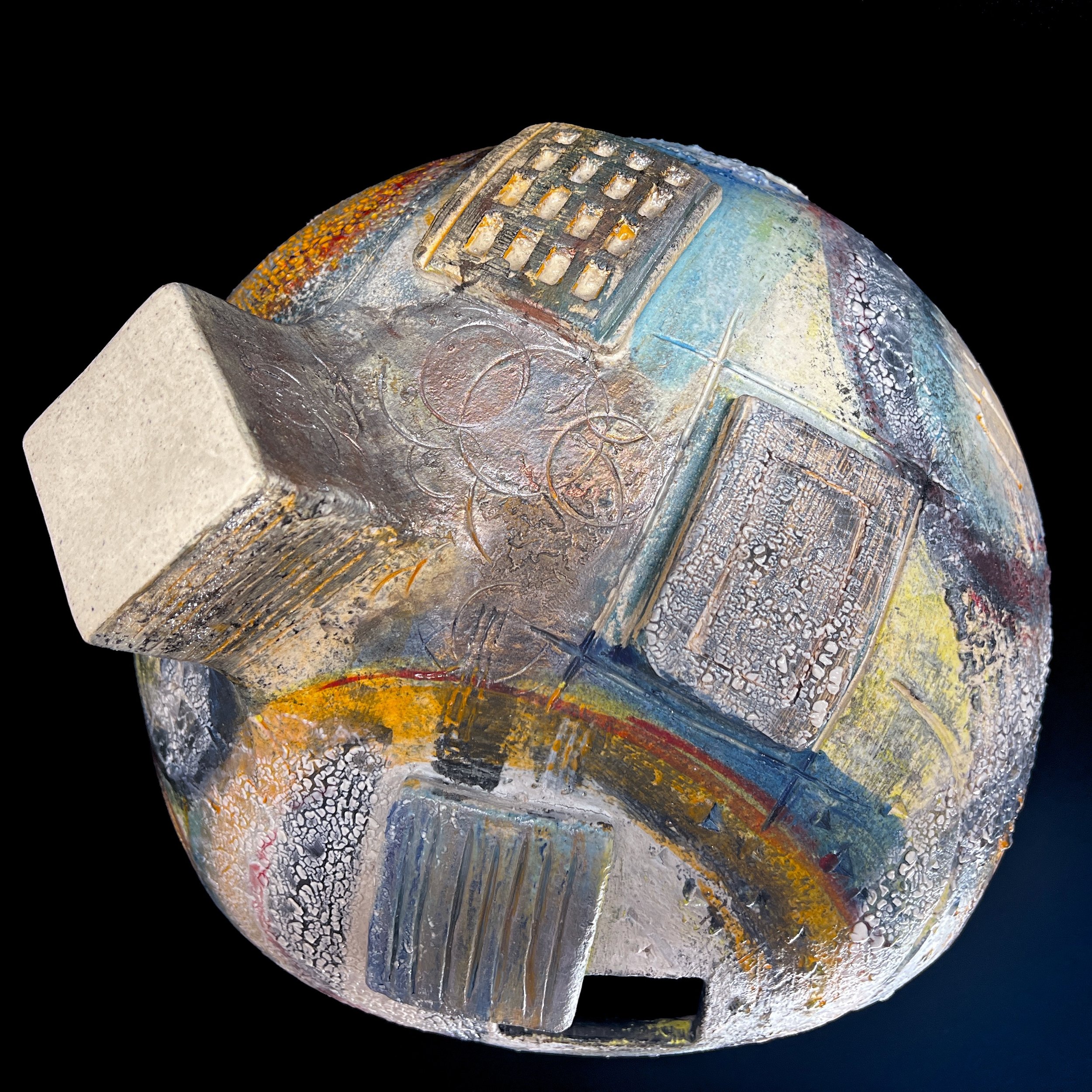
Responsibility rarely sits neatly. Neither does this vessel.
Responsibility makes emotional weight physical.
The vessel is deliberately substantial — 5.3 kilograms of clay, surface and accumulated decisions. Its rounded, voluptuous body refuses a fixed orientation. Without support it can gently roll and settle into different positions, presenting different openings and surfaces according to where its weight takes it.
One opening passes completely through the form. Another reveals a darker internal vessel. Light can enter, but the interior is never fully exposed.
The surface was built extensively while the clay was still green. Thick grogged slip was applied, carved, impressed and scratched before firing, then layered with dry underglaze, washes, oil pastel and textural glazes. Rough, crackled and pitted passages sit beside smoother, glazed areas.
The work emerged during a period when responsibility itself felt physically heavy. Some of the smaller attached forms originally carried more specific meanings, but with distance those explanations have become less important than the body of the vessel itself.
Responsibility does not sit neatly.
Neither does what we carry.
Keeper of Light · 2026
Coil-thrown stoneware, ceramic glaze and mixed-media rechargeable light
15 × 14 × 14 in
(approximately 38 × 36 × 36 cm)
17.2 lb / approximately 7.8 kg
CA$1,200 · Available
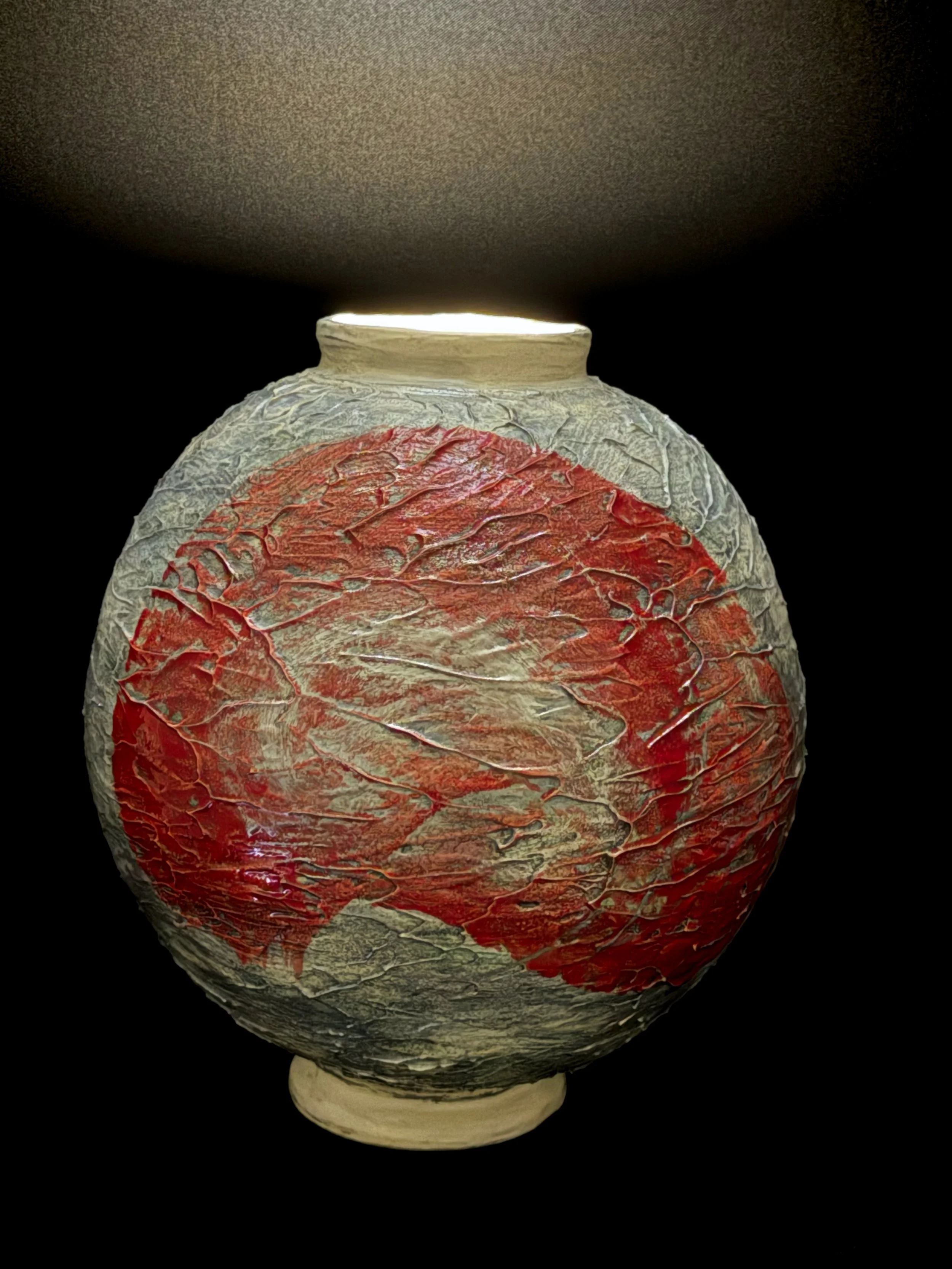
Keeper of Light — Weight and illumination held within the same form.
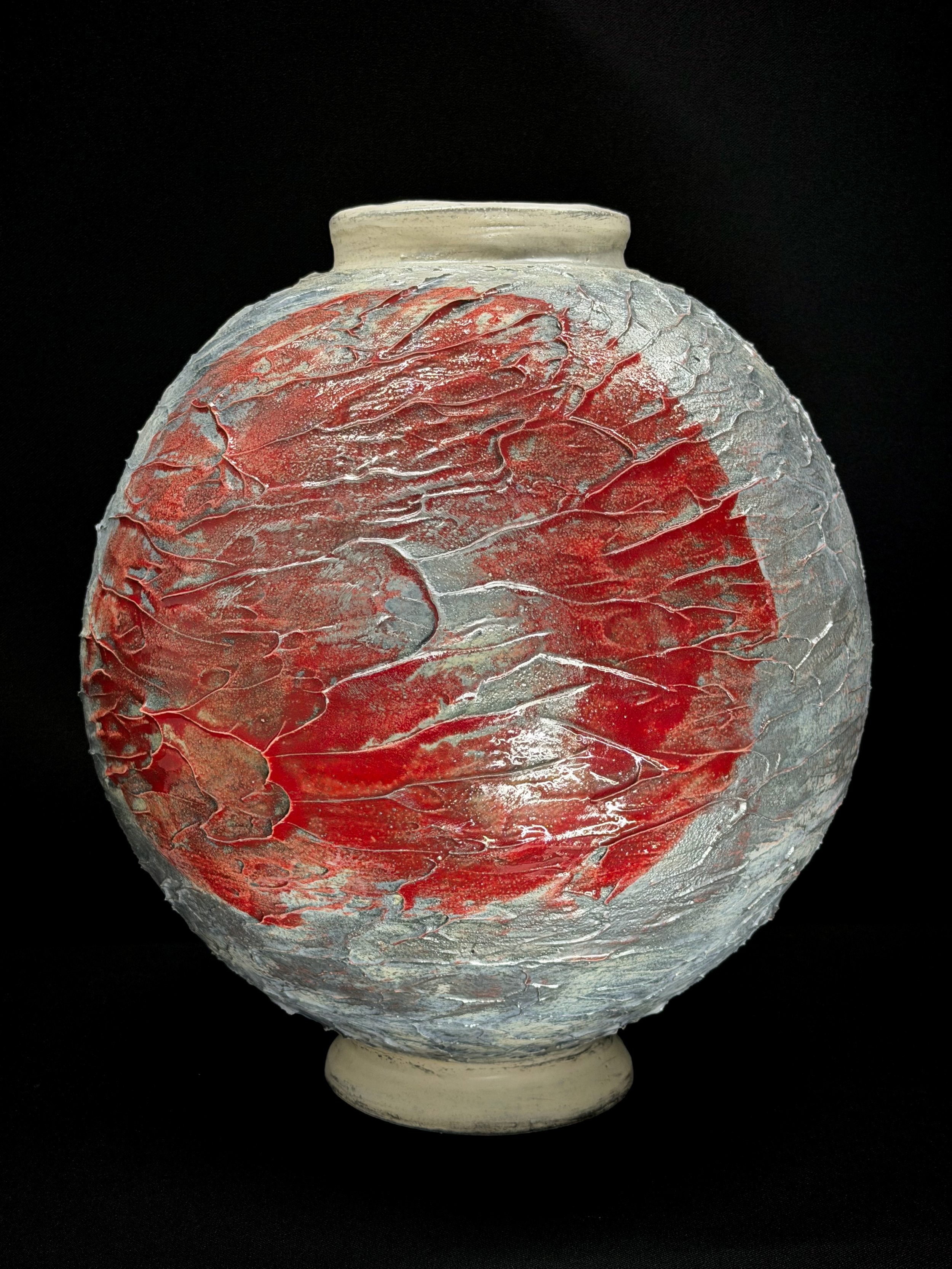
The surface records accumulation rather than trying to erase it.
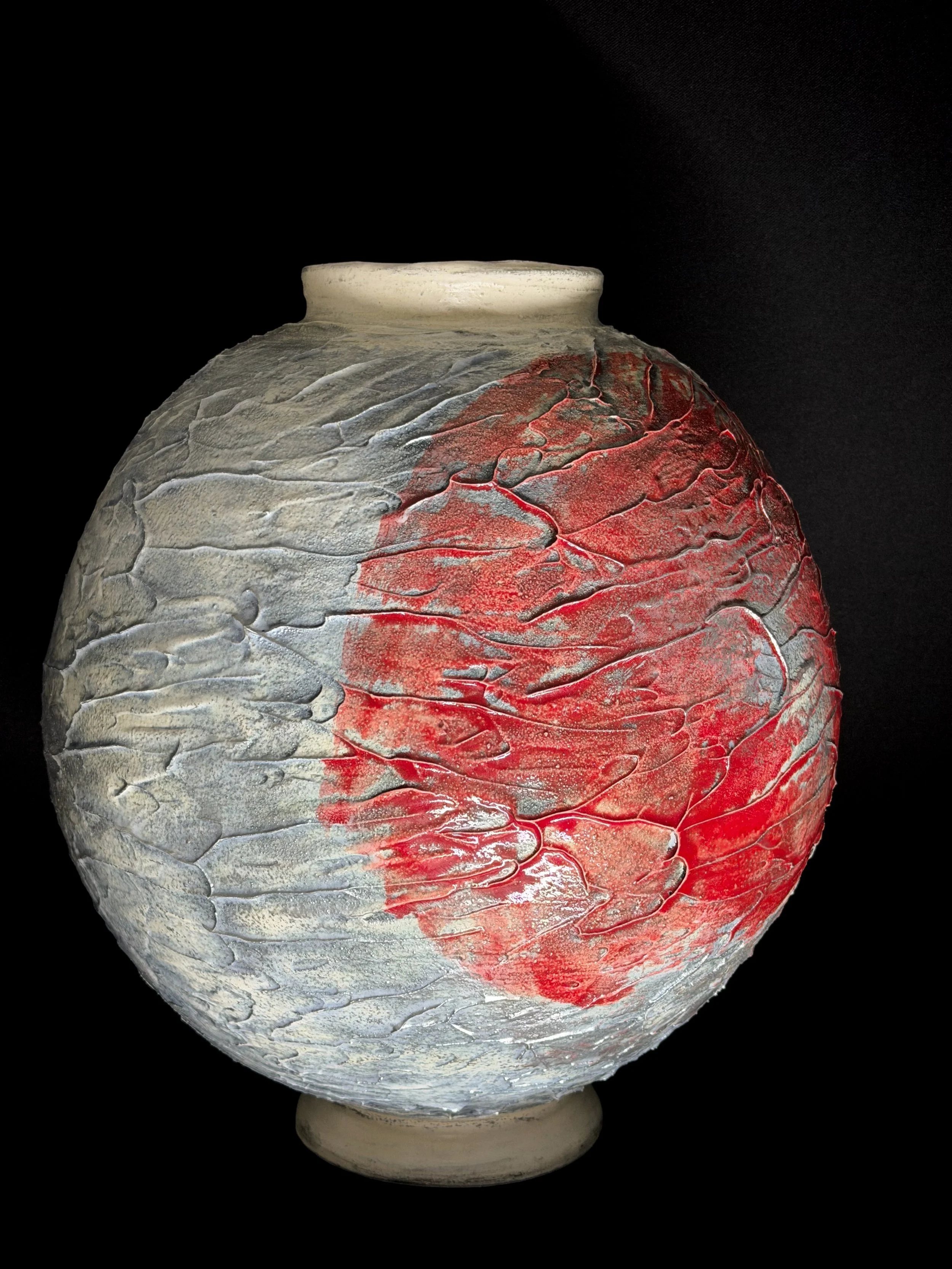
Light remains present even when it is not immediately visible.
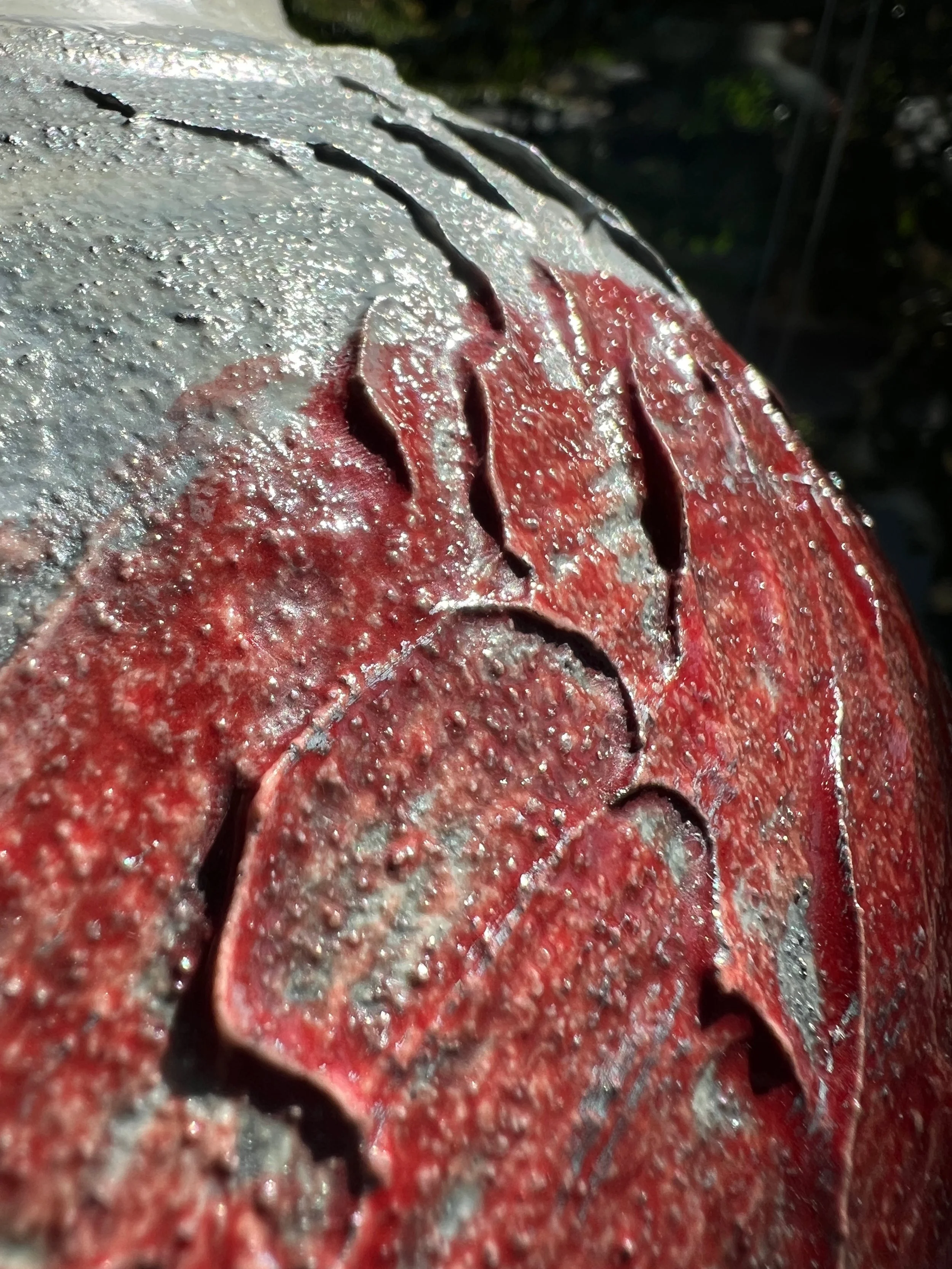
The outer form carries the marks of experience.
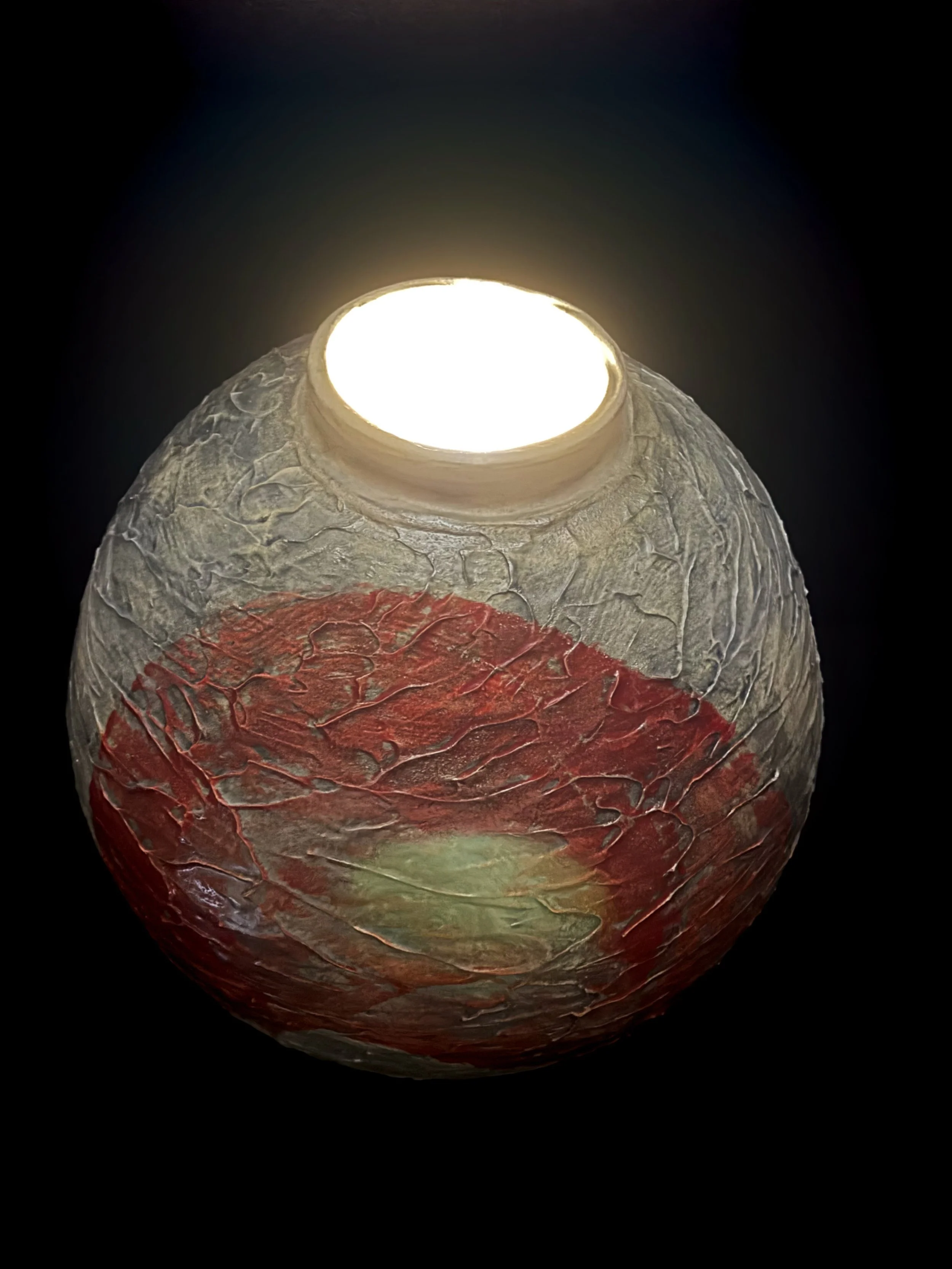
The light comes from within the weight, not in spite of it.
What changes us does not necessarily extinguish what guides us.
Keeper of Light considers the self as something continuously formed rather than fixed.
The vessel is deliberately substantial. Its weight, texture and visible evidence of making reflect the accumulation of lived experience — the way time leaves traces and alters how we move through the world.
A rechargeable light is housed inside the form. Rather than illuminating the vessel from outside, the light emerges through the opening from within.
That relationship became central to the work: the outer form can be changed considerably by what it has lived through while still containing something capable of offering direction.
The light may brighten or dim. At times it may be clearly visible; at others it may be difficult to see.
But it remains within.
Keeper of Light asks what we carry forward, what changes us, and what is needed to continue illuminating the way.
A Void in the Garden · 2025
Coil-built ceramic sculptural vessel; mixed ceramic surface treatments, selective clear glaze and painted/underglaze floral elements
29 × 22 × 20 cm · 2,933 g
CA$650 · Available
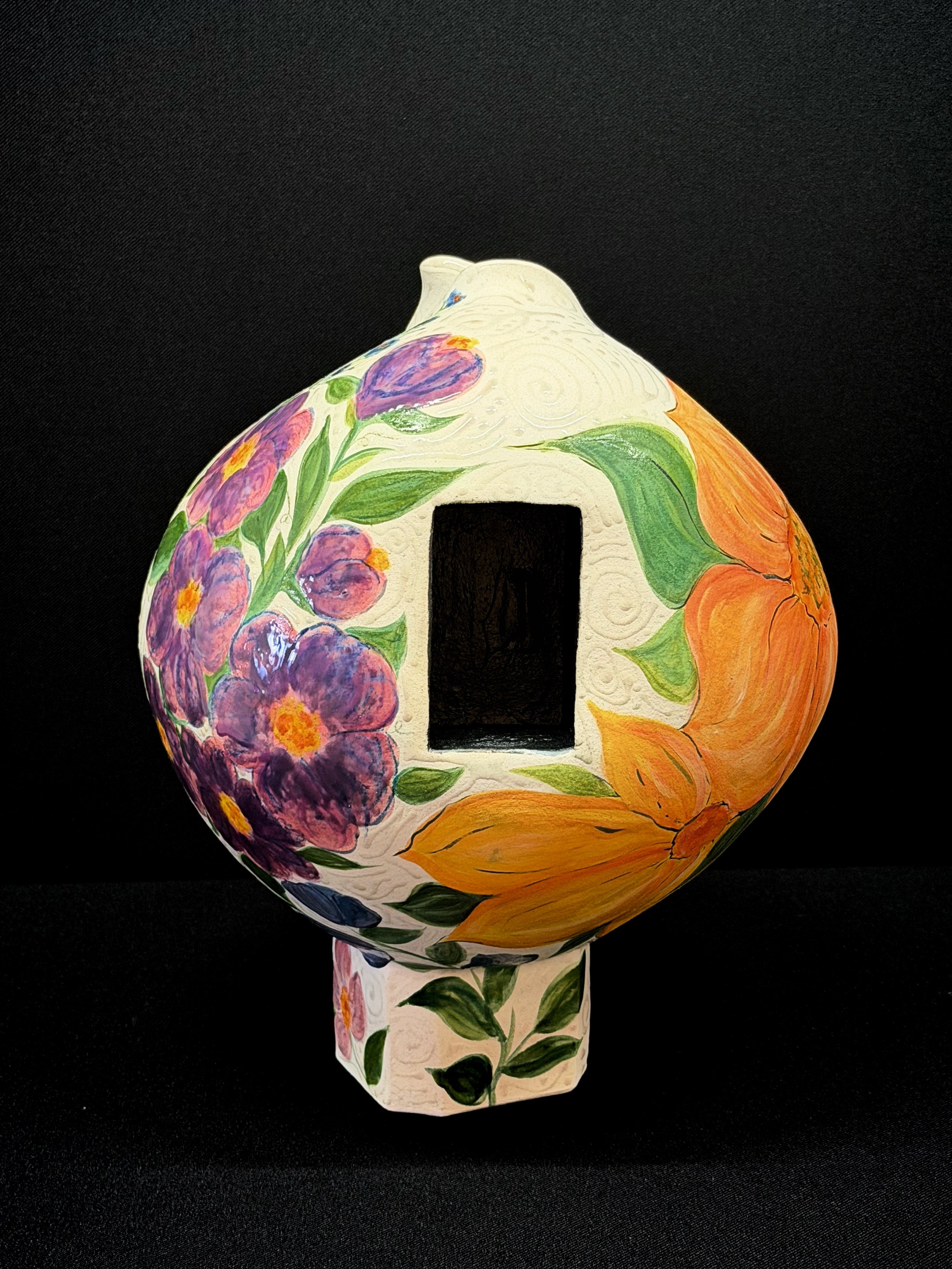
A Void in the Garden — The garden continues around what is absent.
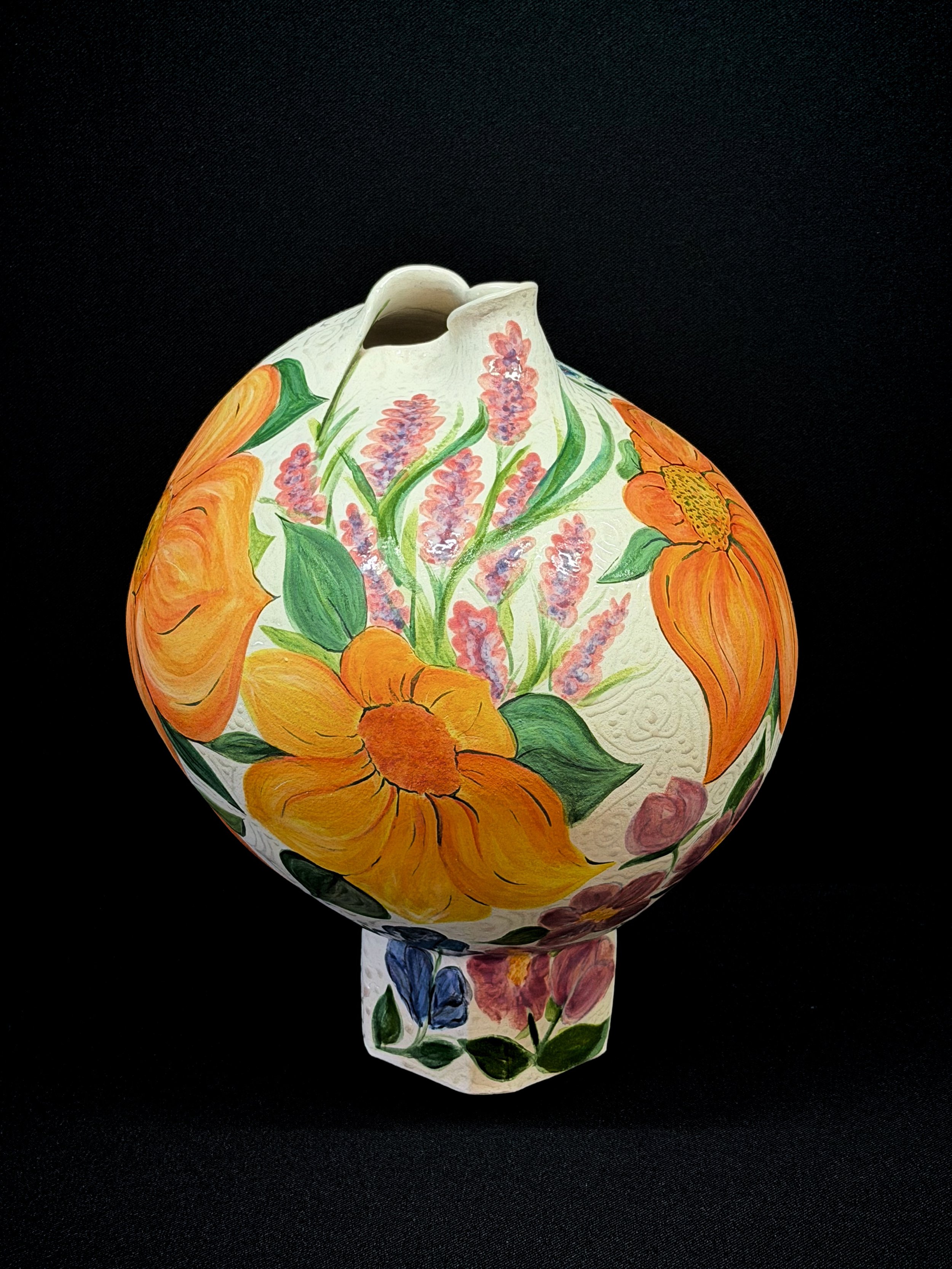
Colour and growth surround an opening that does not pass all the way through.
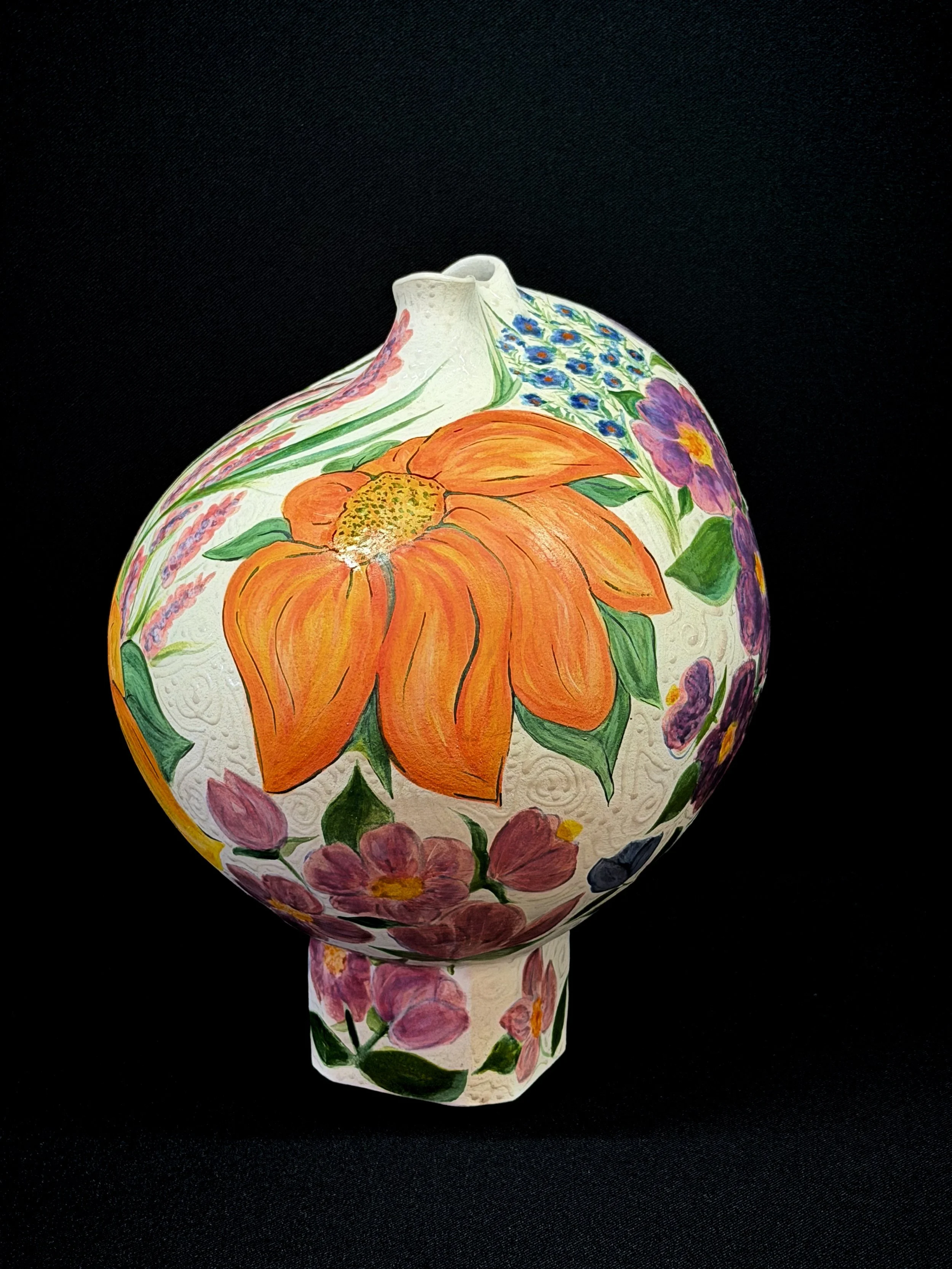
The void remains — not as failure, but as part of the landscape.
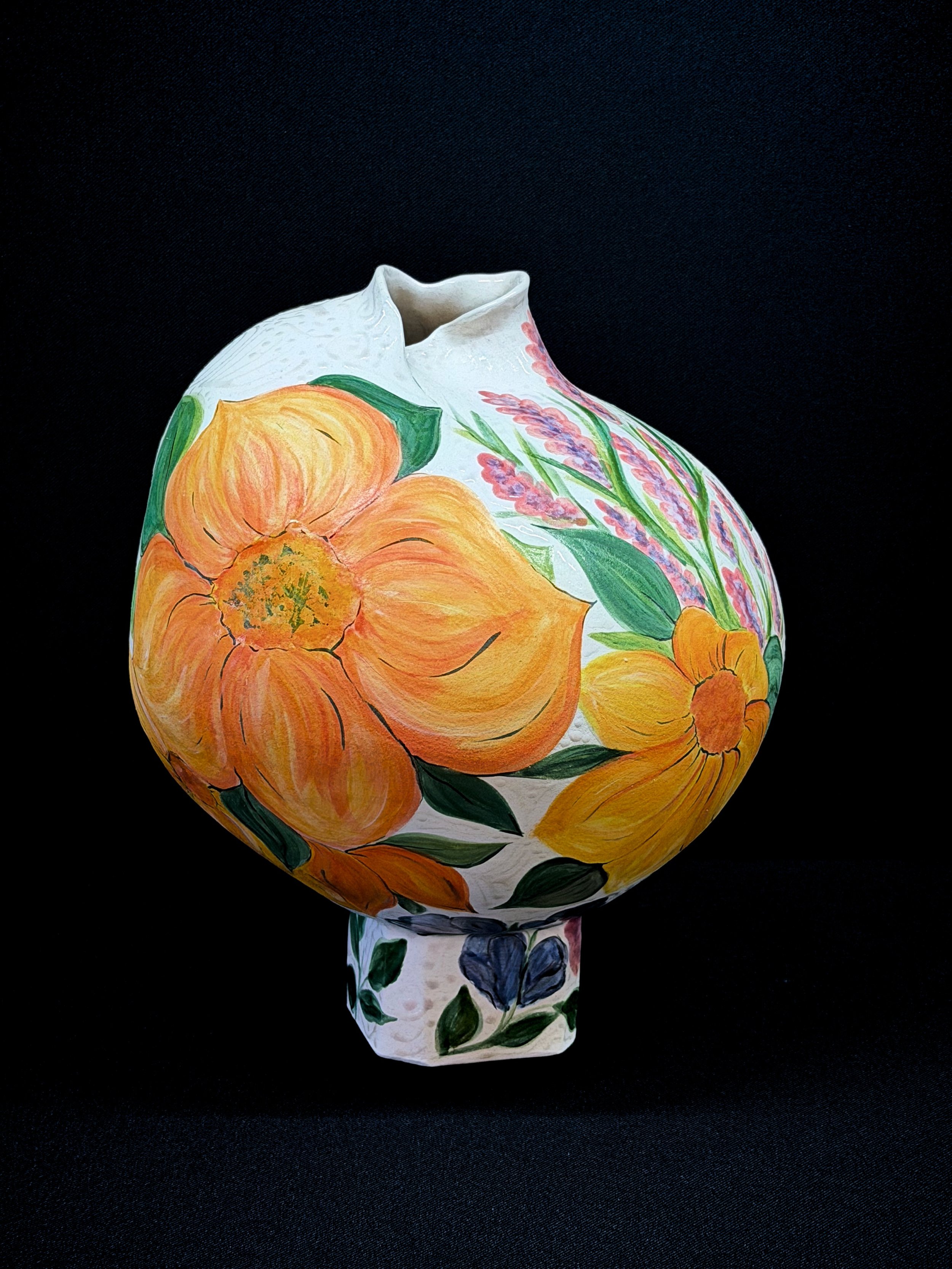
The flowers bloom. The absence remains.
A Void in the Garden explores absence held within a form rather than cut completely through it.
The vessel is deliberately awkward: a cubular base supports an uneven rounded body, the rim rises and dips unpredictably, and an off-centre rectangular void enters the vessel without passing all the way through.
Around that absence, the surface remains unexpectedly abundant. Flowers, leaves, colour and small clear-glaze marks continue across the body. The floral language is intentionally direct and folk-like rather than botanical or refined.
What interests me most is the coexistence of those two things: the garden continues, and the void remains.
This was an early work in my return to clay, and the surface reflects that period of experimentation. Some colour passages are heavier and more literal than I would use now, but the central idea has remained important in later work: absence does not always need to be repaired, closed or removed.
Sometimes it simply becomes part of the landscape.
Hands Off · 2025
Coil-built ceramic vessel; slab-built interruption, layered ceramic surfaces, openings/voids, handprints and raised marks
28 × 23 cm · 2,417 g
CA$650 · Available
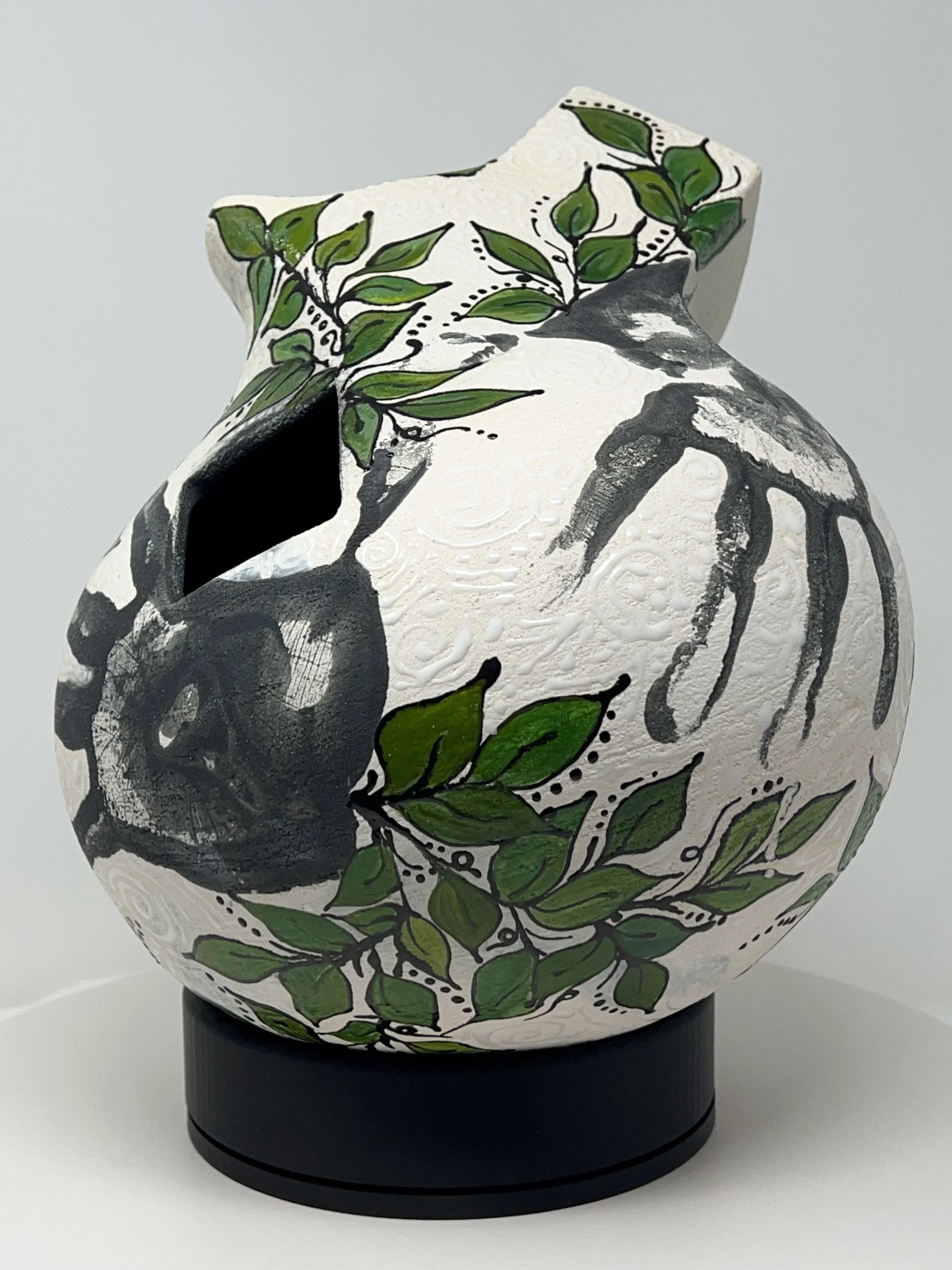
Hands Off — Boundaries made physical.
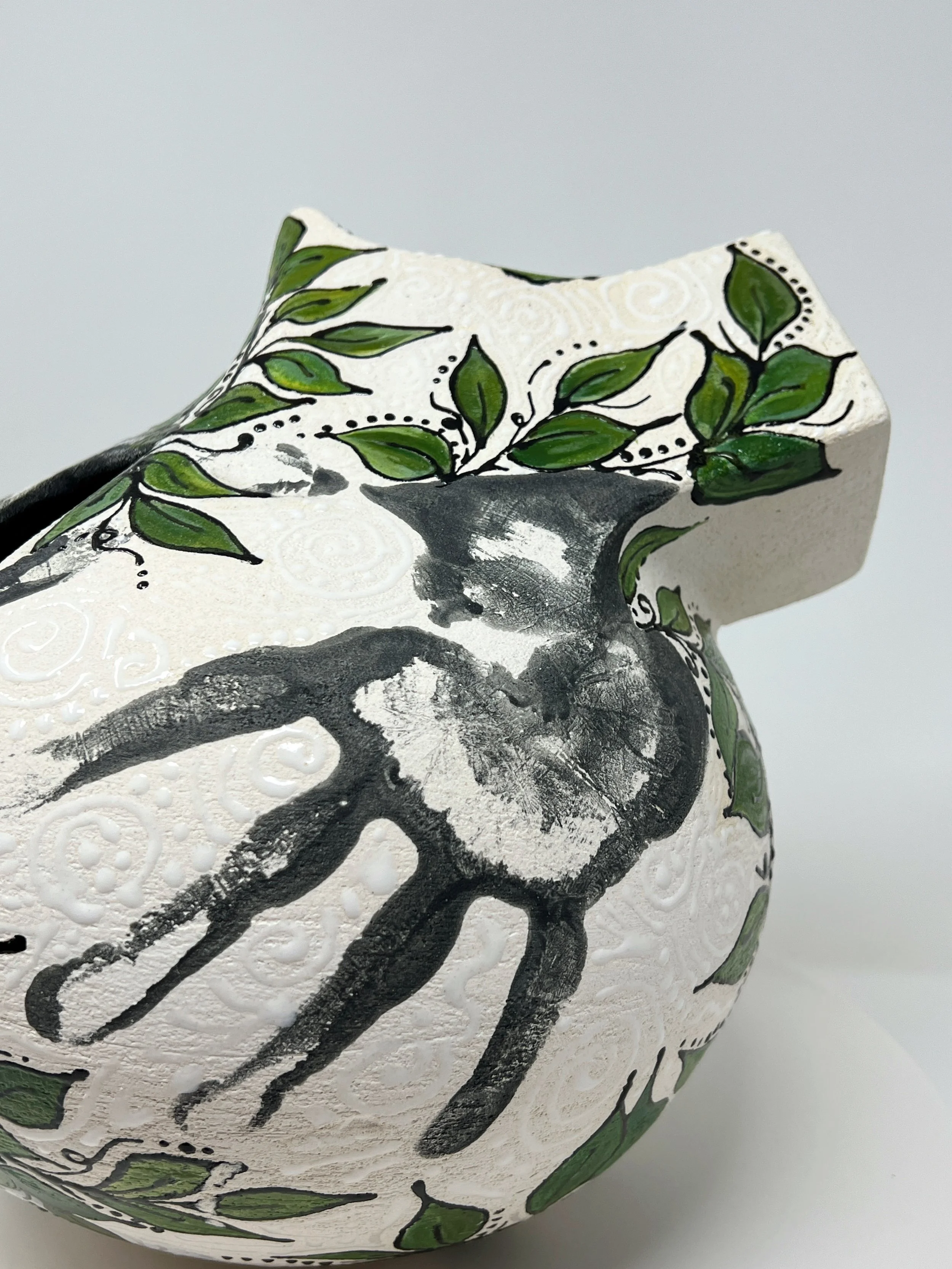
The marks remain. They do not define the whole form.
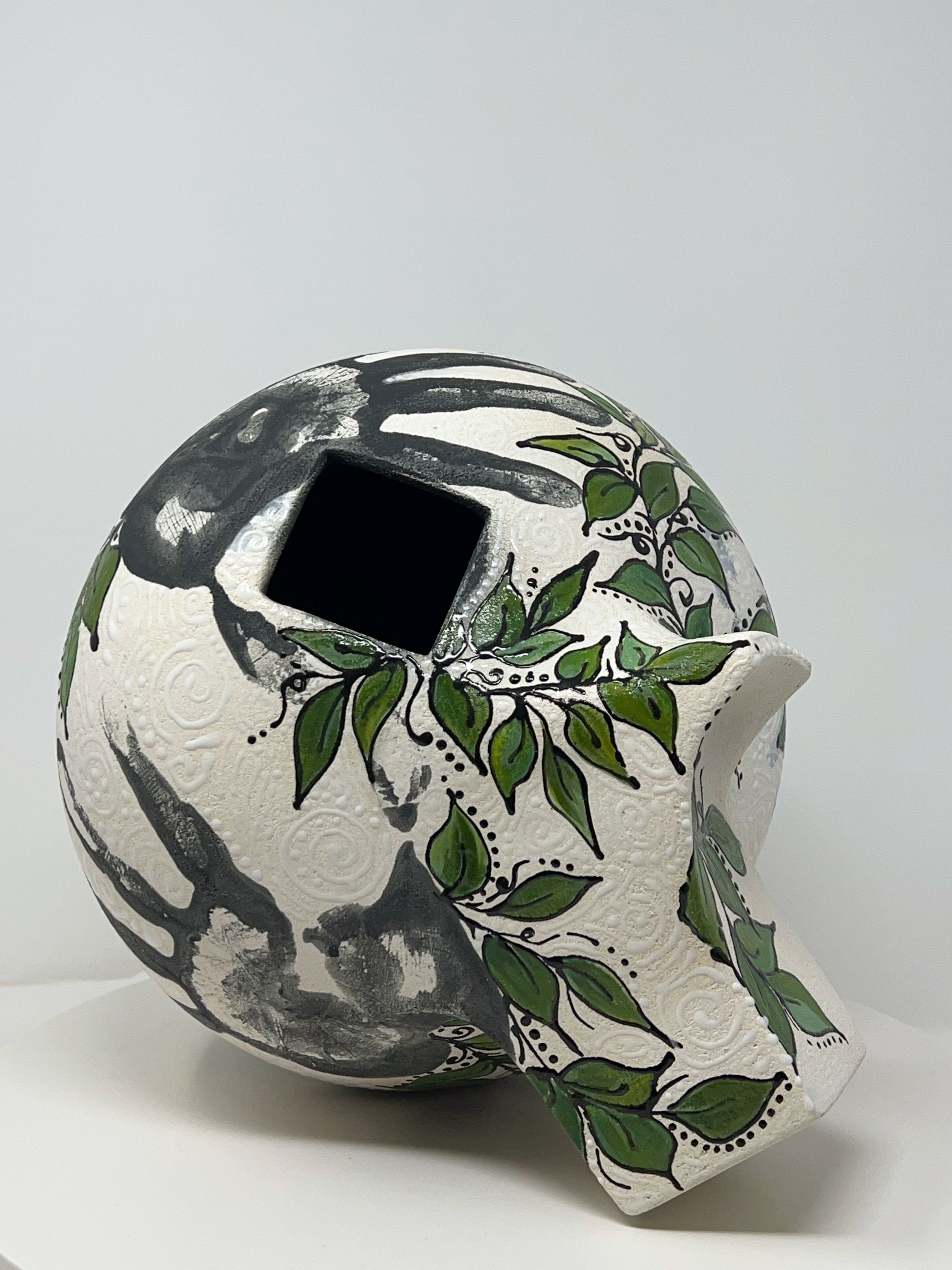
The opening becomes a place of vulnerability, access and refusal.
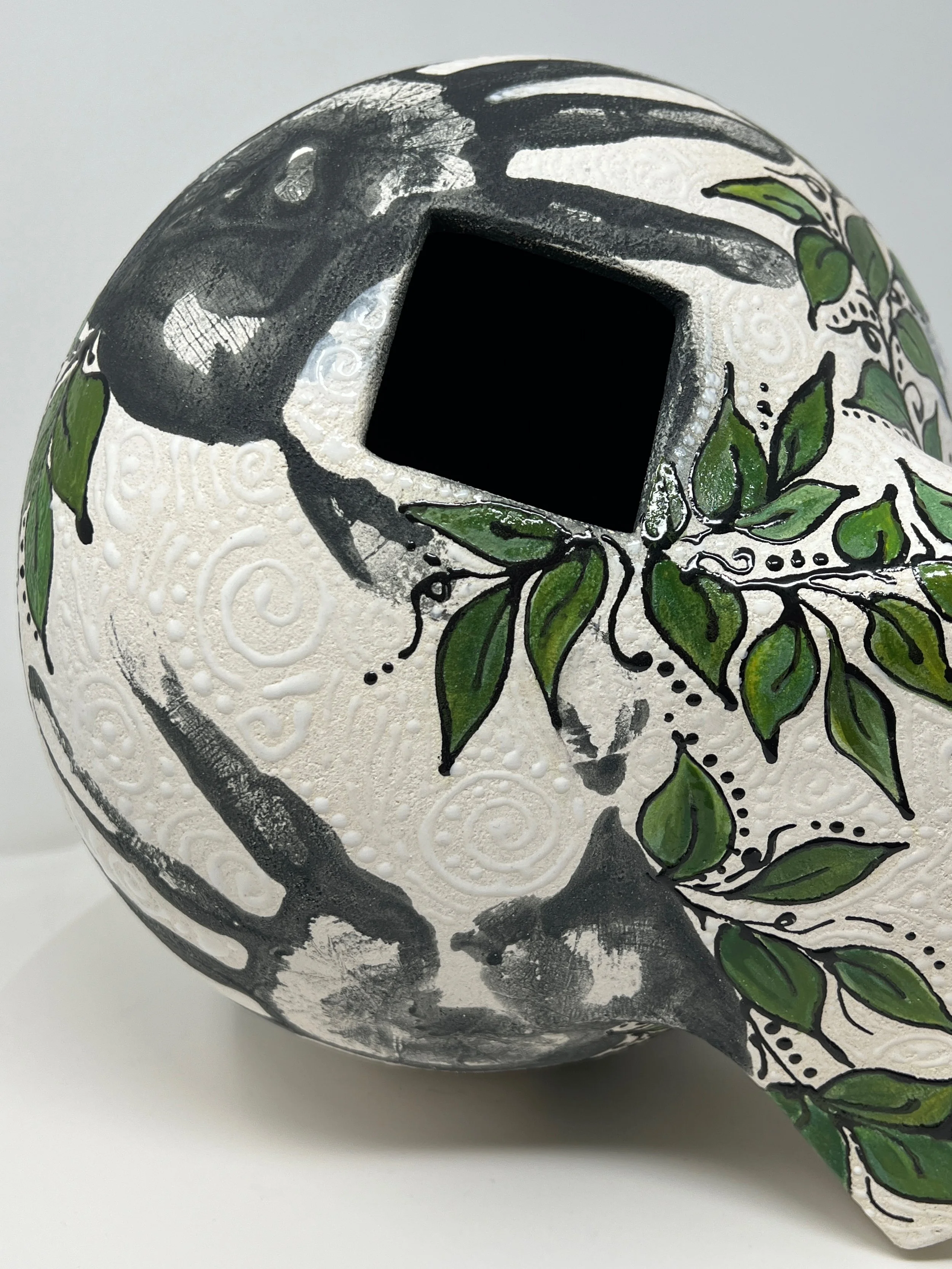
Growth continues around what has been breached.
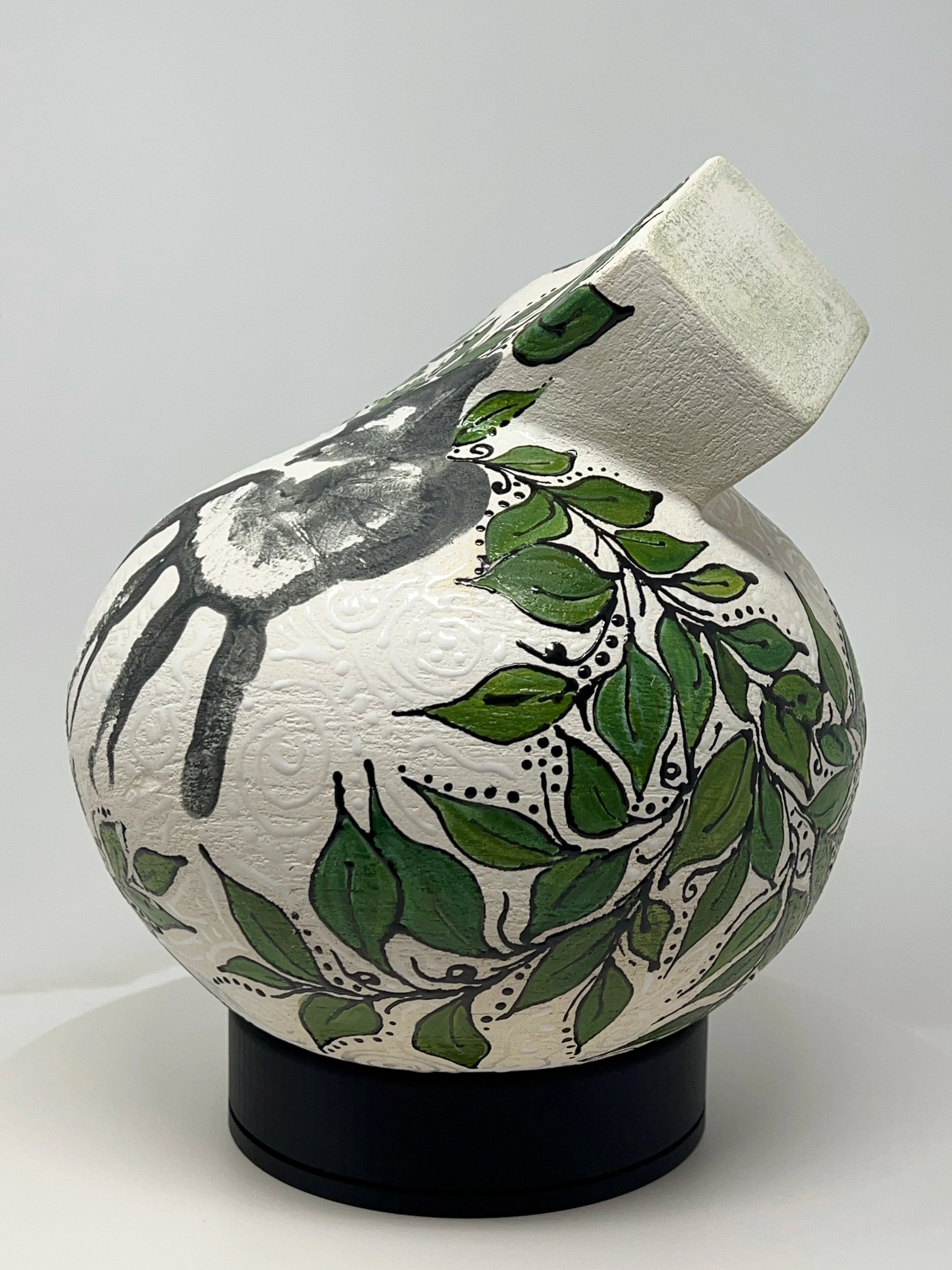
The body remains its own.
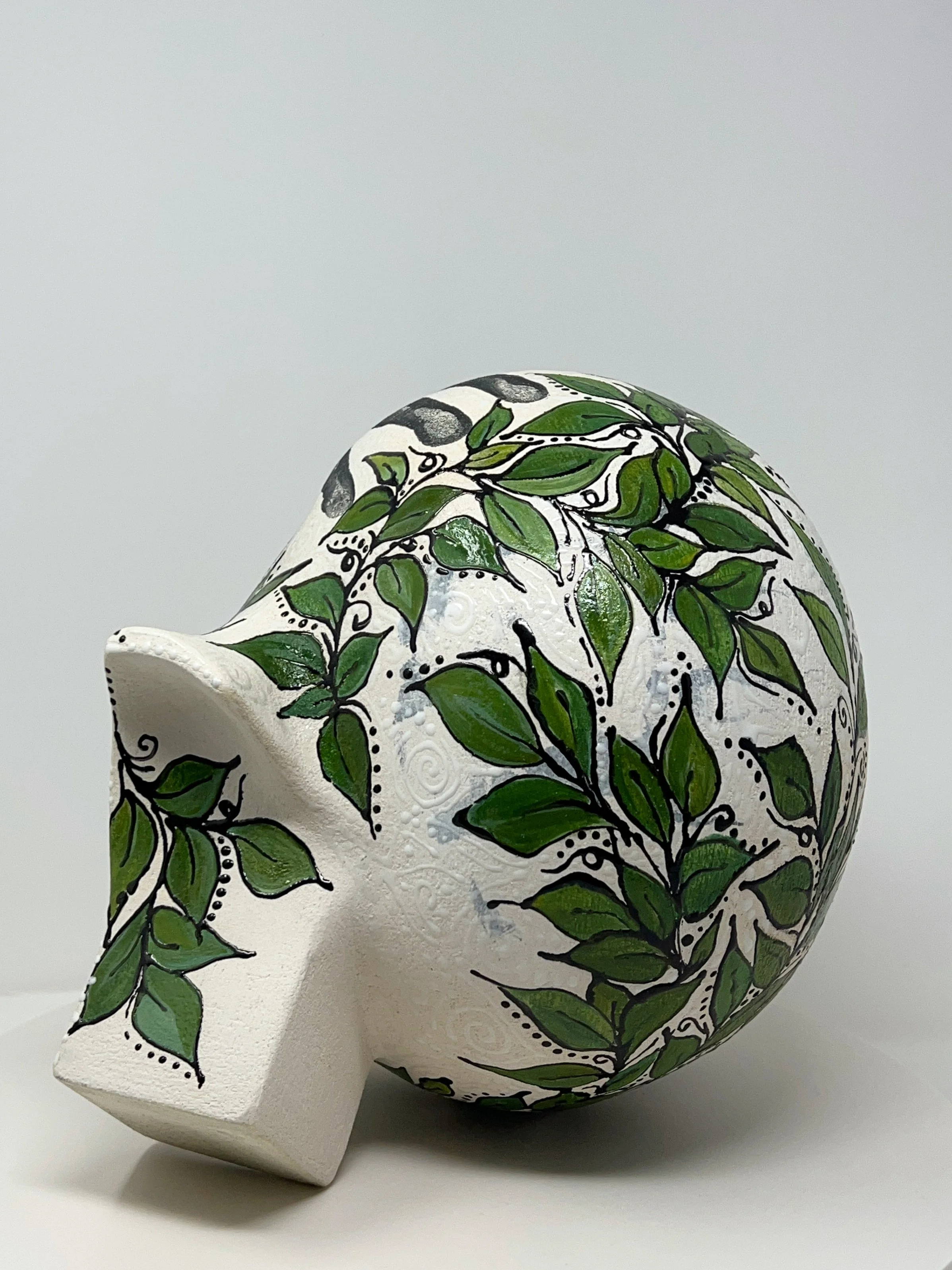
Hands off. This is mine.
Hands Off · 2025
Coil-built ceramic vessel; slab-built interruption, layered ceramic surfaces, openings/voids, handprints and raised marks
28 × 23 cm · 2,417 g
CA$650 · Available
Hands Off explores boundaries as something physical rather than abstract.
The vessel is deliberately uncomfortable. A rounded body is interrupted by a projecting slab-built form, a dark opening cuts into the surface, and handprints remain visible across the clay.
The piece developed from thinking about what happens when personal boundaries are ignored or crossed. The opening is not simply decorative negative space; it suggests access, vulnerability and the possibility of intrusion.
At the same time, growth continues around the damaged or exposed areas. Leaf-like marks move across the surface and around the opening rather than avoiding it.
The work does not attempt to erase what happened.
It asks what it means to reclaim ownership of the body and of the space around it.
Hands off. This is mine.
The Flame Within · 2025
Coil-built stoneware; mixed ceramic surface treatments and internal ceramic element
23 × 27 cm
Collection of Artist · Conceptual reference work · Not for sale
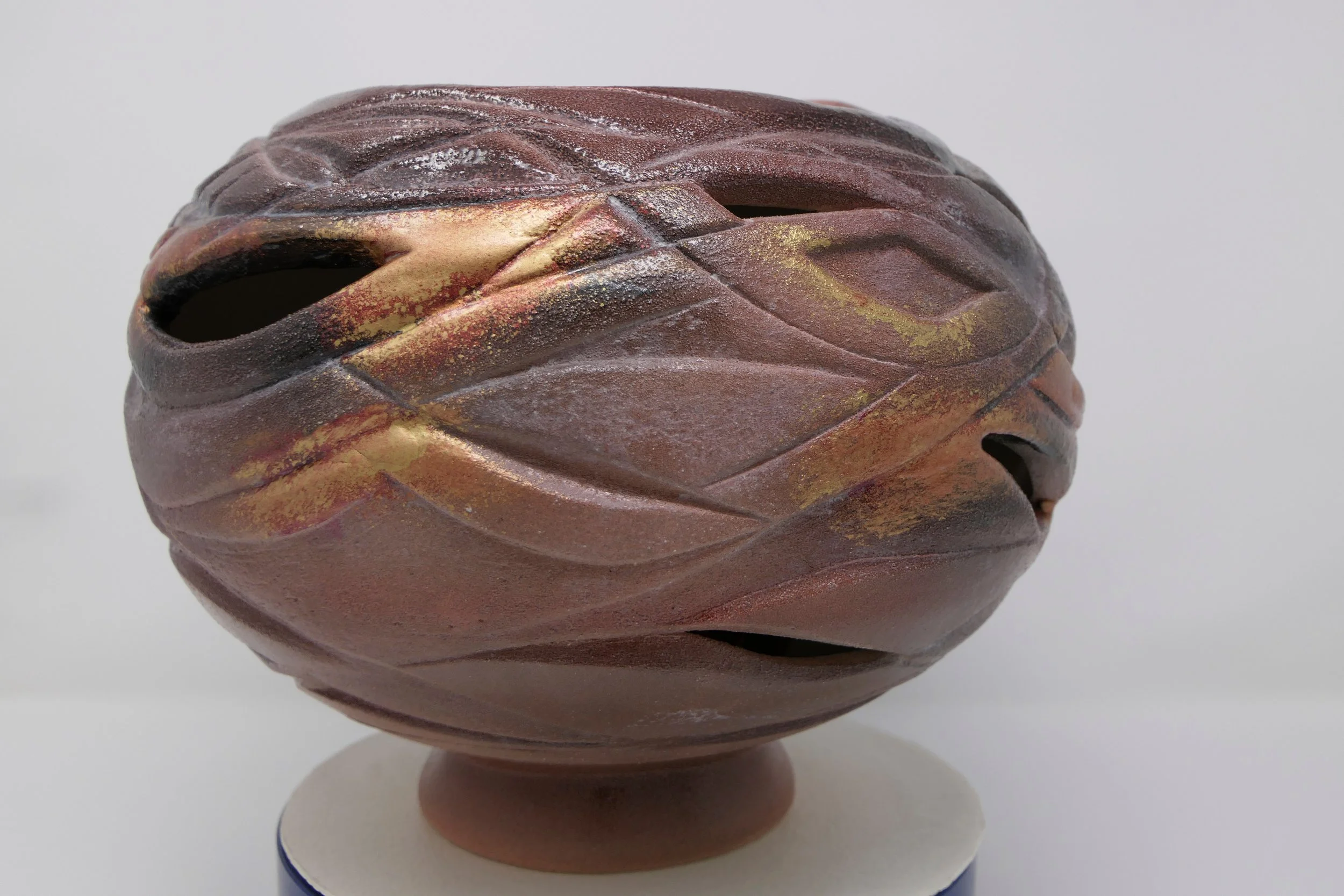
The Flame Within — An early exploration of inner and outer form.
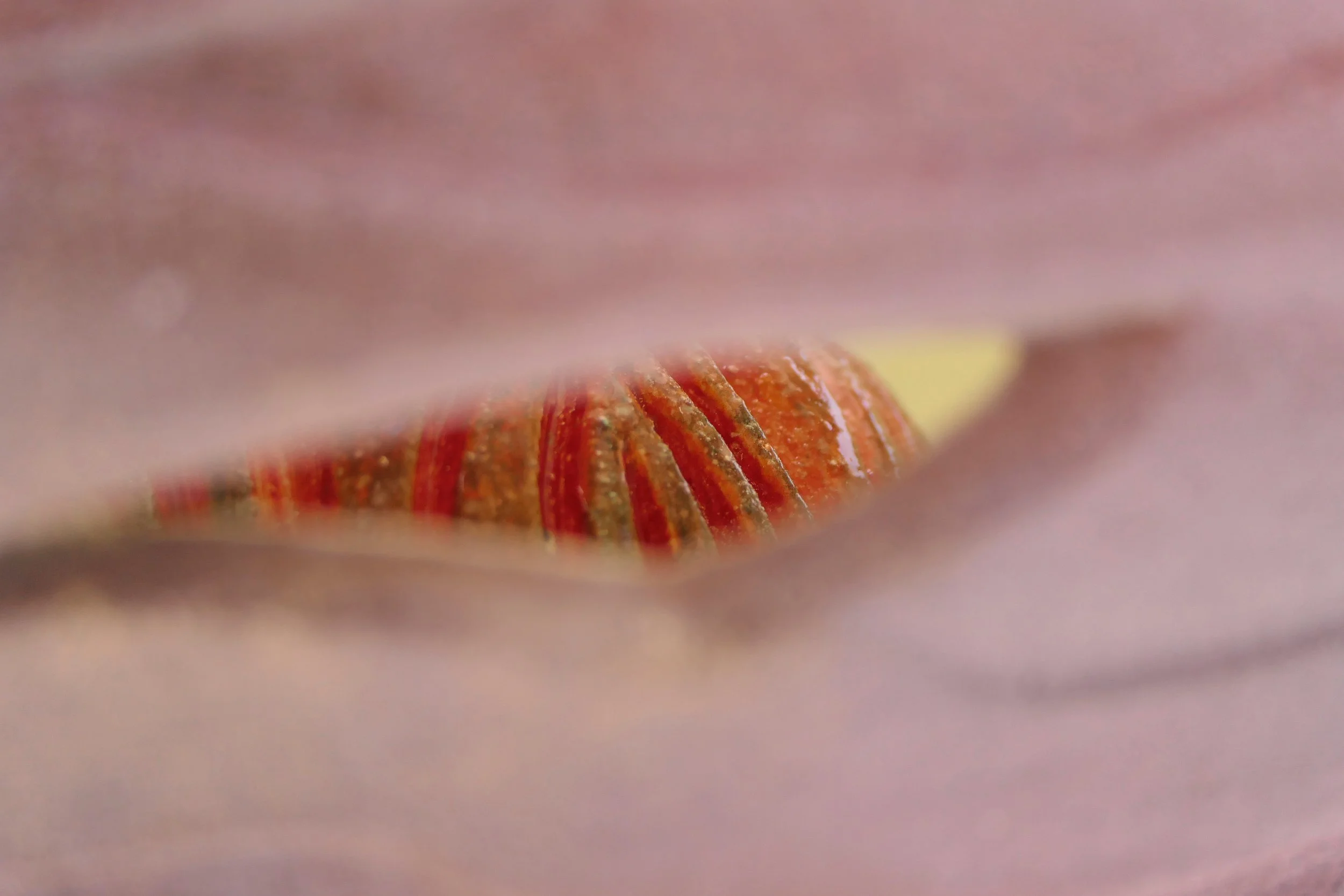
A smaller vessel is held within the larger body.
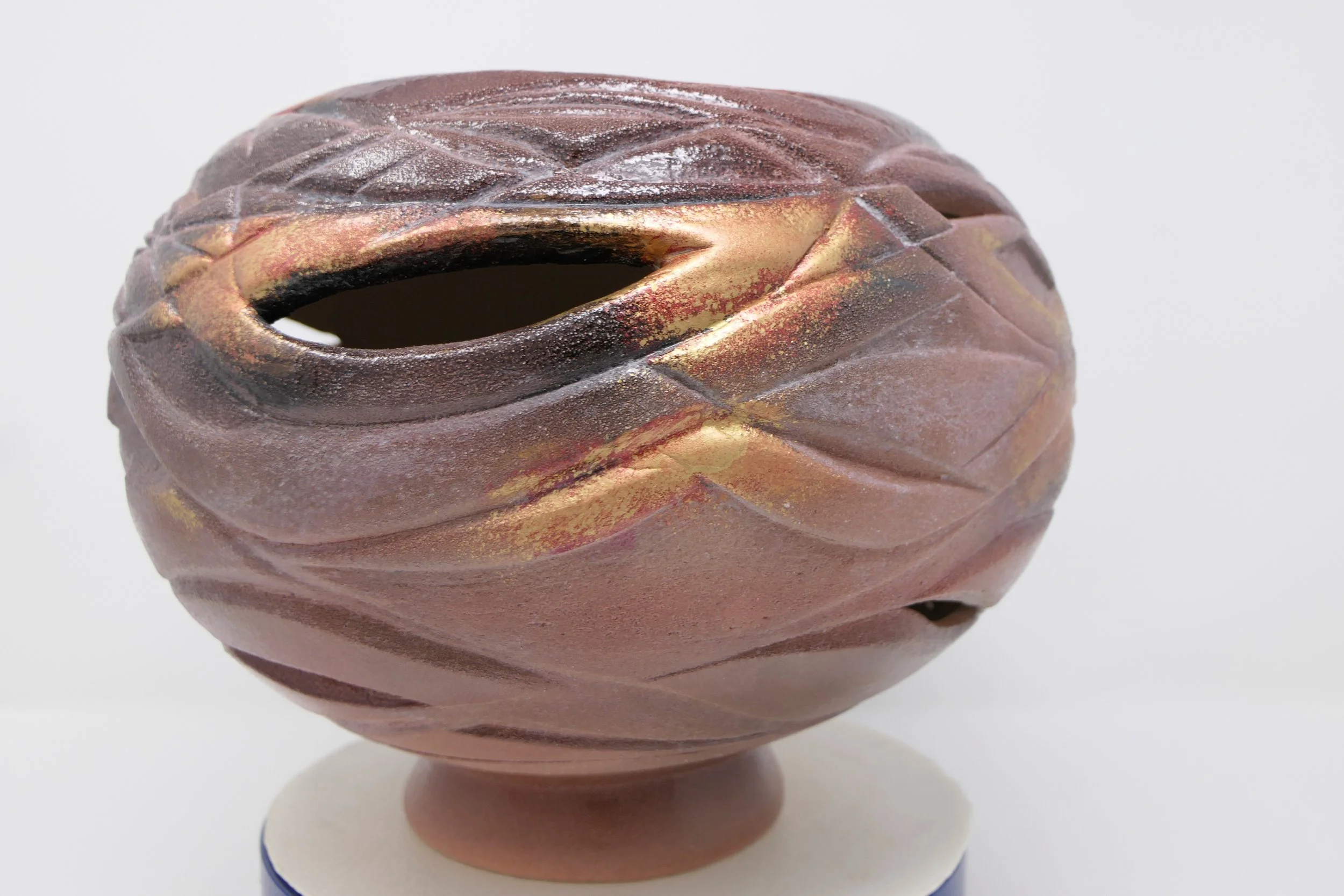
The idea proved stronger than the surface resolution.
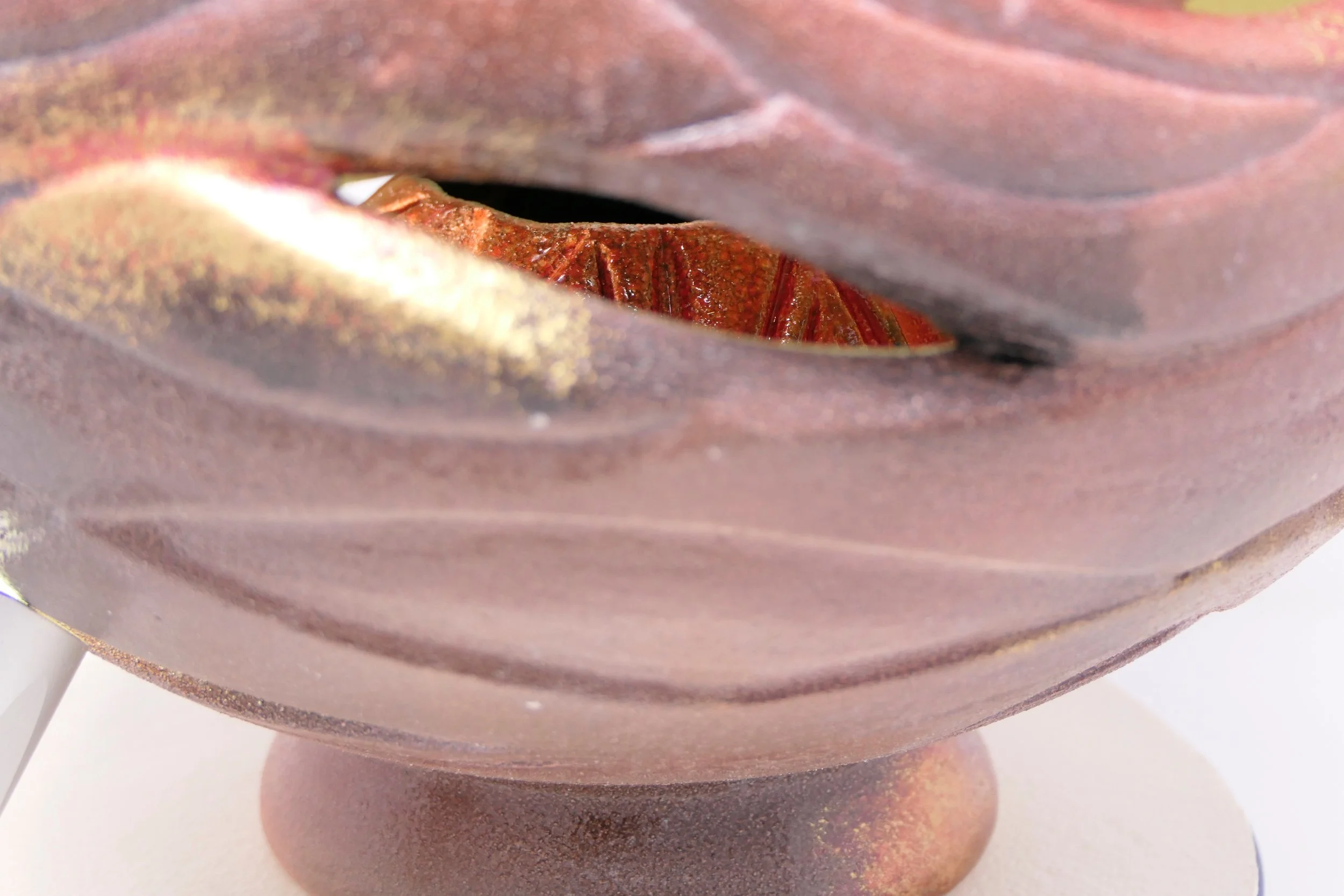
What remained worth carrying forward was the inner flame itself.
The Flame Within is more important to me for the idea it carries than for its technical resolution.
The vessel explores something held inside something else: an inner flame, light, pain or energy that is not immediately visible from the exterior. Openings in the outer form offer glimpses inward, where a smaller ceramic element suggests the source of that internal presence.
Technically, the work taught me as much through what did not succeed as through what did. The clay cracked around several openings, the carving lacked the refinement I wanted, and the surface colour never fully settled into the red, brown and burgundy language I had imagined.
The small inner form came closest to the original intention.
I keep The Flame Within because the idea remains important: the interior can carry something the exterior does not immediately reveal. That thread continues through later works, including Keeper of Light.
Guilt Jar · 2025
Coil-built ceramic vessel; mixed ceramic surface treatments
34 × 19 cm
Collection of Artist · Conceptual study · Not for sale
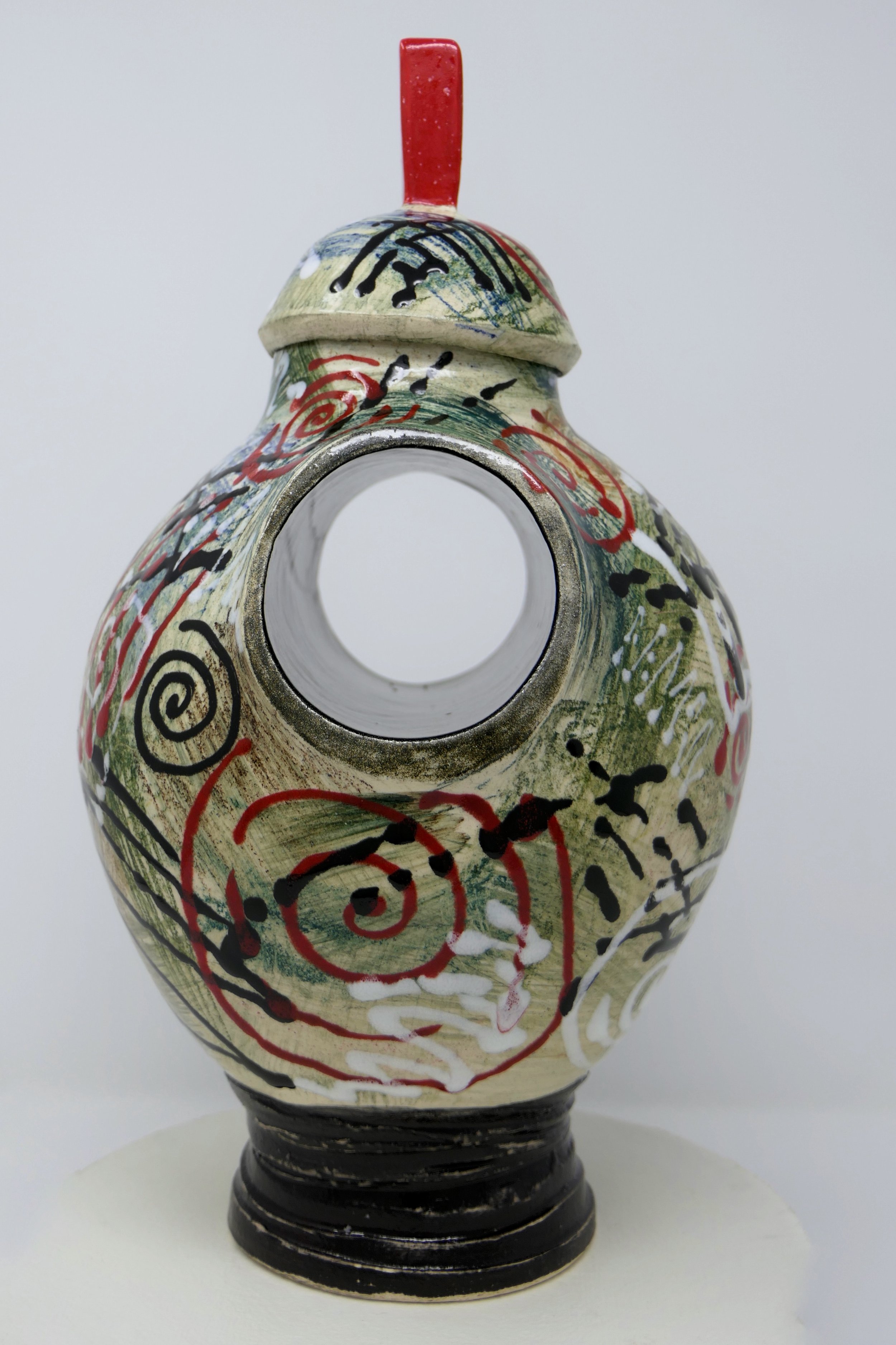
Guilt Jar — A vessel designed to hold what we are ready to put down.
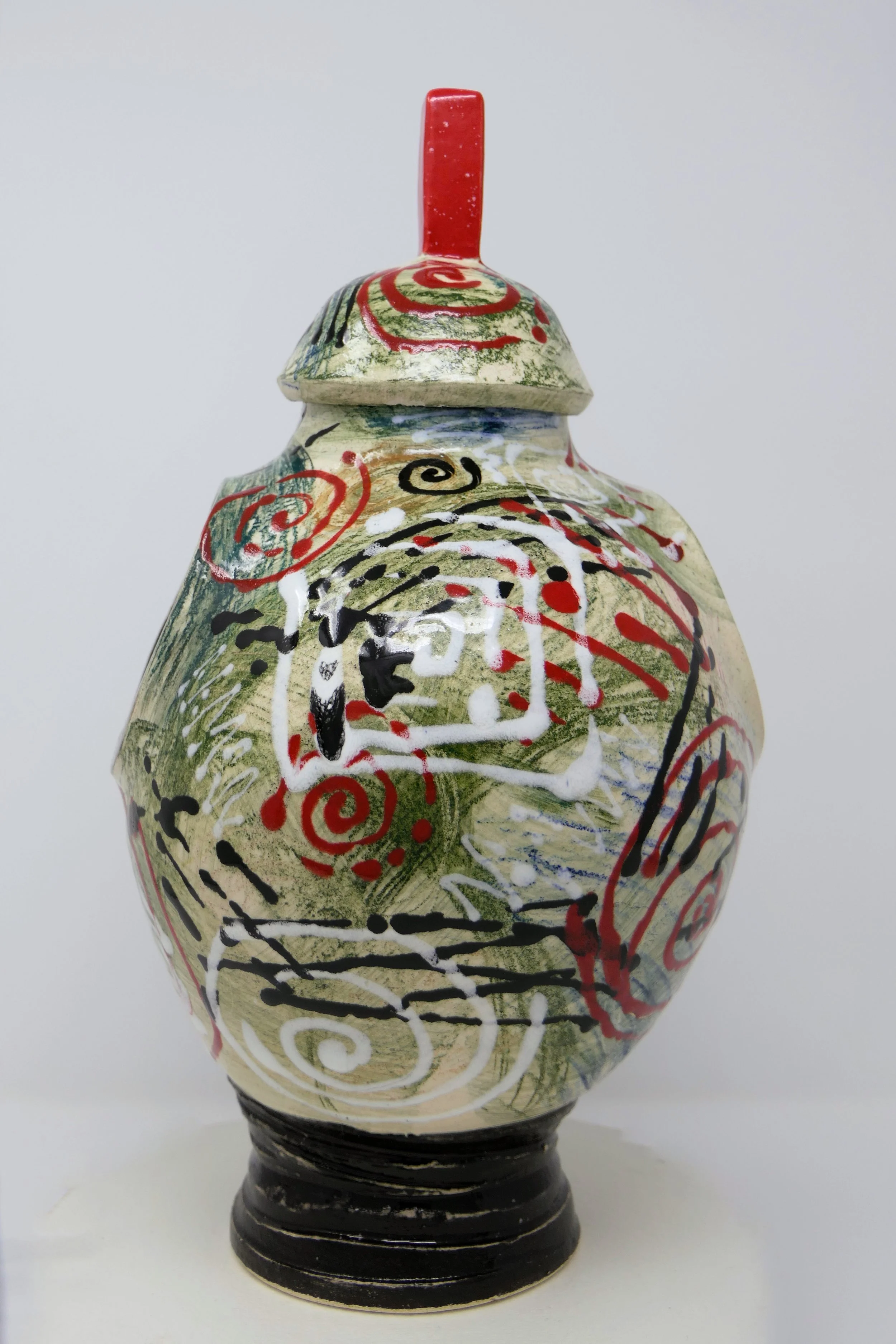
Containment became emotional as well as physical.
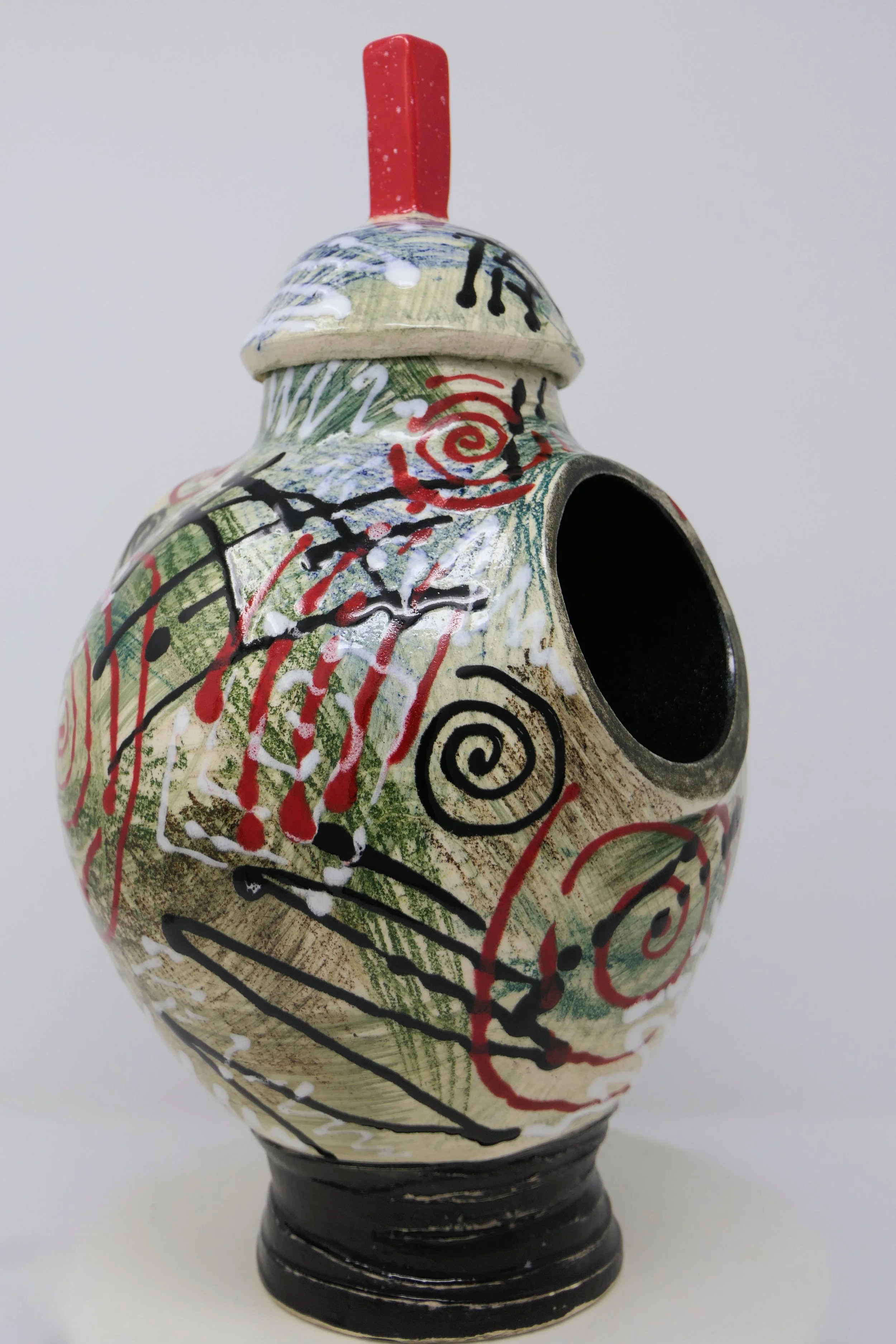
Write it down, drop it in, and let the vessel do the holding.
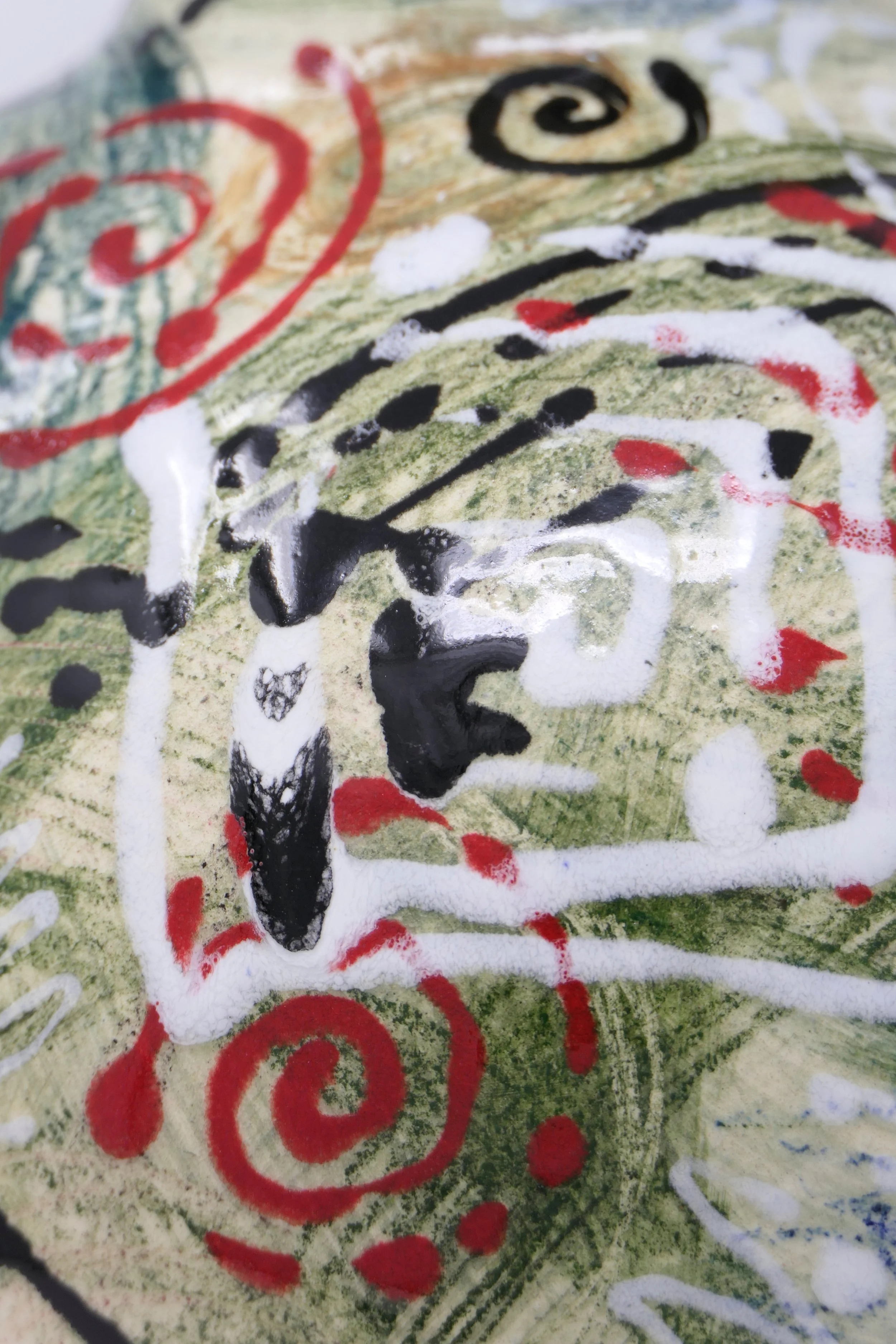
The first note never came back out. That became the work.
Guilt Jar · 2025
Coil-built ceramic vessel; mixed ceramic surface treatments
34 × 19 cm
Collection of Artist · Conceptual study · Not for sale
Guilt Jar began as an experiment in giving an emotional experience a physical place to go.
The vessel invites a simple action: write down something you feel guilty about, place the note inside, and let the vessel hold it.
The most interesting part of the work emerged accidentally. Once a note was dropped through the opening, it could not easily be retrieved. What began as a ceramic vessel became a one-way container — a place to put something down without immediately taking it back.
Technically, this is not one of the works I consider fully resolved. The surface belongs to an earlier period of experimentation and is more visually busy than I would choose now.
But the concept remains useful to me: containment can be emotional as well as physical.
That idea continues to influence how I think about vessels, openings, interiors and what an object can be asked to hold.
Confusion on a Plate · 2024
Woven porcelain, stoneware, black underglaze, sgraffito, wire and mixed ceramic surface treatments
Artist’s Collection · Not for Sale
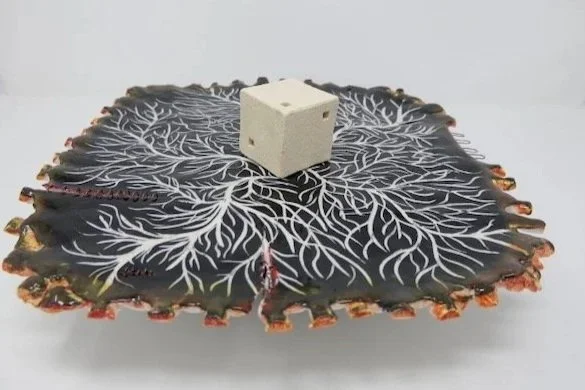
Confusion on a Plate — A fractured body trying to understand what broke it.
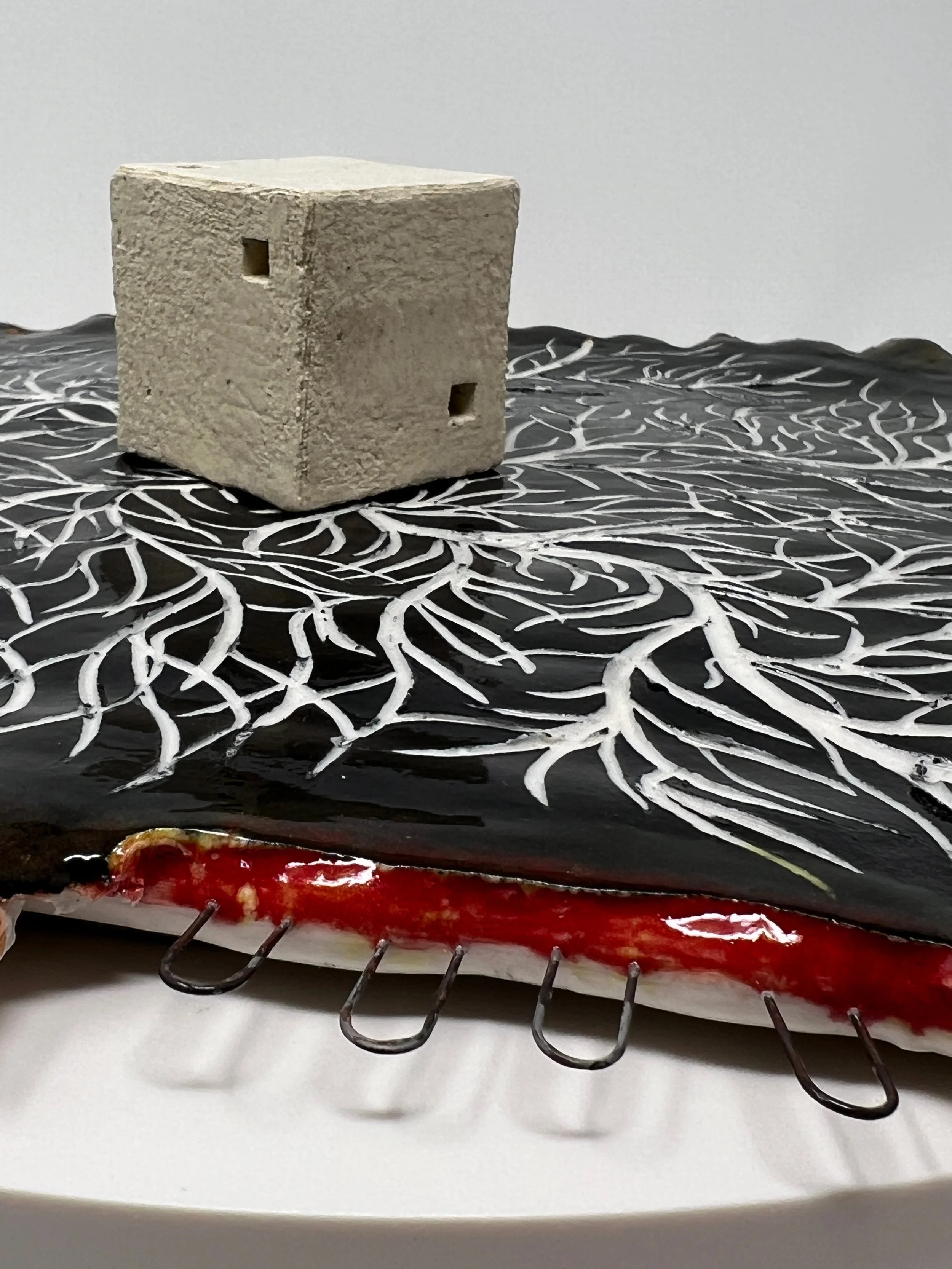
The porcelain began as woven coils, then flattened, cracked and broke as it dried.
Wire staples hold broken edges together like a ribcage closed after being cut open.
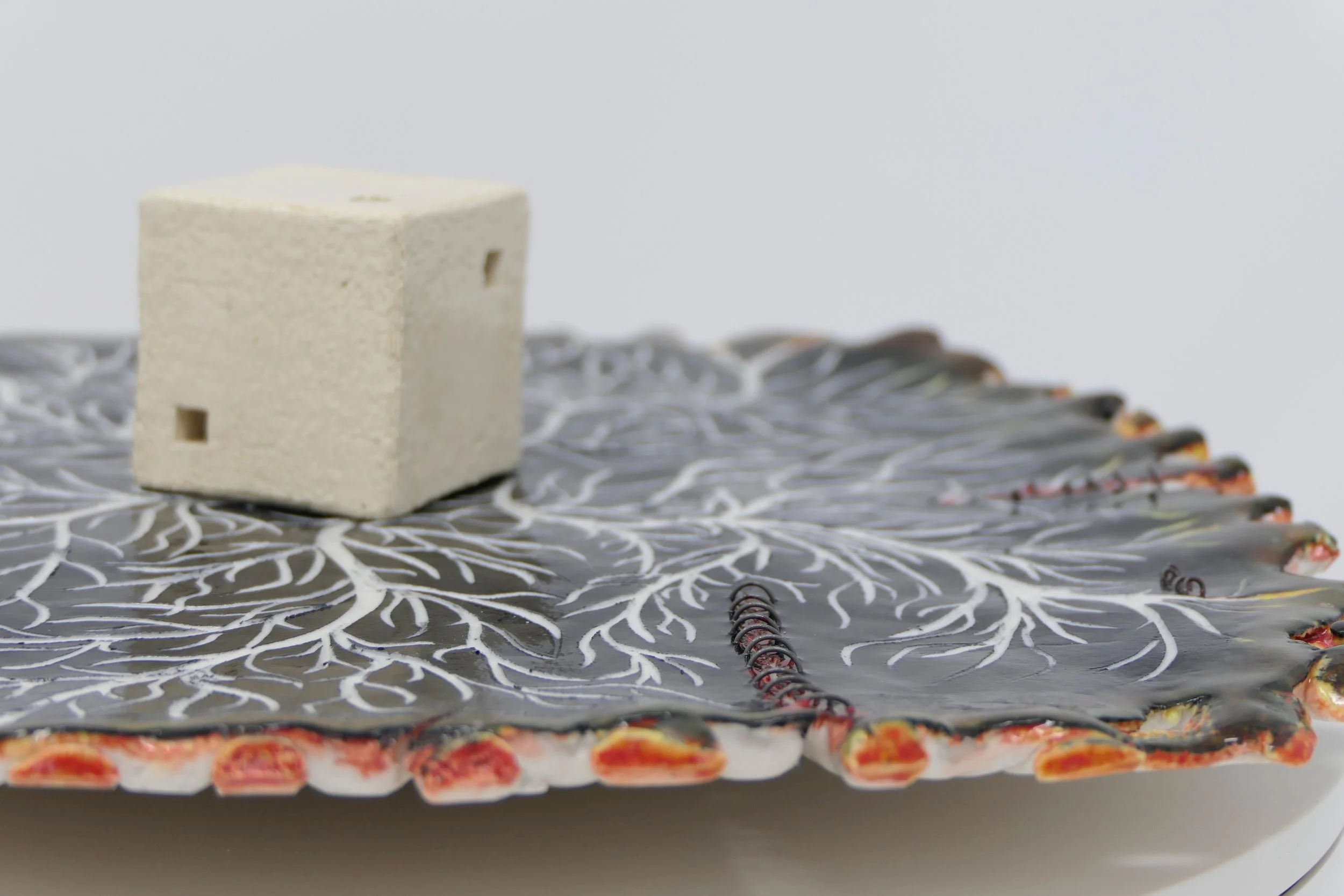
Sgraffito marks spread across the interior like branching tissue or the inside of a lung.
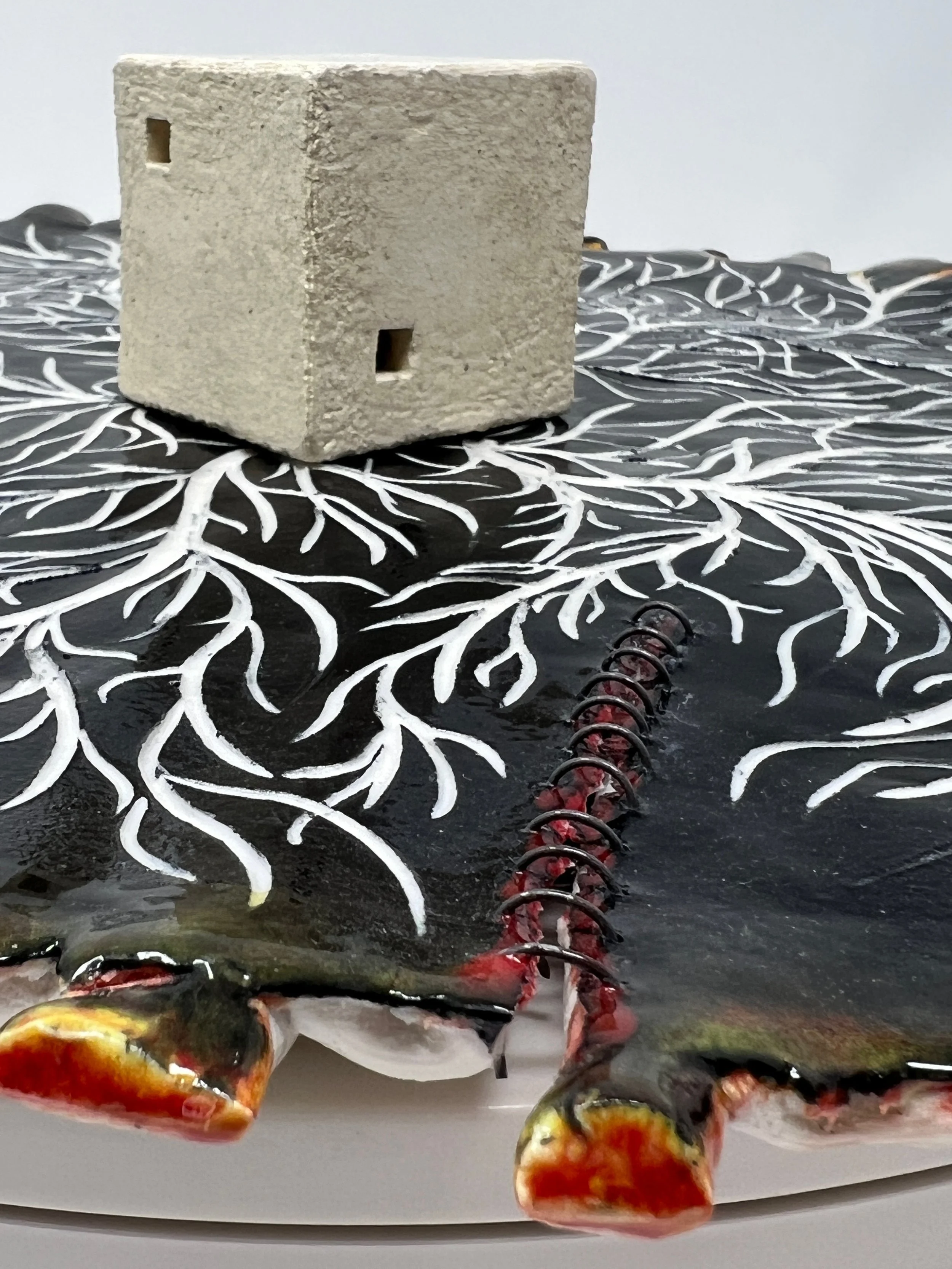
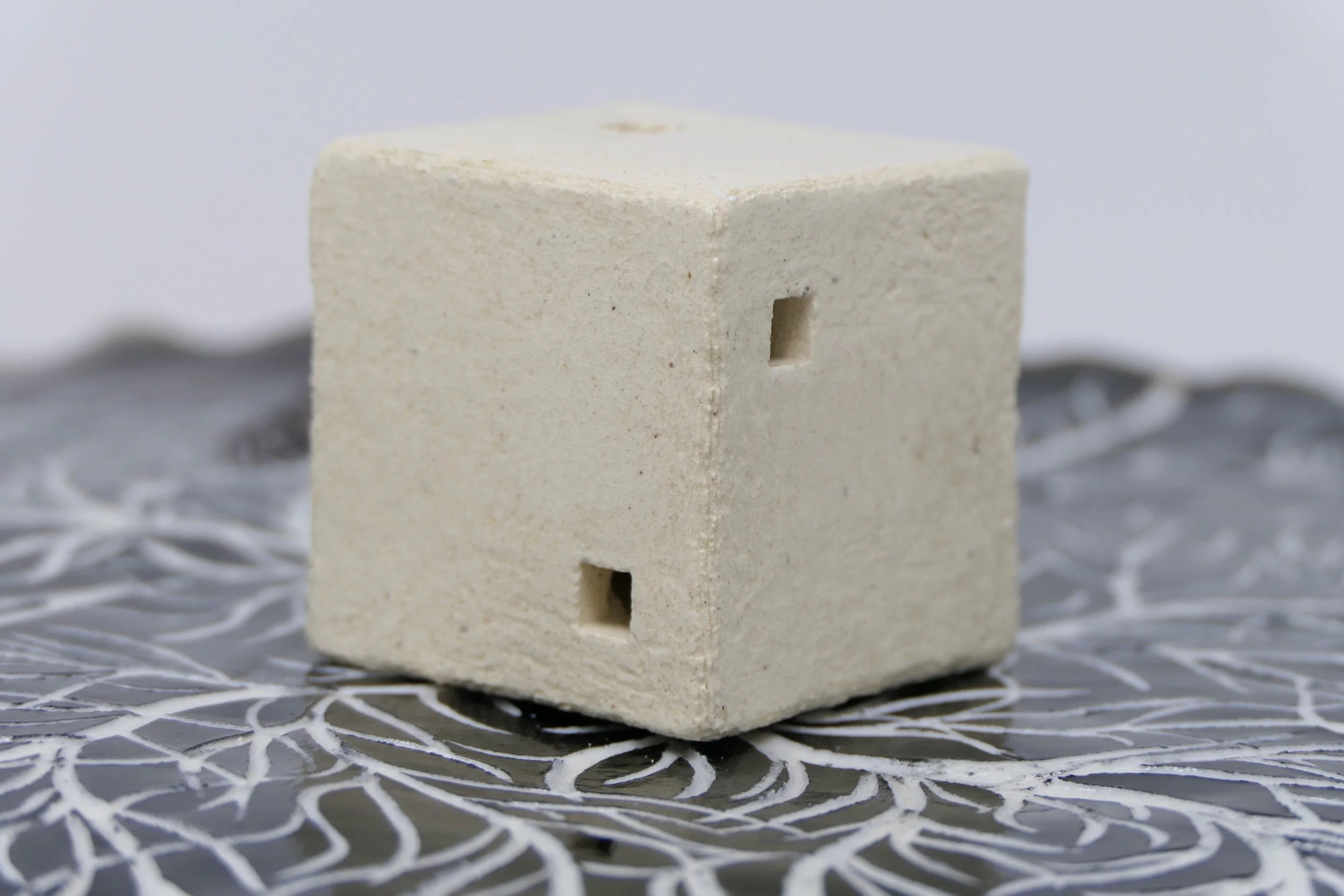
The carefully made cube represents the ordered, analytical “square” I had learned to perform.
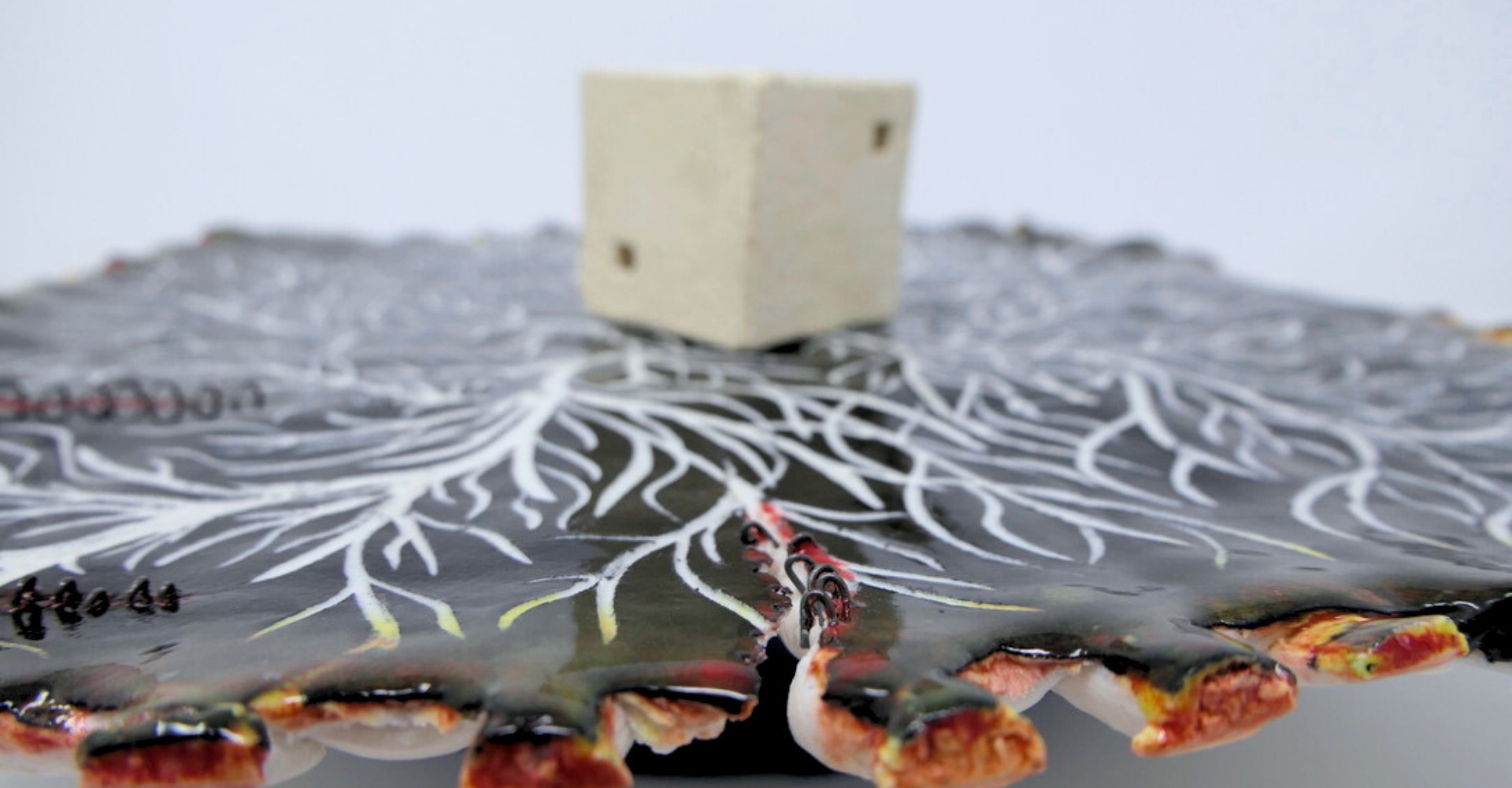
I could carry the cube. The question was what carrying it had cost.
Confusion on a Plate was made early in my medical leave, at a time when I was trying to understand how I could have been so capable and still have reached a point of collapse.
The plate began with porcelain coils woven together. I smoothed the inside of the weaving into a semi-flat surface, covered it with black underglaze and carved through it using sgraffito.
As the porcelain dried, the plate began to flatten and crack. Each time it was handled, more broke away. When a friend picked it up and another section fractured, the damage felt strangely accurate rather than accidental.
The broken edges began to resemble a ribcage cut open and crudely stapled back together. Wire staples cross some of the fractures, sharp and exposed, holding together what no longer fits cleanly. The carved interior reminds me of the branching structure of lungs.
Firing altered it again. The plate slumped further, and particles from the kiln shelf fused to the underside, leaving the object sharp and difficult to handle from almost every direction.
Resting on the plate is a small, carefully slab-built cube. Unlike the fractured porcelain beneath it, the cube is controlled, precise and almost perfectly square. Small fragments trapped inside cause it to rattle, and openings through its walls allow the viewer to see through it depending on how it is held.
At the time, a workplace personality assessment had described me as a “square”: analytical, organised, administrative, comfortable with spreadsheets, systems, numbers and rules.
I could do all of those things — and had done them extremely well.
But being capable of something did not mean it came naturally, or that carrying it indefinitely was without cost.
The cube can be moved around the plate, but its weight threatens the fragile surface beneath it.
Confusion on a Plate grew from that contradiction:
If I could do everything people believed I could do, why had doing it broken me? That is the piece.
Discombobulated · 2024–2025
Porcelain and thrown ceramic components; glaze, thread, beads, found stone and epoxy clay
Collaboration: Michelle Winkel & Cheryl-Ann Webster
18 × 33 × 30 cm · 2,754 g
Artist’s Collection · Not for Sale
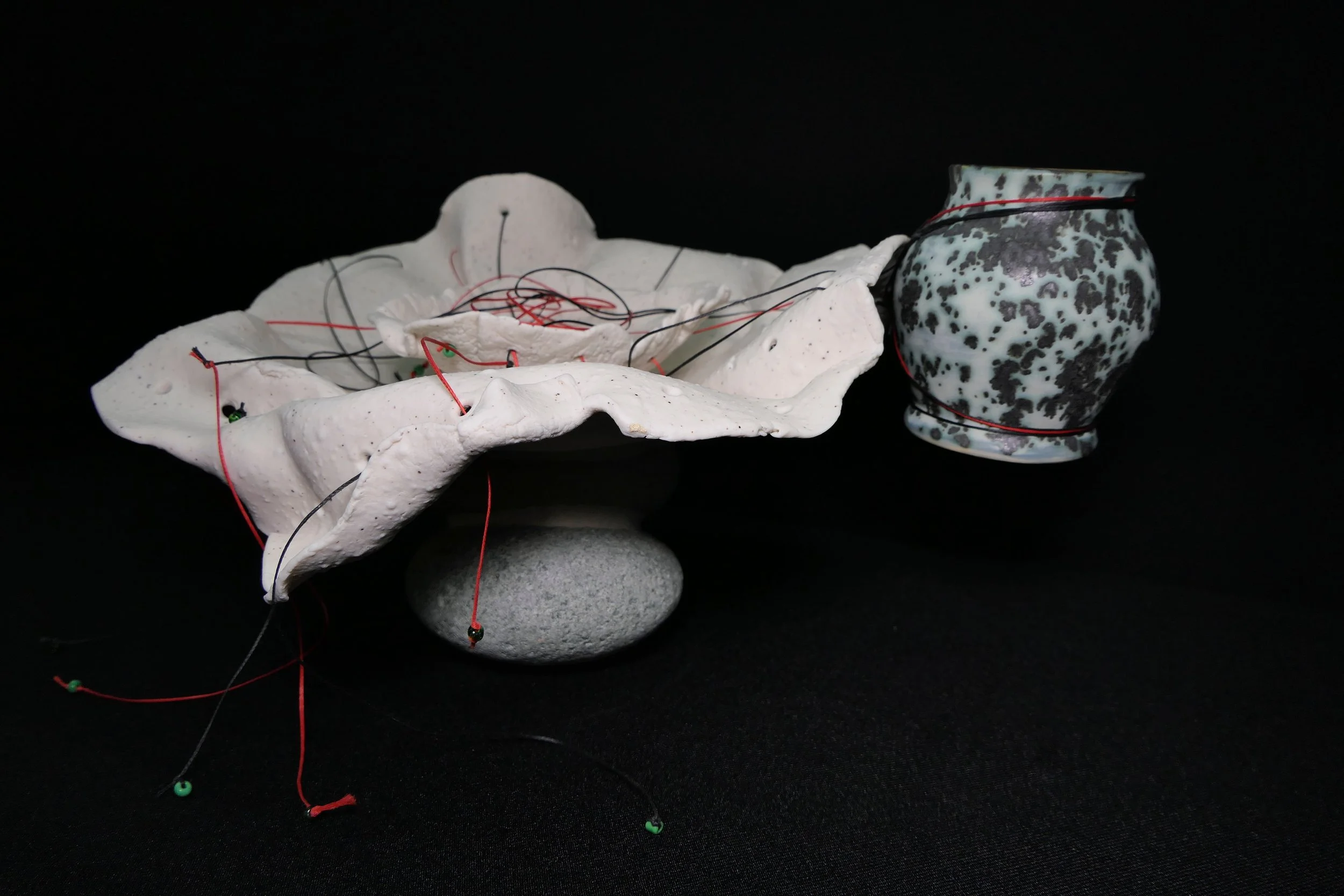
Discombobulated — A kiln accident became a material record of entanglement.
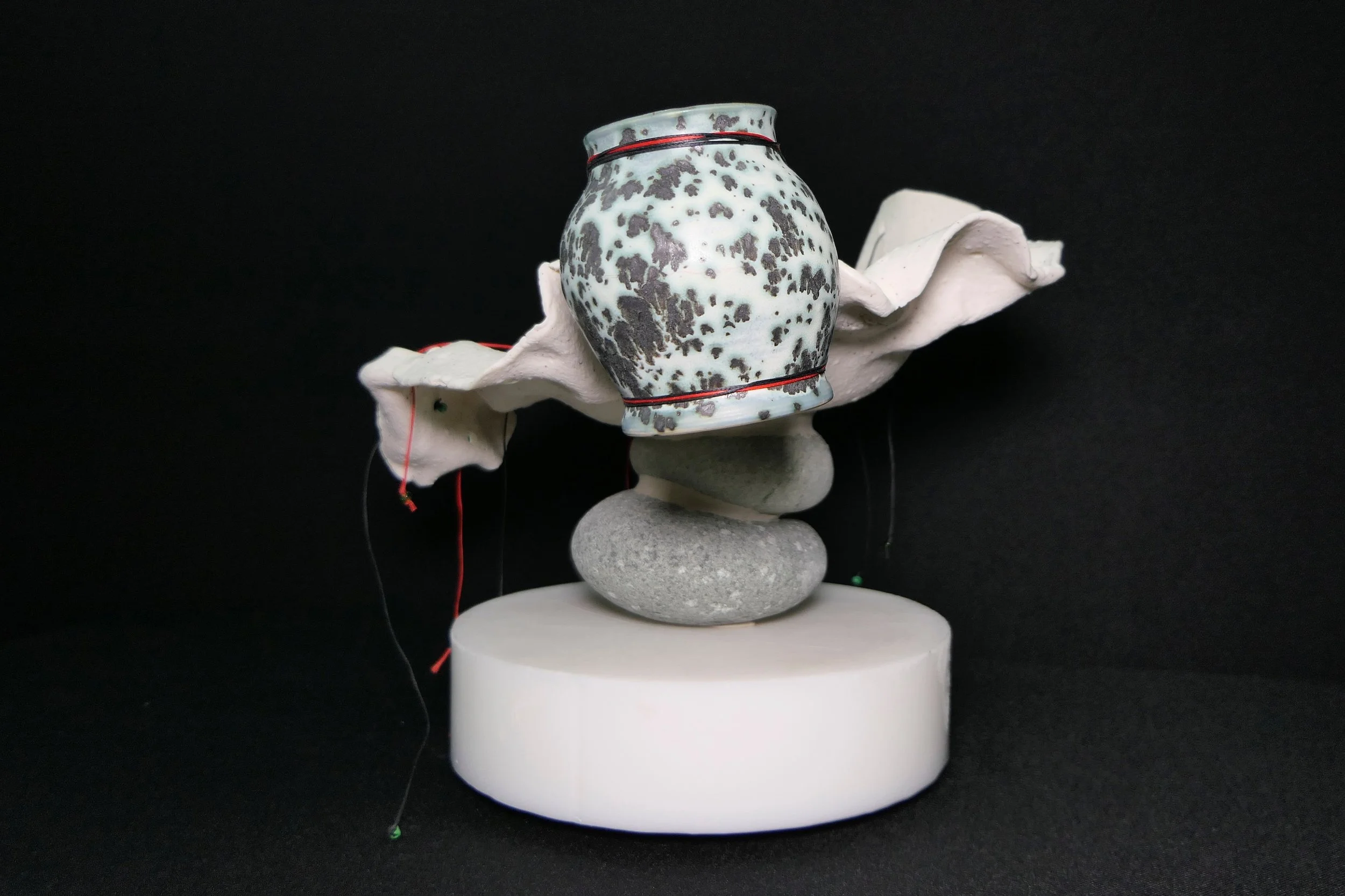
Three ceramic forms became permanently connected in the firing.
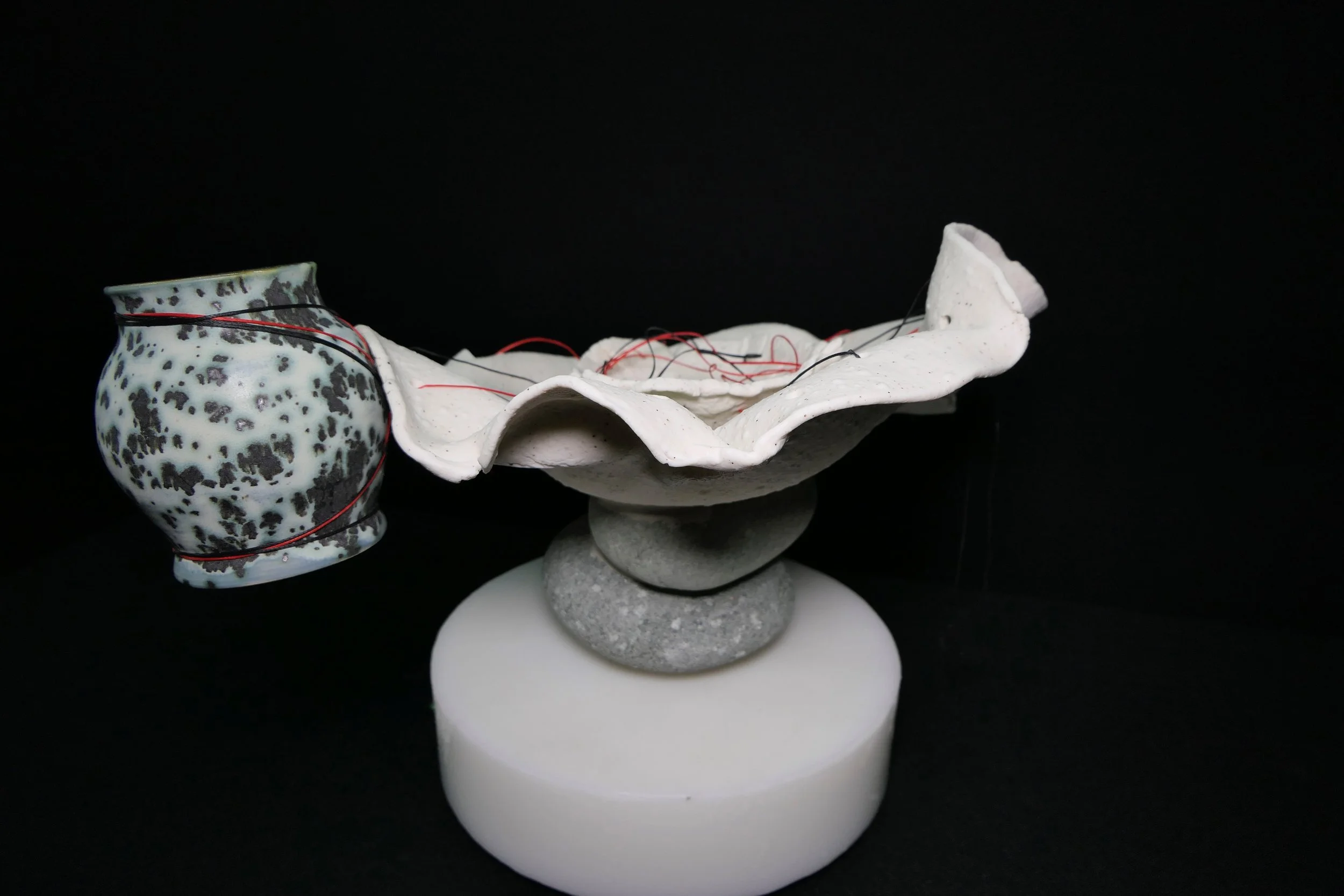
What appears unstable is carefully held in balance.
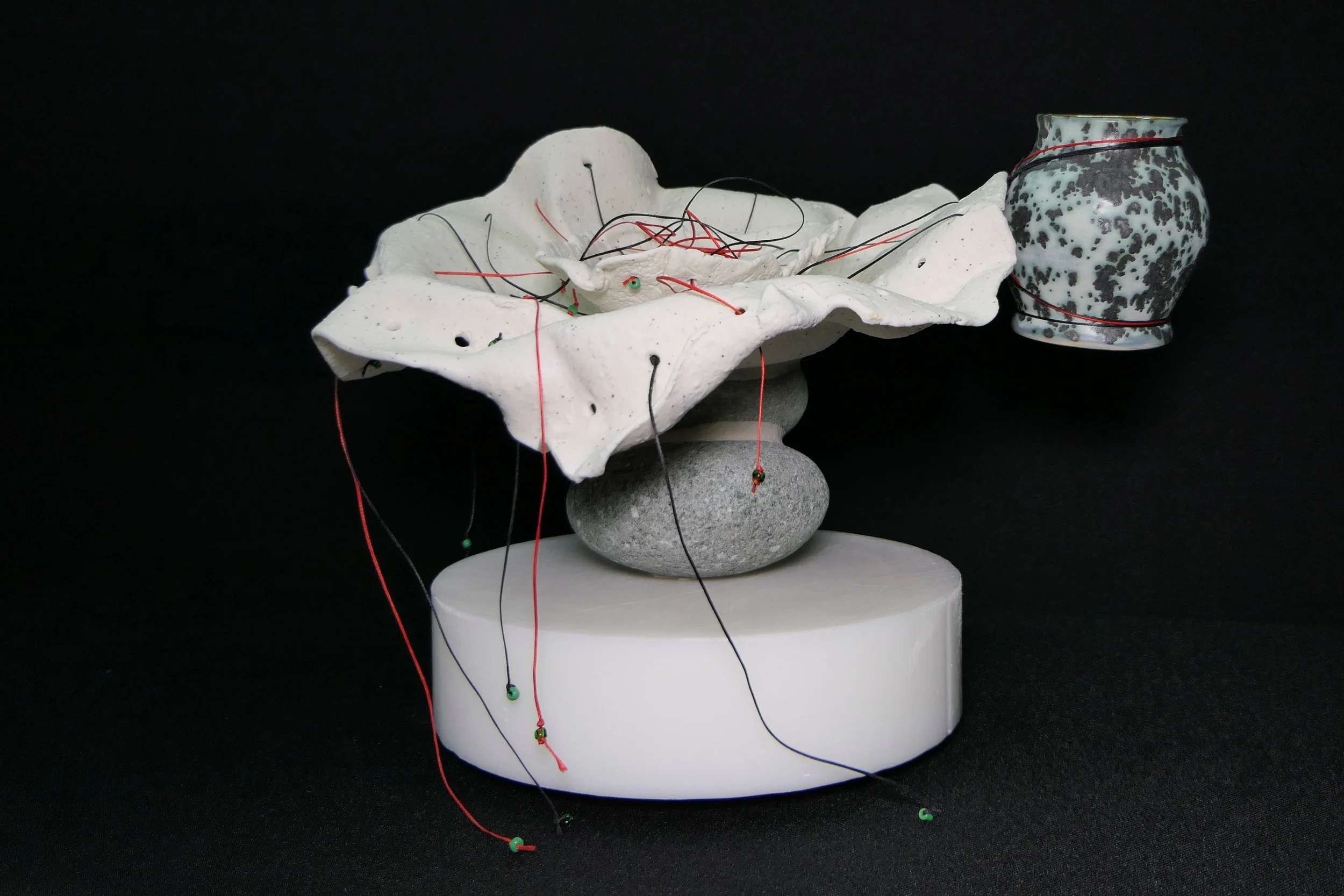
Red and black threads carry emotion, structure and responsibility through the work.
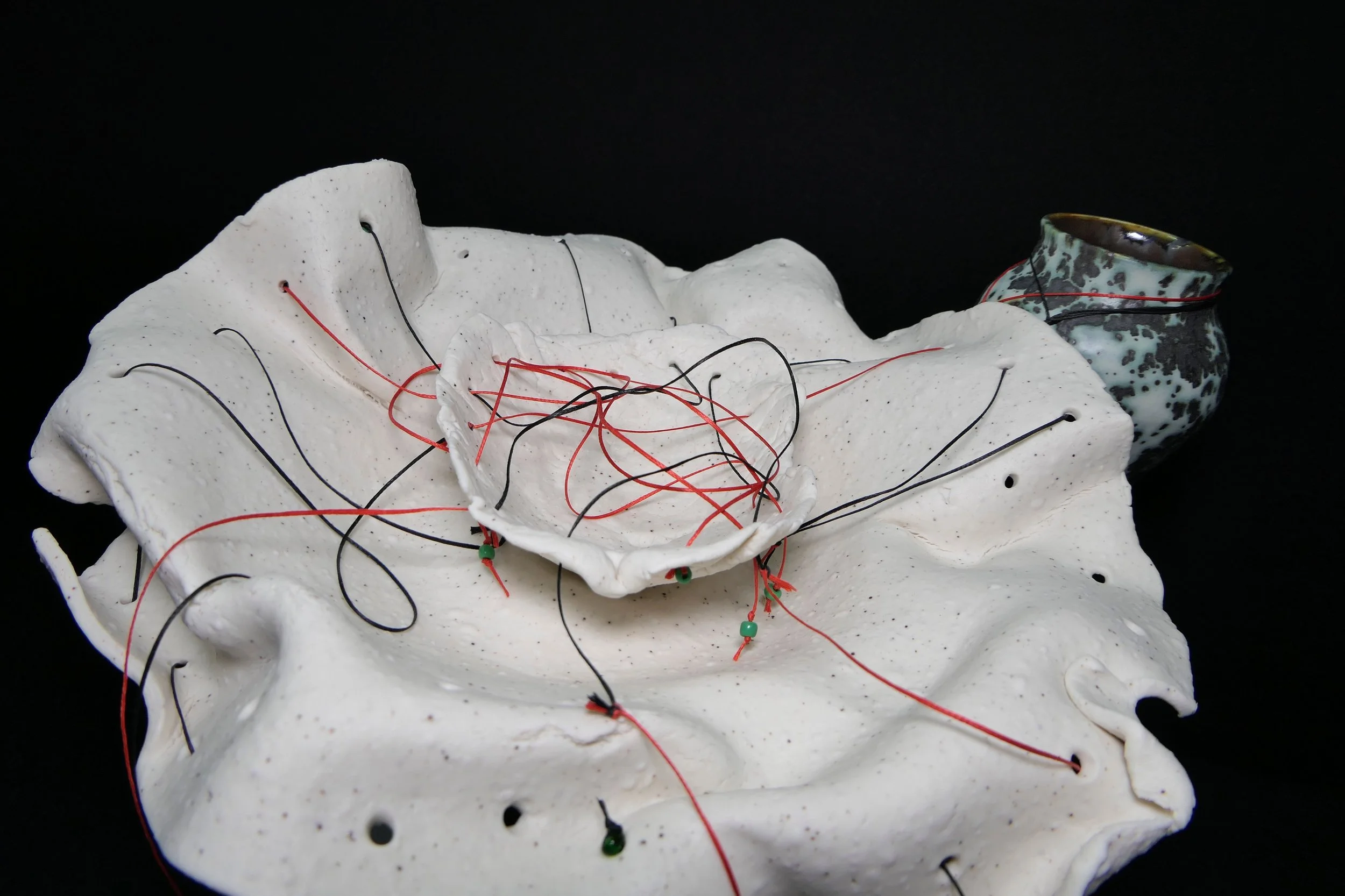
Pull gently and parts of the tangle begin to straighten — briefly.
Discombobulated began as a kiln accident and became an account of a relationship.
Two porcelain test forms had been stacked together for firing. During a severe overfire, they softened, distorted and fused. As they moved, they reached outward and permanently attached themselves to a third small vessel — one made collaboratively with Michelle.
The resulting object could not have been designed.
Its instability, interdependence and improbable attachment gradually became an unexpectedly accurate metaphor for a relationship in which affection, work, creativity, responsibility and boundaries had become thoroughly entangled.
Red and black threads travel through the ceramic. Some remain tangled; others can be gently pulled so that disorder briefly begins to straighten before shifting again.
Two found stones support the construction below. The piece appears precarious, but is physically stable.
What began as kiln failure became something more useful: a material record of connection, imbalance, responsibility and the strange ways relationships can hold together.
Window of Tolerance · 2024
Ceramic vessel; impressed greenware, carved and textured surfaces, layered ceramic surface treatments, matte, satin and glossy glaze
21 × 11 cm · 1,004 g
Studio Study · Not for Sale
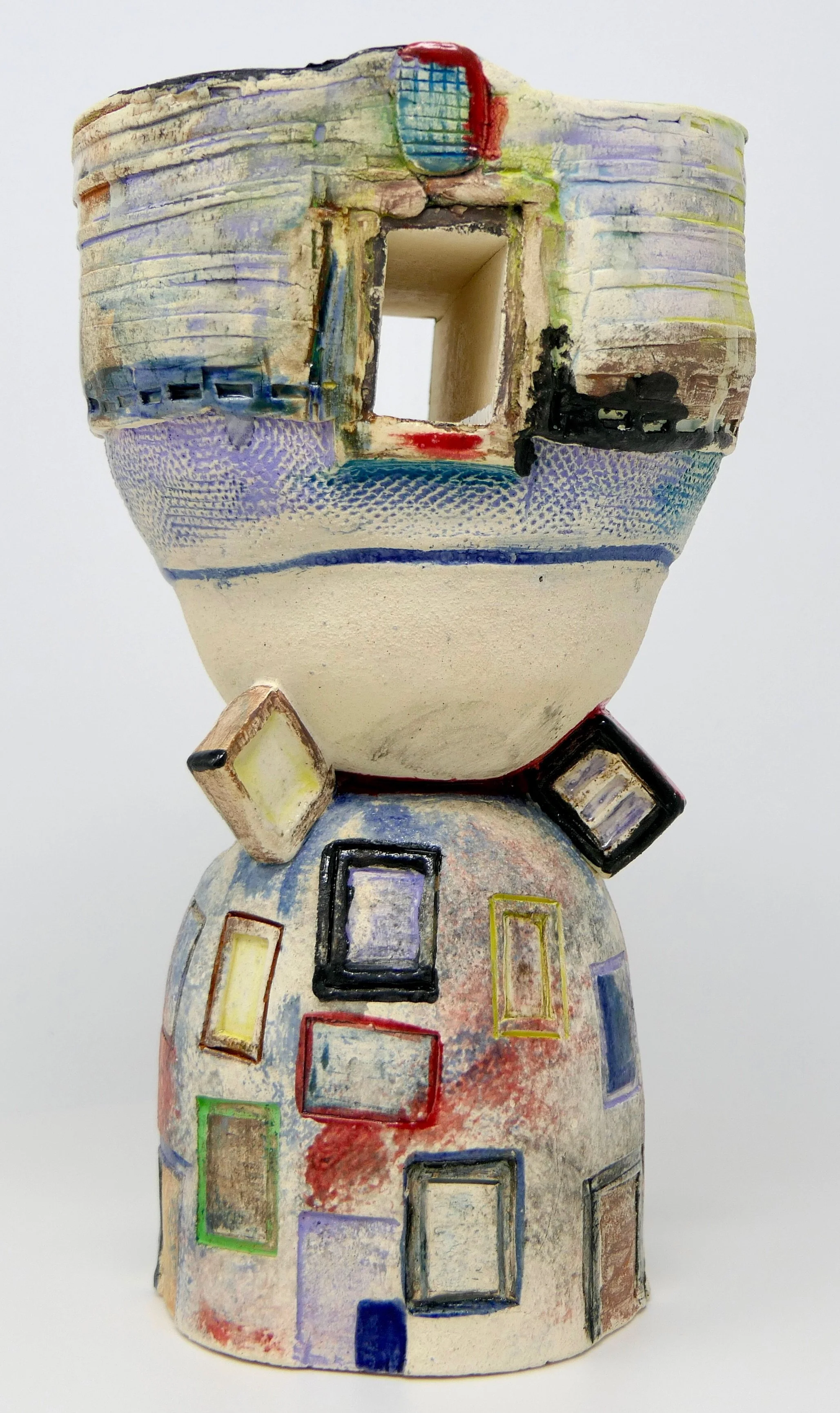
Window of Tolerance — A study in texture, opening and layered surface.
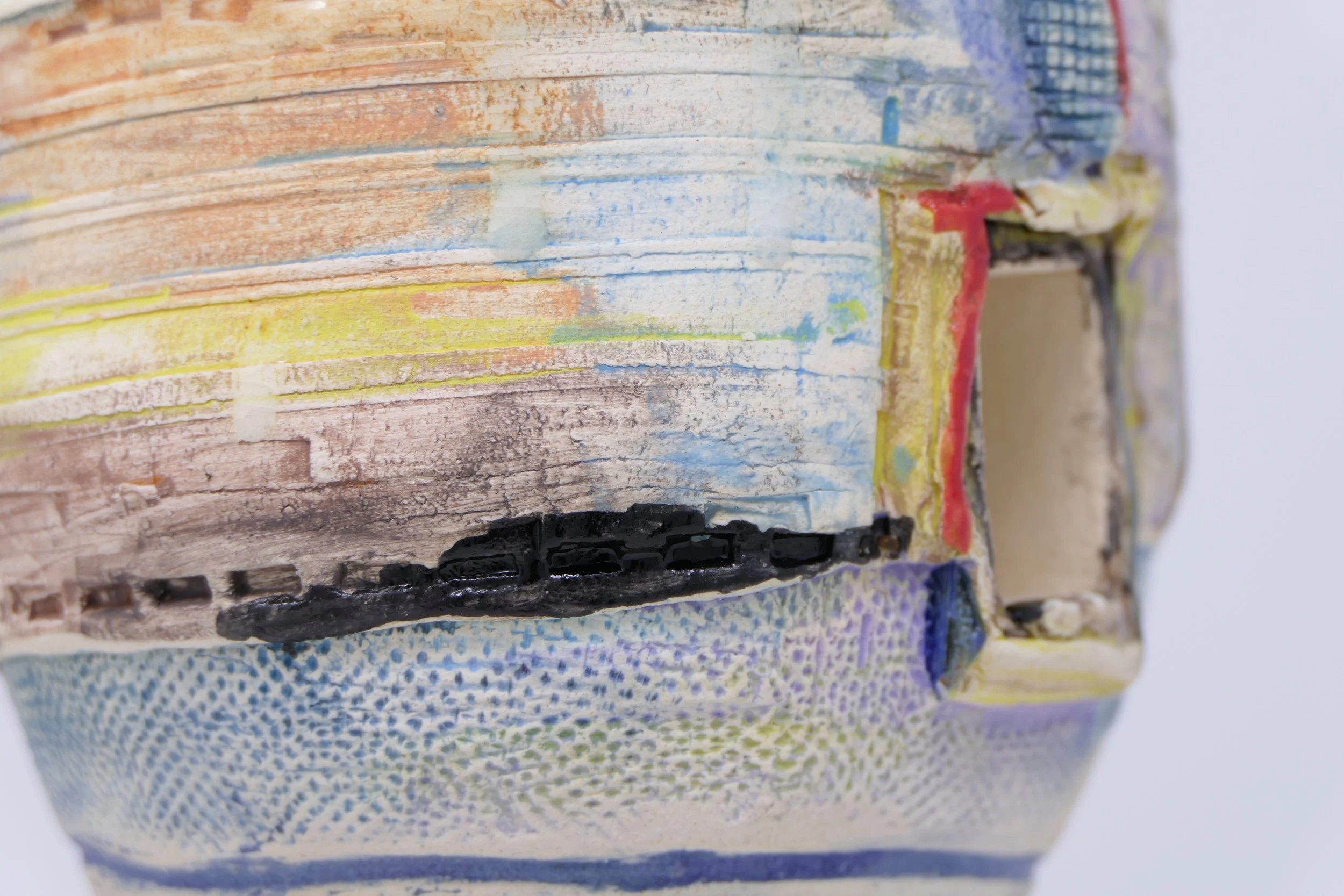
Impressions made in soft clay remain embedded in the finished surface.
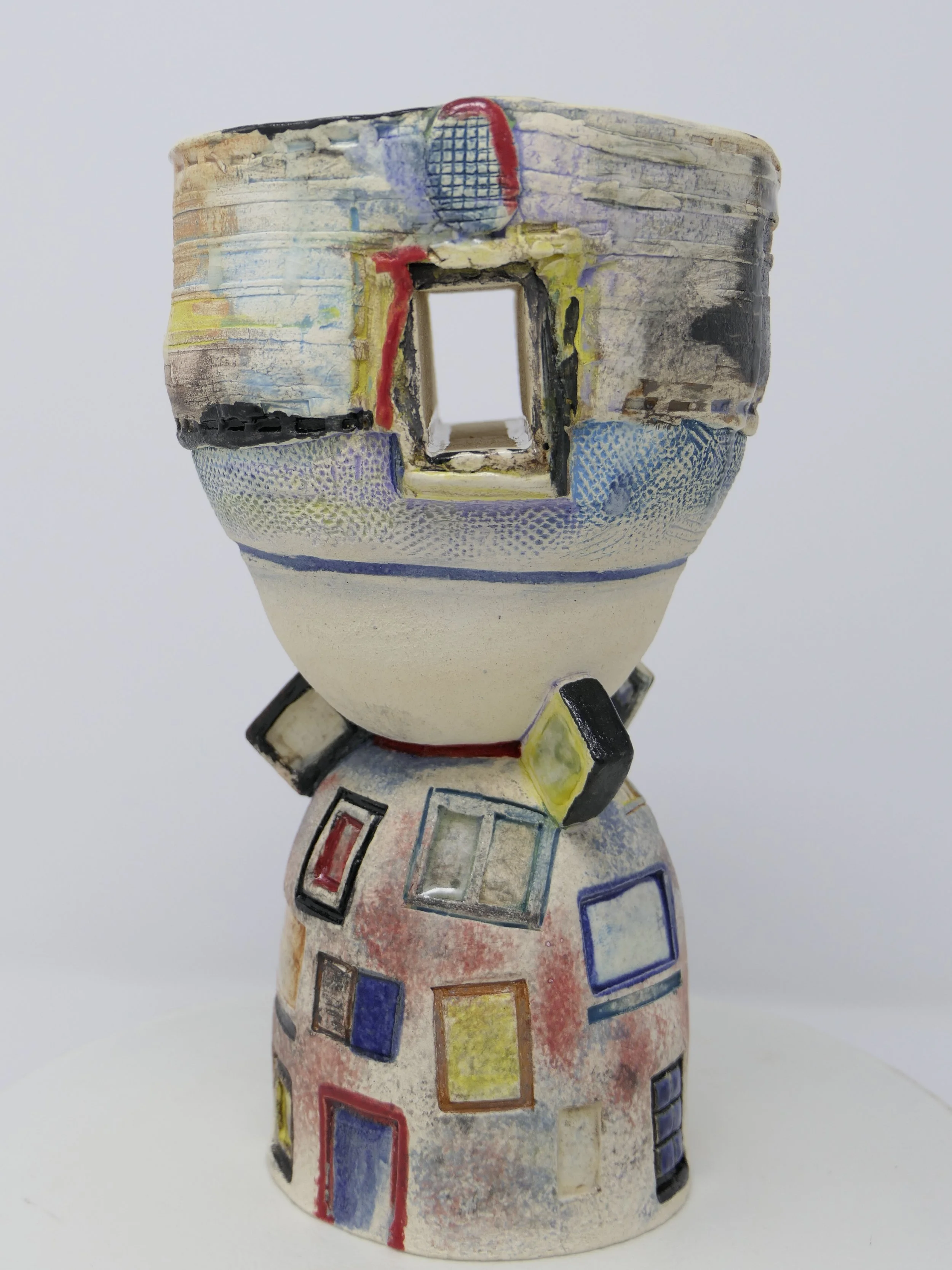
The form was less successful than the process it revealed.
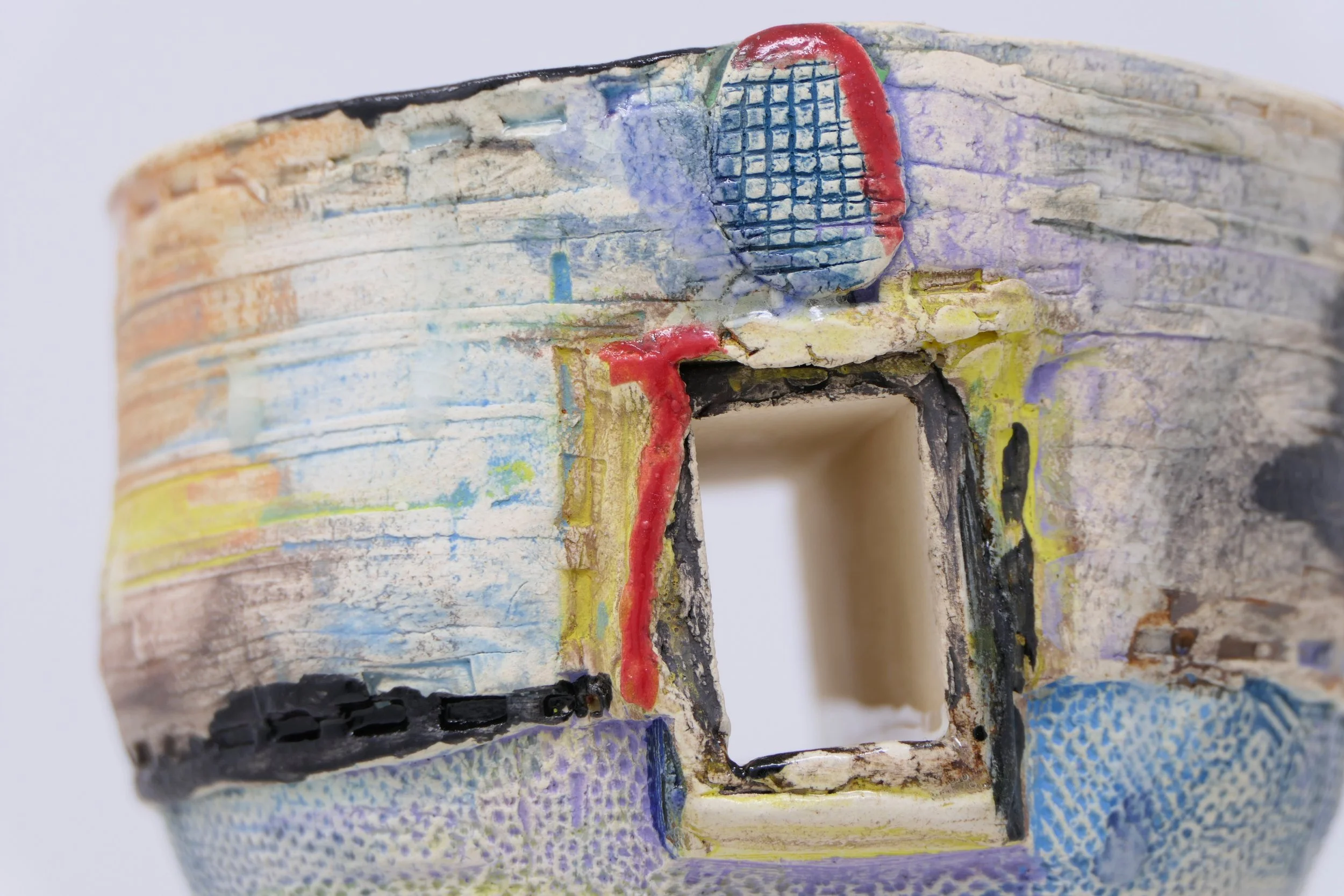
The lasting lesson: build the surface while the clay is still alive.
Window of Tolerance is important to me less as a resolved artwork than as a record of discovery.
The form itself is awkward and comparatively unrefined, but the surface contains several ideas that became increasingly important in later work. Texture was impressed directly into soft clay, marks were layered before bisque, and matte, satin and glossy finishes were allowed to sit beside one another.
The piece also experiments with openings and stacked architectural interruptions. Those formal elements are not something I feel compelled to repeat, but the process taught me something fundamental:
Greenware is not simply a stage to pass through on the way to firing. It is one of the richest opportunities to build the surface itself.
That lesson continues throughout my current work.
It Could Never Be · 2025
Ceramic vessel; layered glaze and surface media; found stone and epoxy clay
27 × 26 cm
4,653 g including found stone
CA$650 · Available
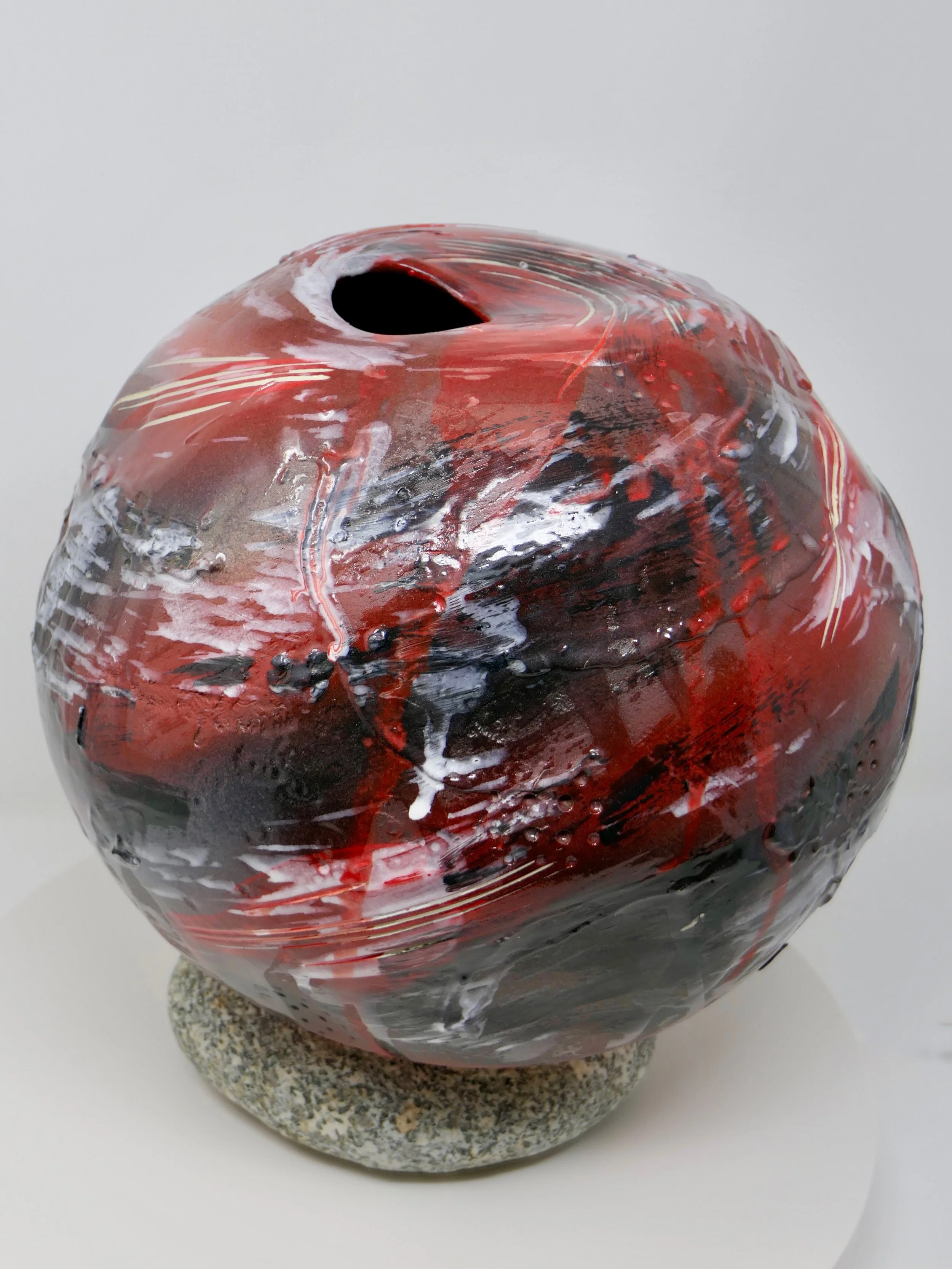
It Could Never Be — A vessel given the weight its grief required.
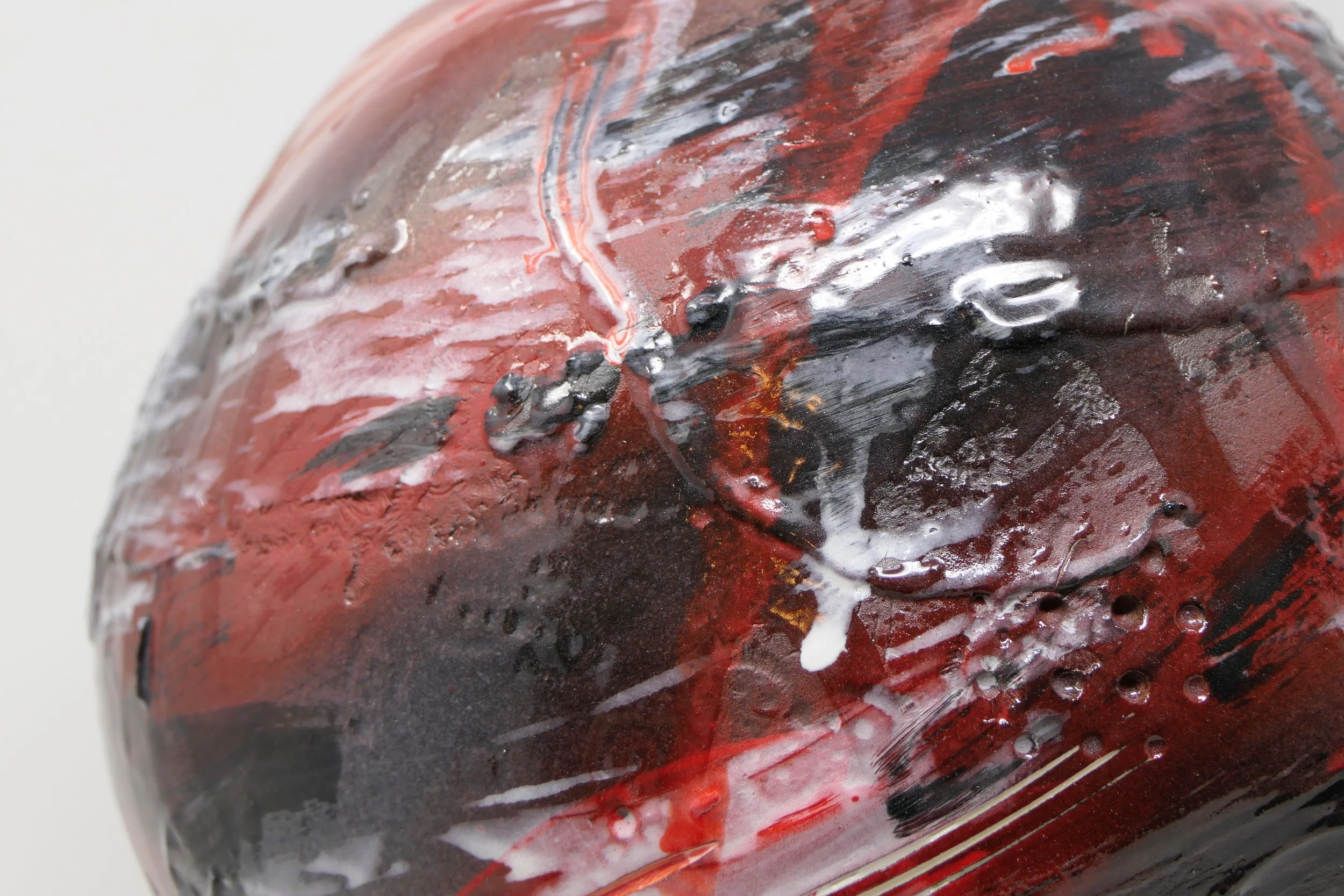
Red, black, grey and white move across a surface that refuses to settle.
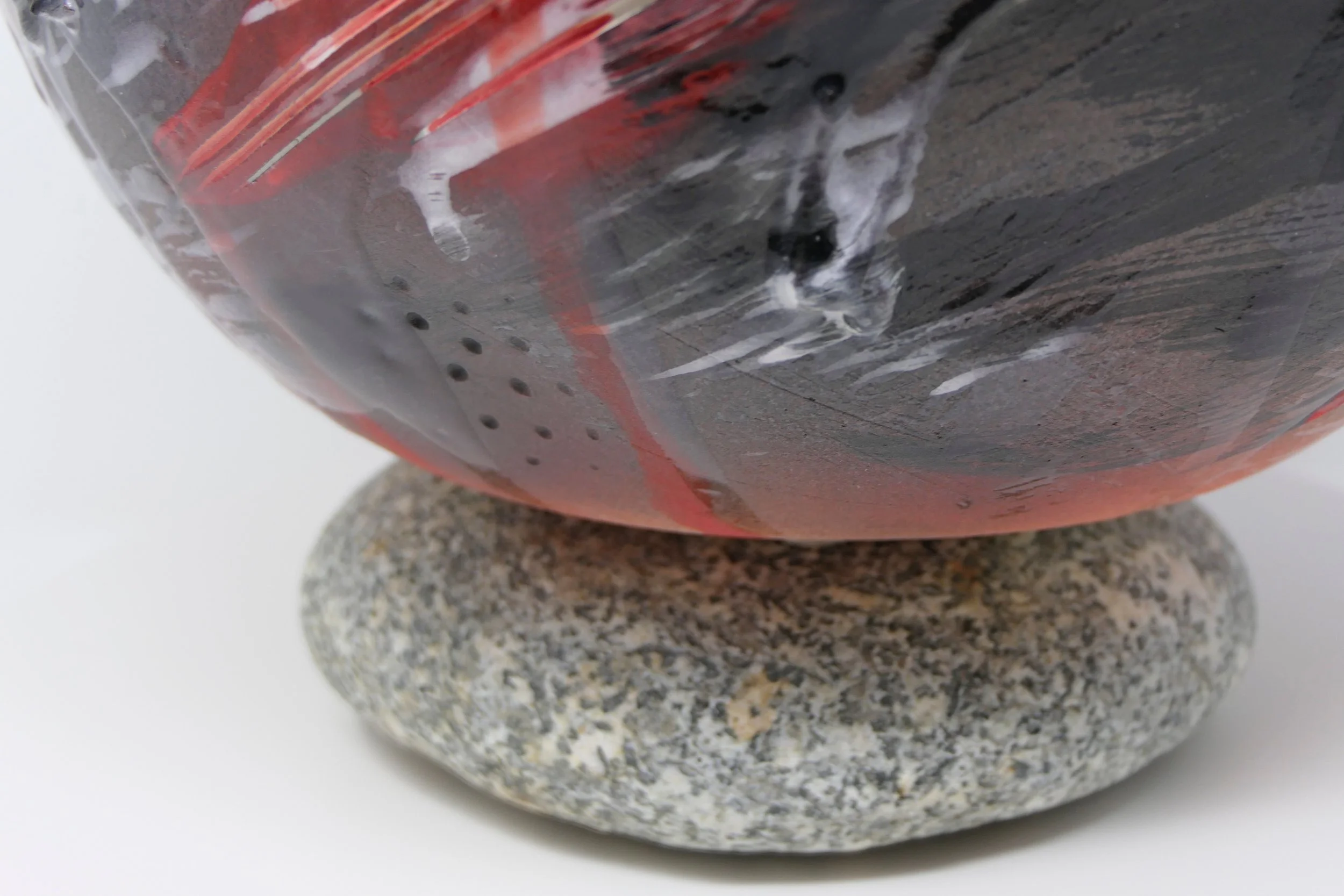
The found stone became more than a base; it became part of the emotional weight.
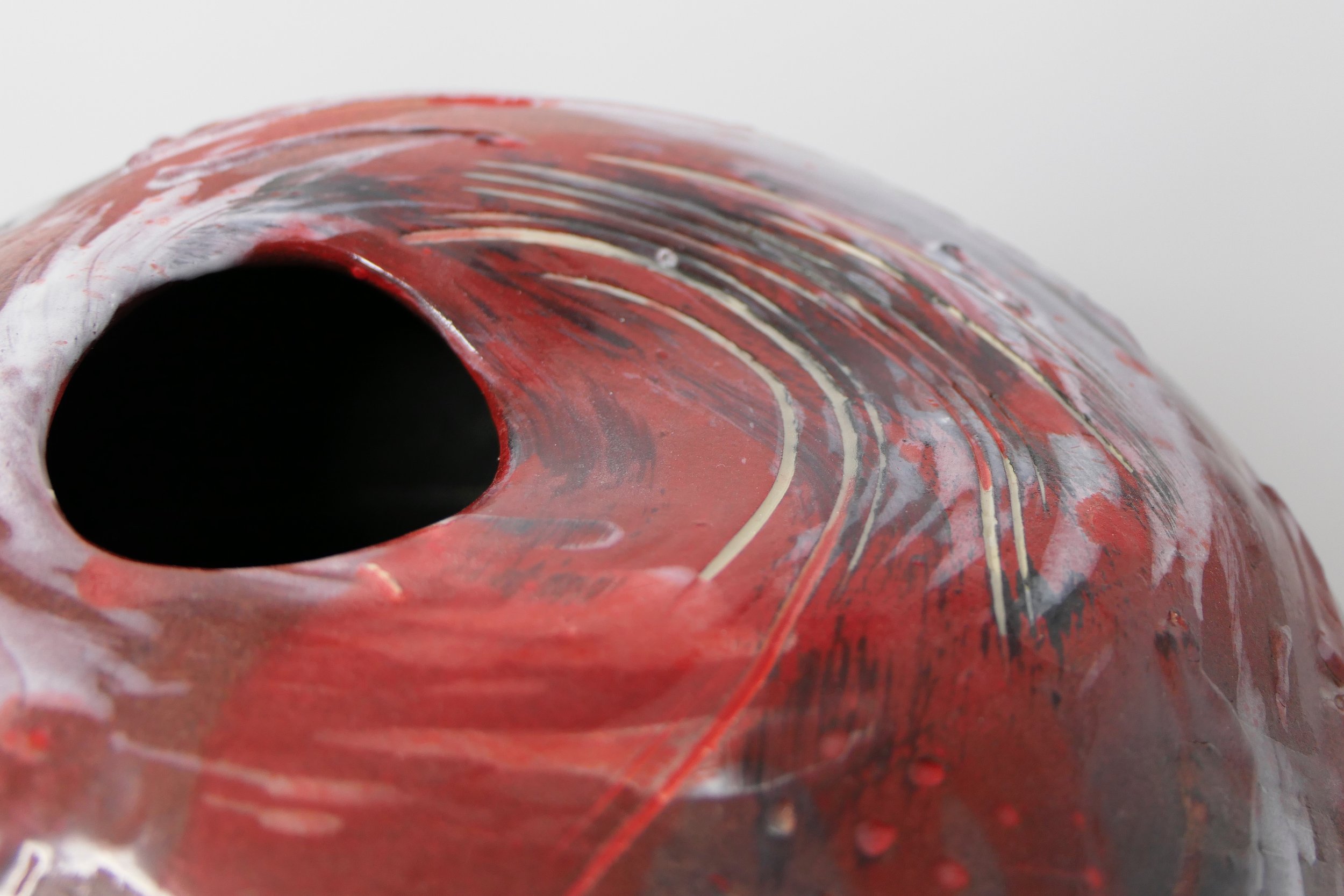
Some things cannot be made possible simply because they were deeply wanted.
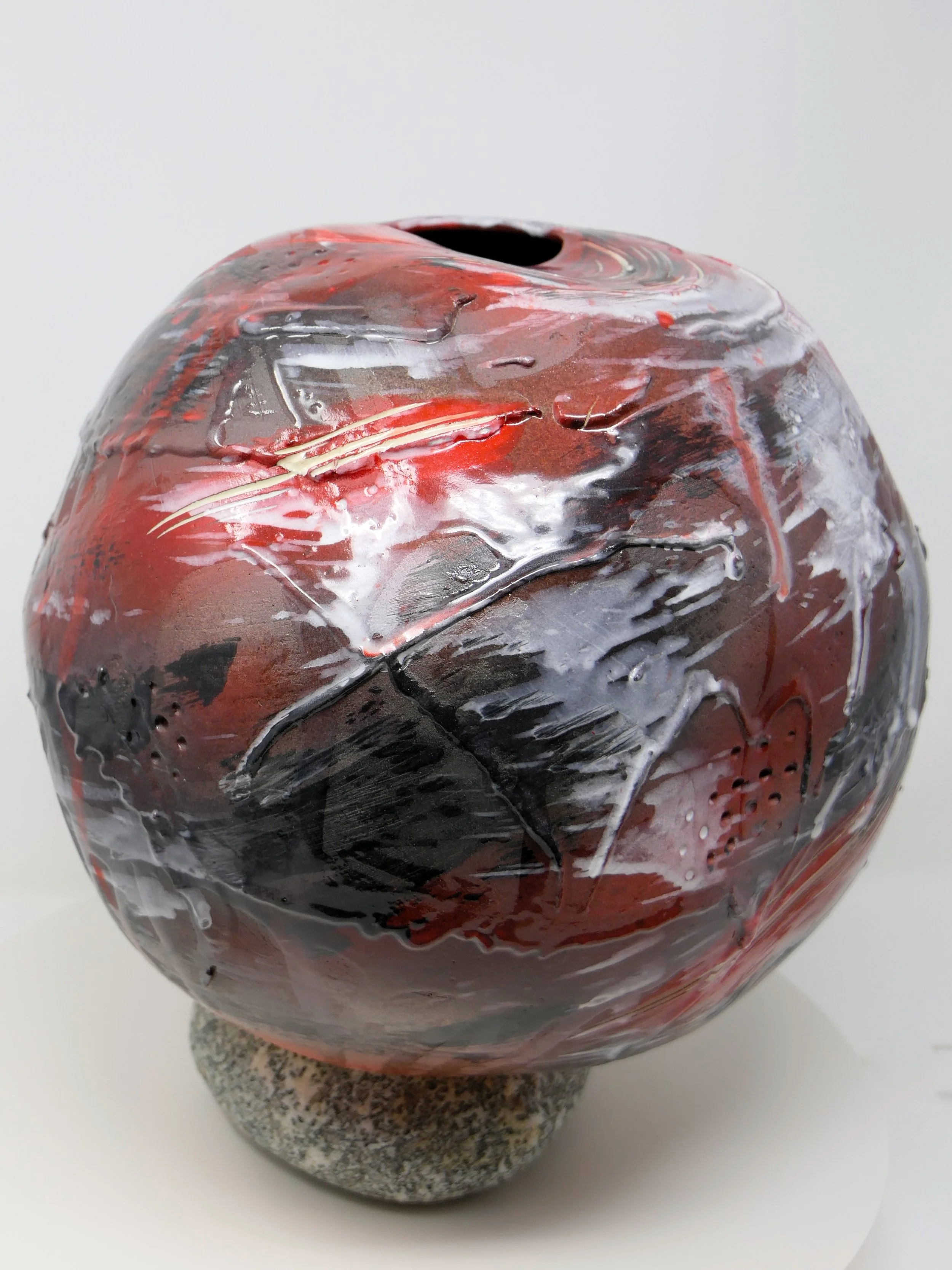
Acceptance does not erase grief. It changes how it is carried.
It Could Never Be · 2025
Ceramic vessel; layered glaze and surface media; found stone and epoxy clay
27 × 26 cm
4,653 g including found stone
CA$650 · Available
It Could Never Be carries grief differently from the anger present in some of the neighbouring works.
The vessel has been pushed, compressed and visually struck. Layers of red, black, grey and white move across the surface through poured, sprayed, brushed and worked marks. Direction changes repeatedly; some areas are dense and forceful, while others remain quieter and more exposed.
When the vessel stood alone, it felt emotionally too light.
I permanently joined it to a found stone.
The stone is not simply a pedestal. It gives the work both physical and psychological weight — a foundation for something that could not become what had once been imagined.
Over time, the work shifted for me from anger toward acceptance. Not everything can be understood, repaired or made possible simply because it was wanted.
It Could Never Be holds that recognition: grief can remain real even when the struggle against reality begins to soften.
I Am Safe Now · 2024–2025
Mixed media on wooden panel: porcelain, Yupo paper, padded envelope, ink, red and black thread, commercial handling labels and hanging hardware
28 × 24 × 4 cm
Approximately 480 g
Artist’s Collection · Not for Sale
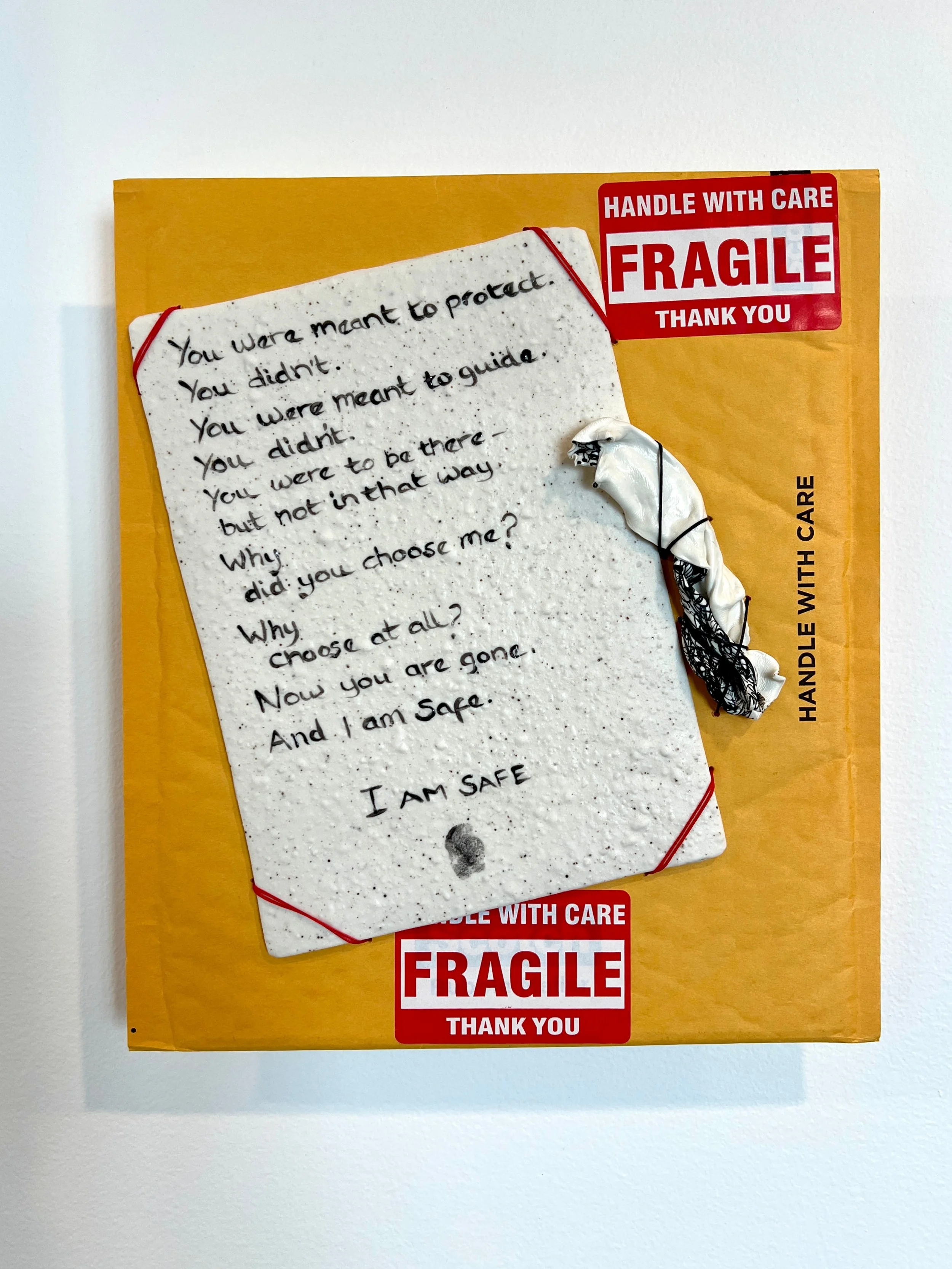
I Am Safe Now — A declaration made beside what came before.
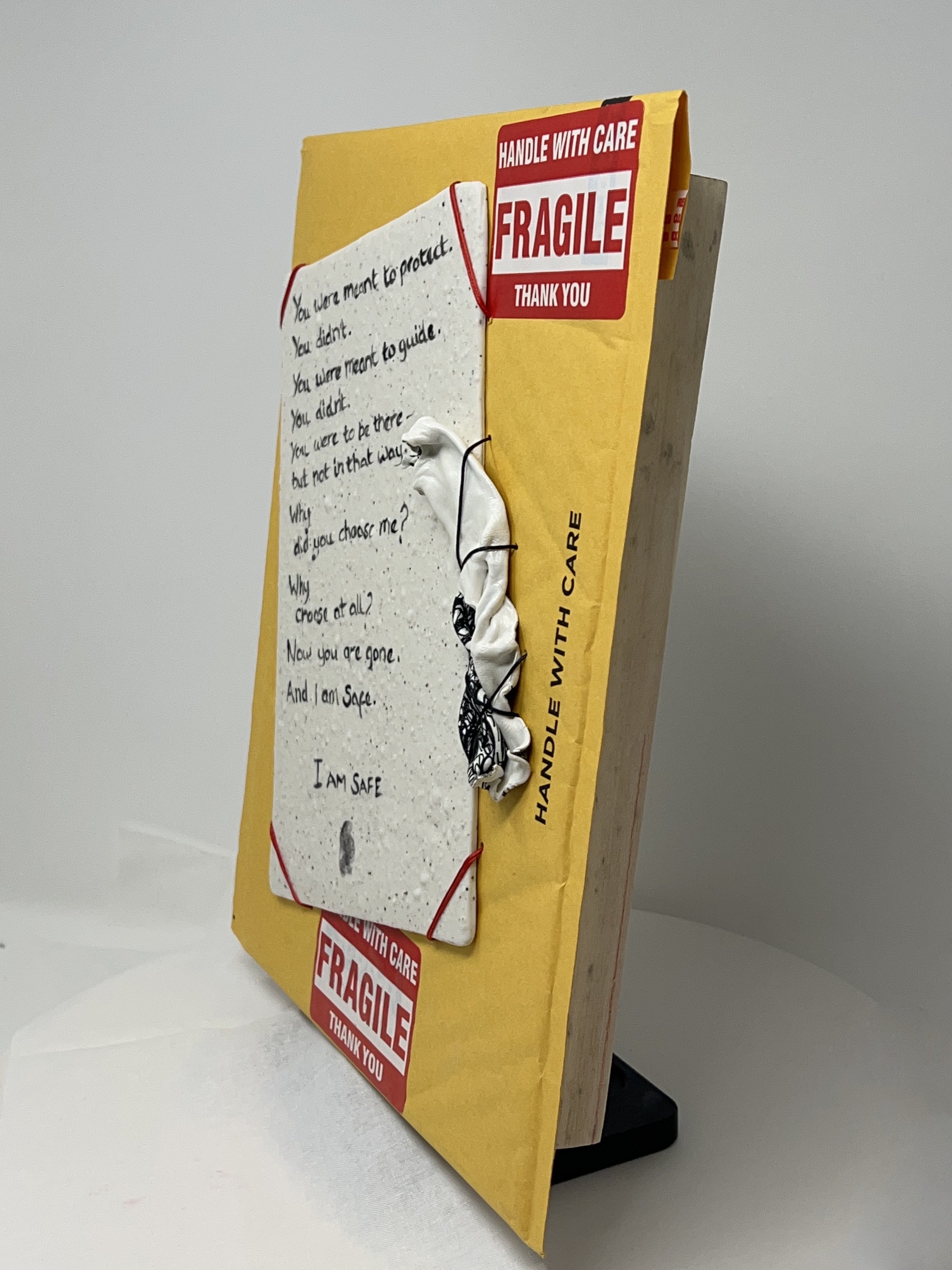
You were meant to protect me.
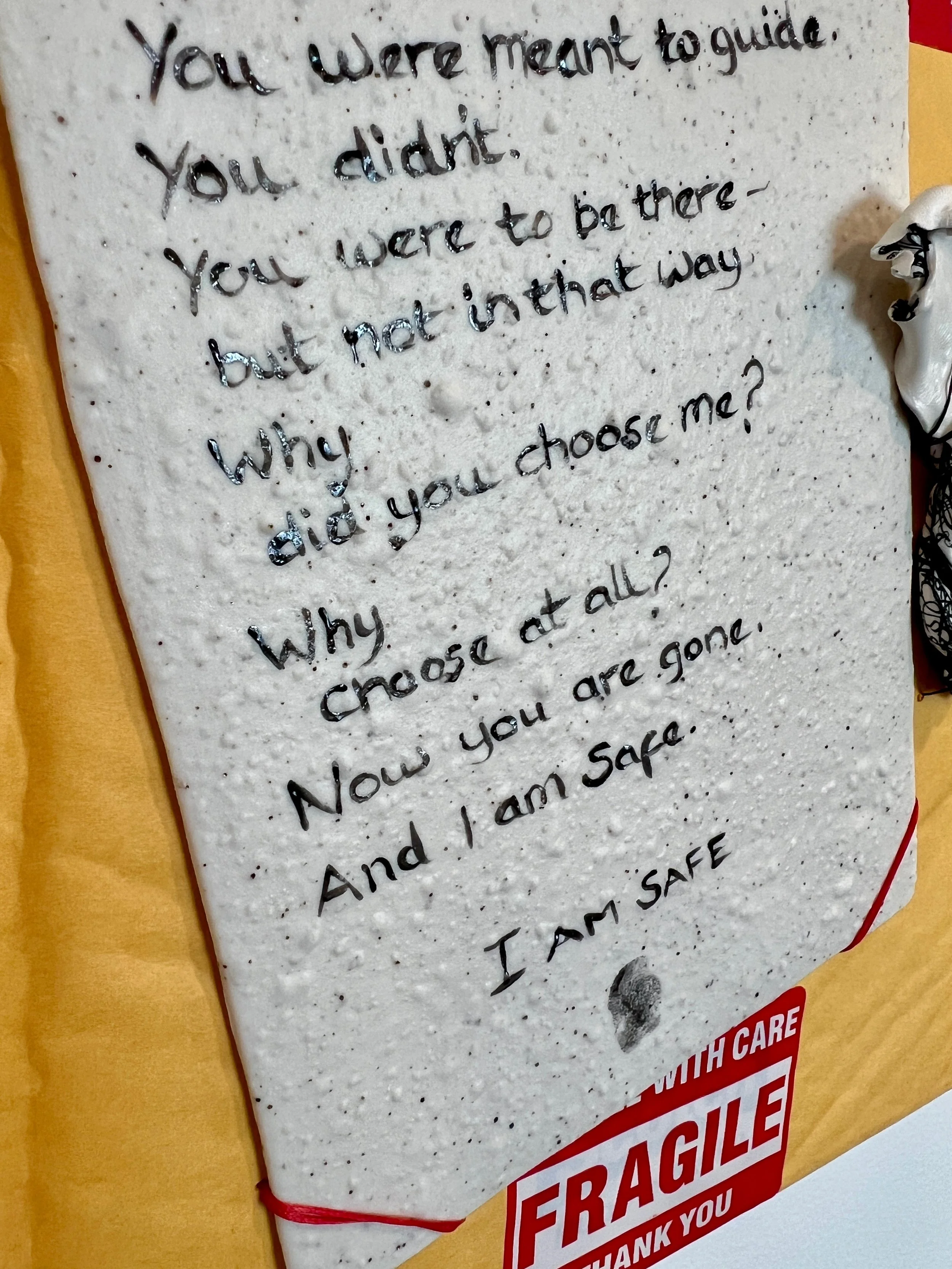
The words remain fragmented. The meaning does not.
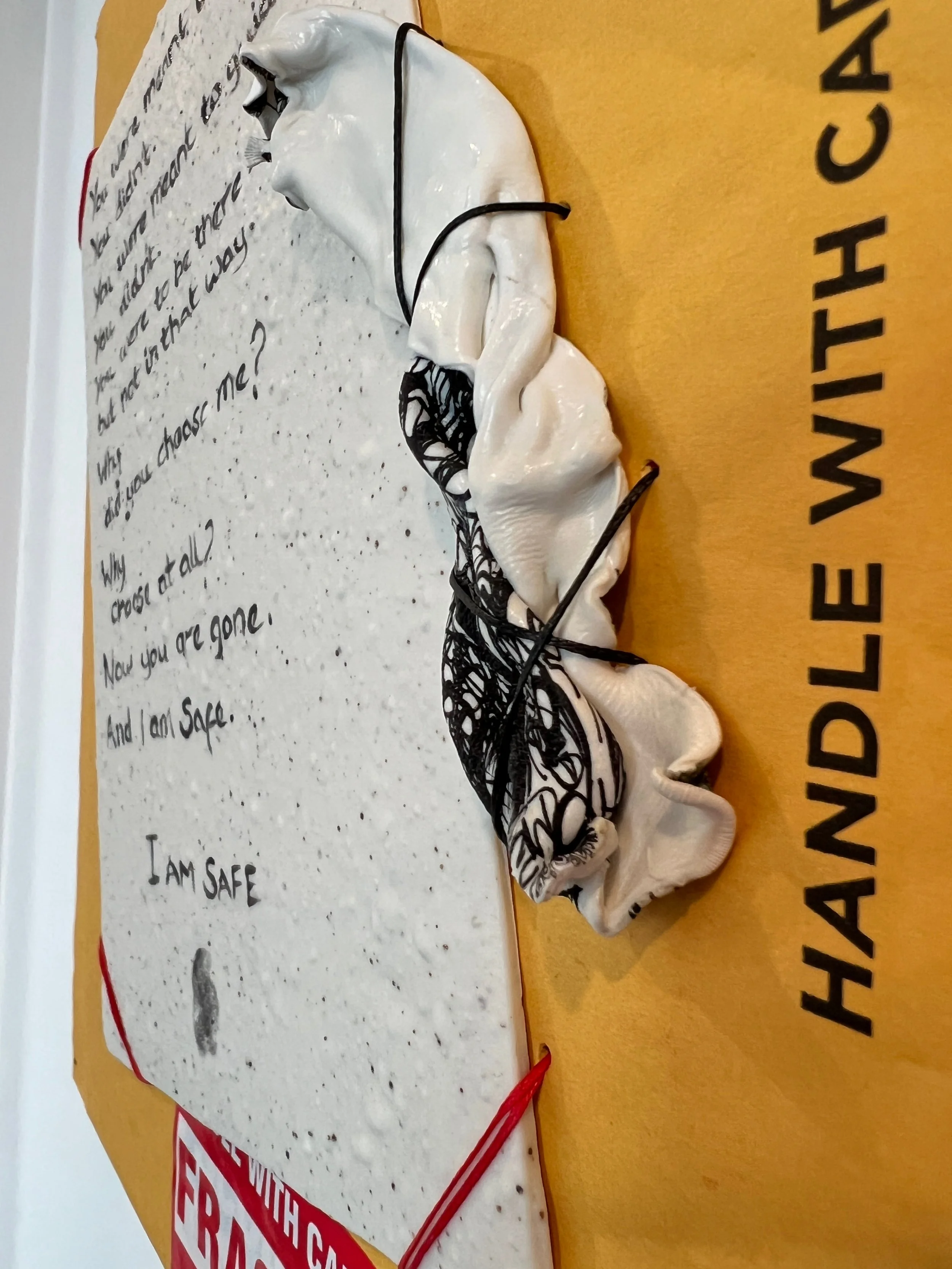
HANDLE WITH CARE. FRAGILE. I AM SAFE.
I Am Safe Now considers the distance between having once needed protection and finally being able to recognise safety.
A porcelain page carries fragmented handwritten thoughts about protection, absence, choice and what should have happened. It is attached to a padded envelope with conspicuous red stitching, while a contracted ink-covered piece of Yupo paper hangs alongside it in black thread.
Commercial handling labels repeatedly instruct the viewer to HANDLE WITH CARE and mark the object as FRAGILE.
Those instructions normally belong to packages.
Here, they belong equally to a person.
The handwritten words do not resolve the past or tidy it into a neat conclusion. They end with something much simpler:
I AM SAFE.
That declaration does not erase what came before.
It exists beside it.
On a Silver Platter · 2024–2025
Wheel-thrown ceramic vessels; carved and scratched surfaces, glaze and underglaze; silver platter and mirror
29 × 22 × 10.5 cm
Approximately 1,115 g including platter
Artist’s Collection · Not for Sale
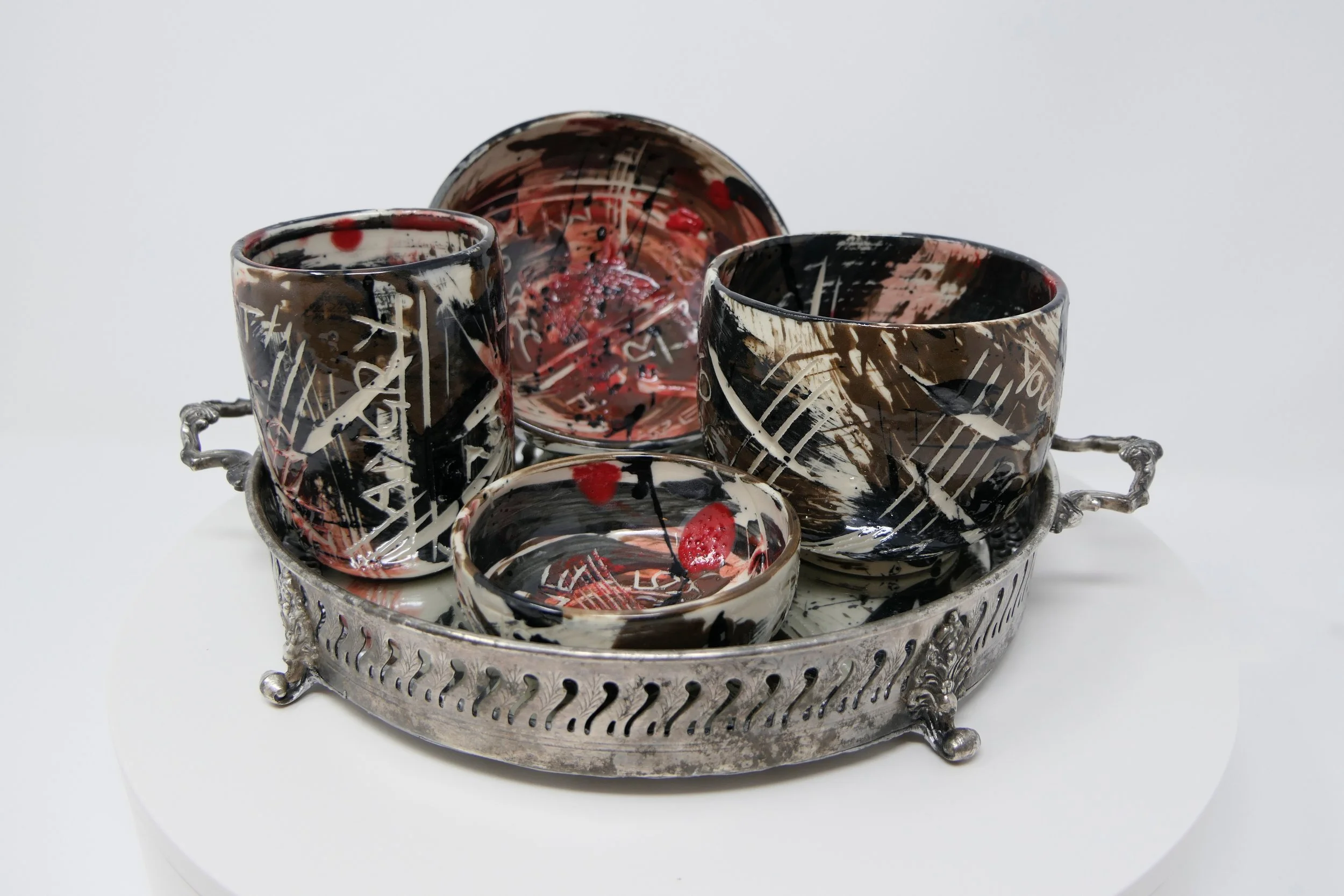
On a Silver Platter — The pedestal was never his.
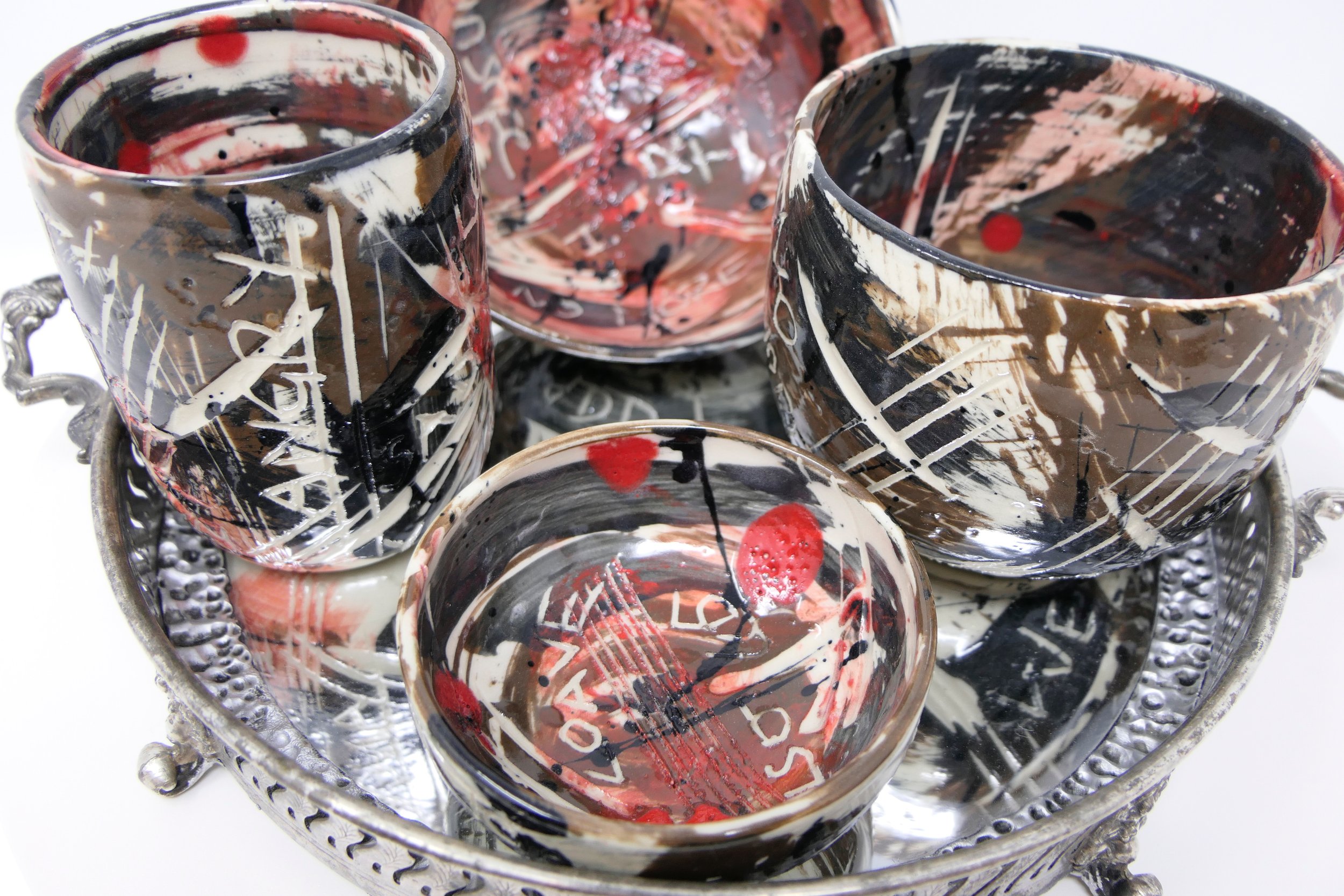
Skill became something to question rather than something to prove.
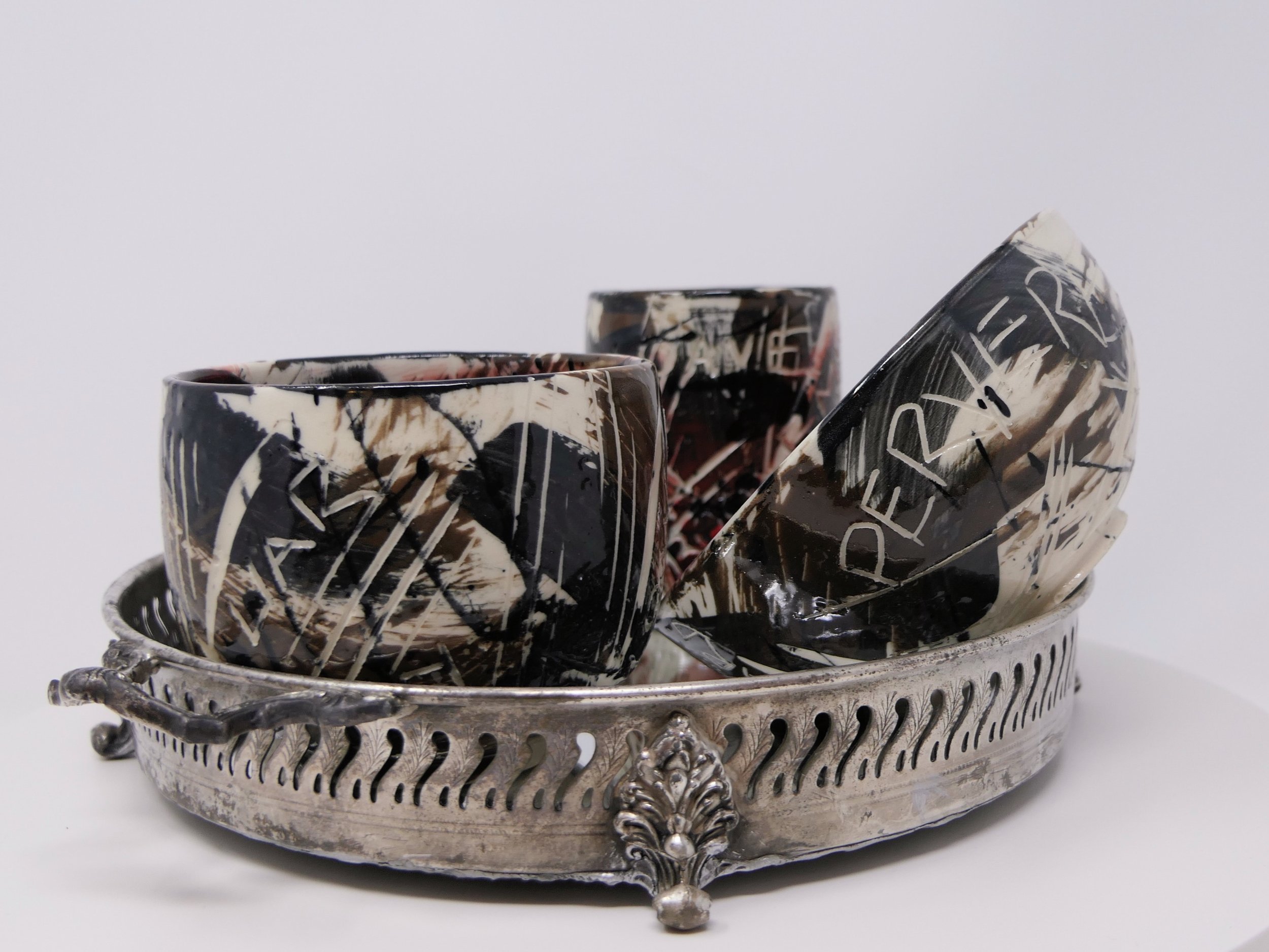
The thrown vessels were carved, scratched and altered once their purpose became clear.
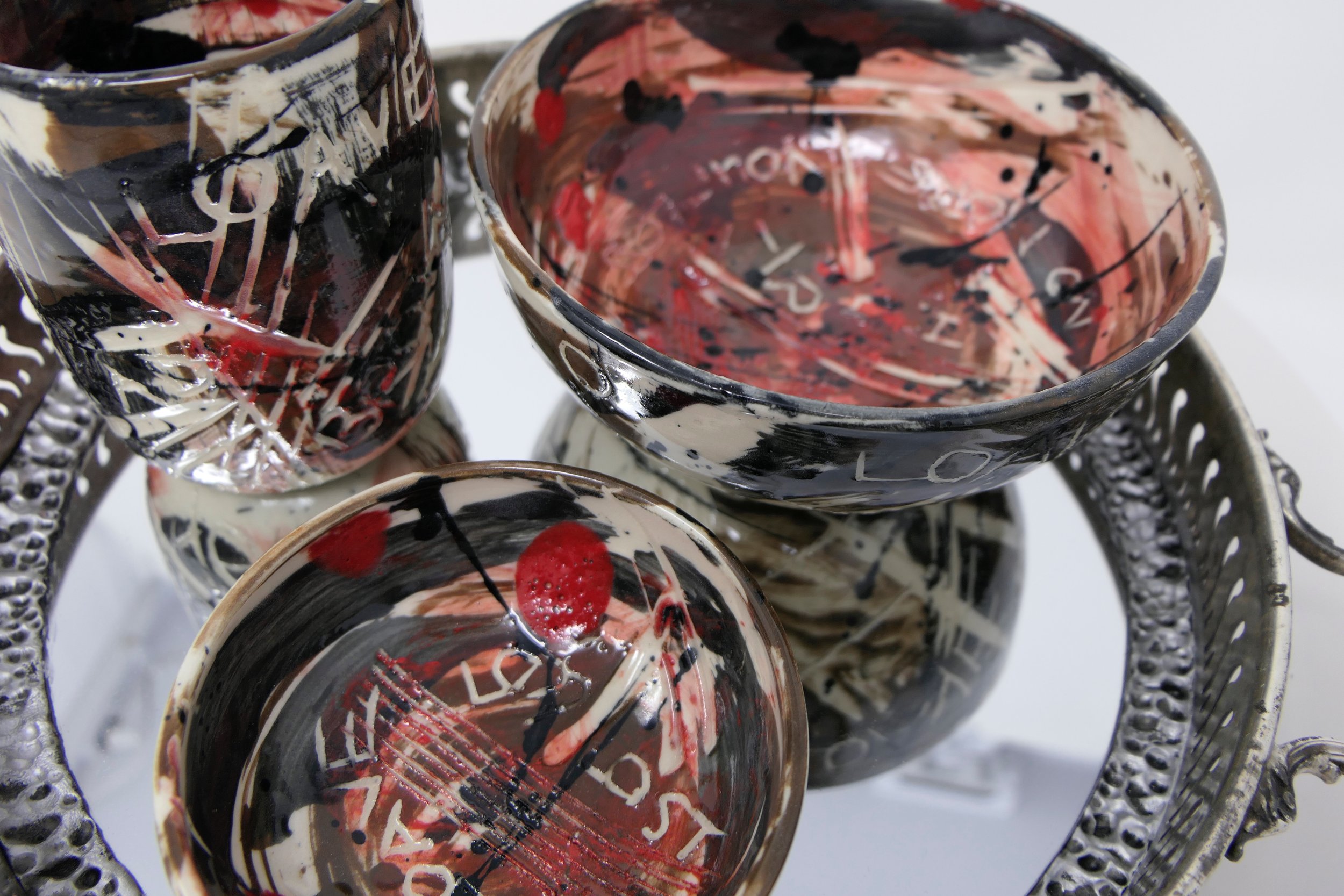
The mirror shifts the question of who was meant to be valued.
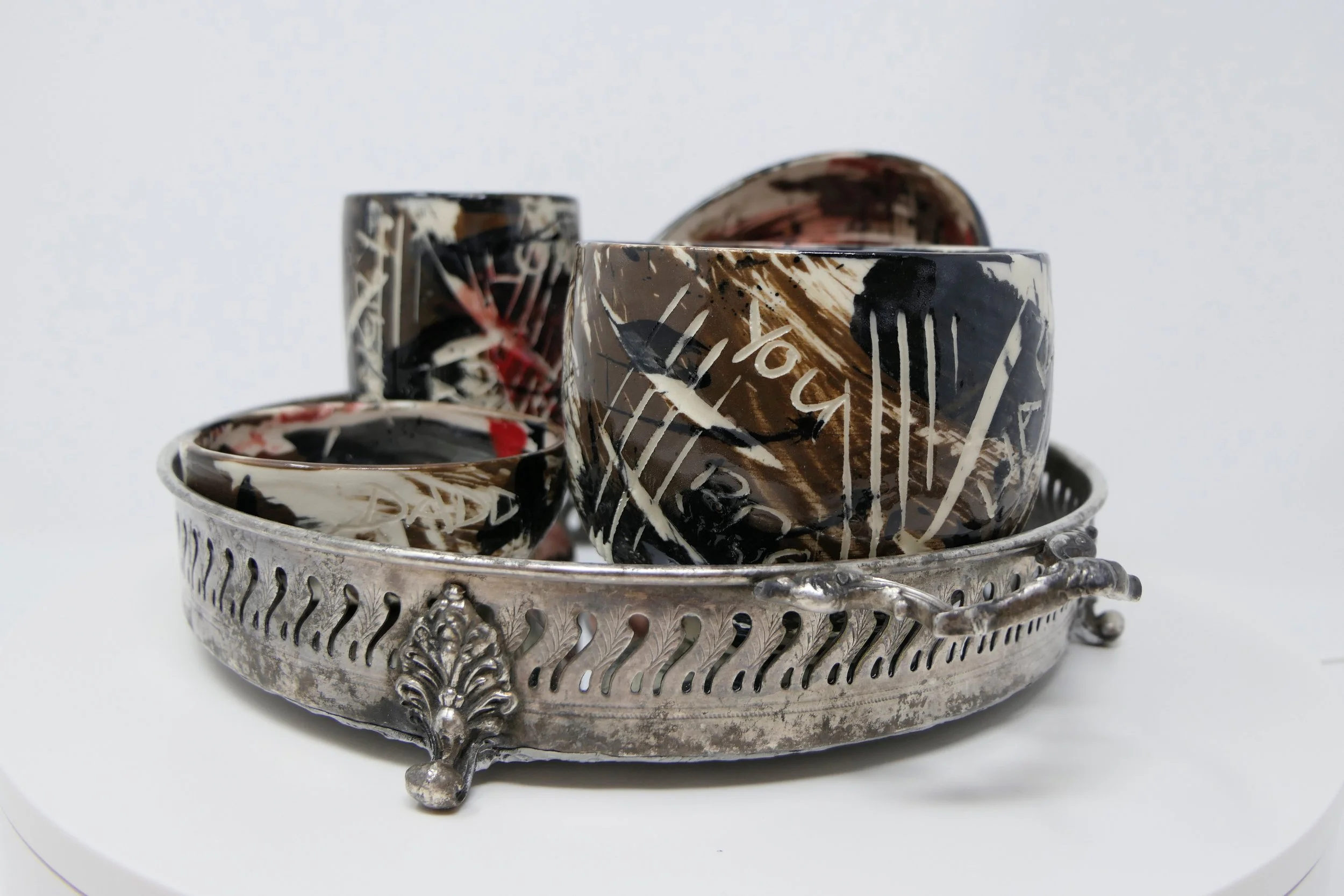
The child belonged on the silver platter.
On a Silver Platter began with four conventionally thrown vessels and ended as a rejection of the reason I had thrown them at all.
Learning to throw had become entangled with my father. Despite the harm he caused, part of me was still trying to make something he might have recognised as skill — something that might finally have made him proud.
When I understood that, the vessels changed.
Their surfaces were carved rapidly and aggressively, scratched, smeared and layered with glaze, marks and words. The controlled thrown forms became places where anger and contradiction could finally interrupt technique.
Eventually the four vessels needed containment. I placed them on a silver platter whose missing centre was replaced with mirror.
The mirror changed the meaning.
The pedestal had never belonged to him. The child was the one who should have been protected, valued and placed on the silver platter.